20 W/mK+ Thermal Putty: Halnziye HY2612 & HY2312 take the crown
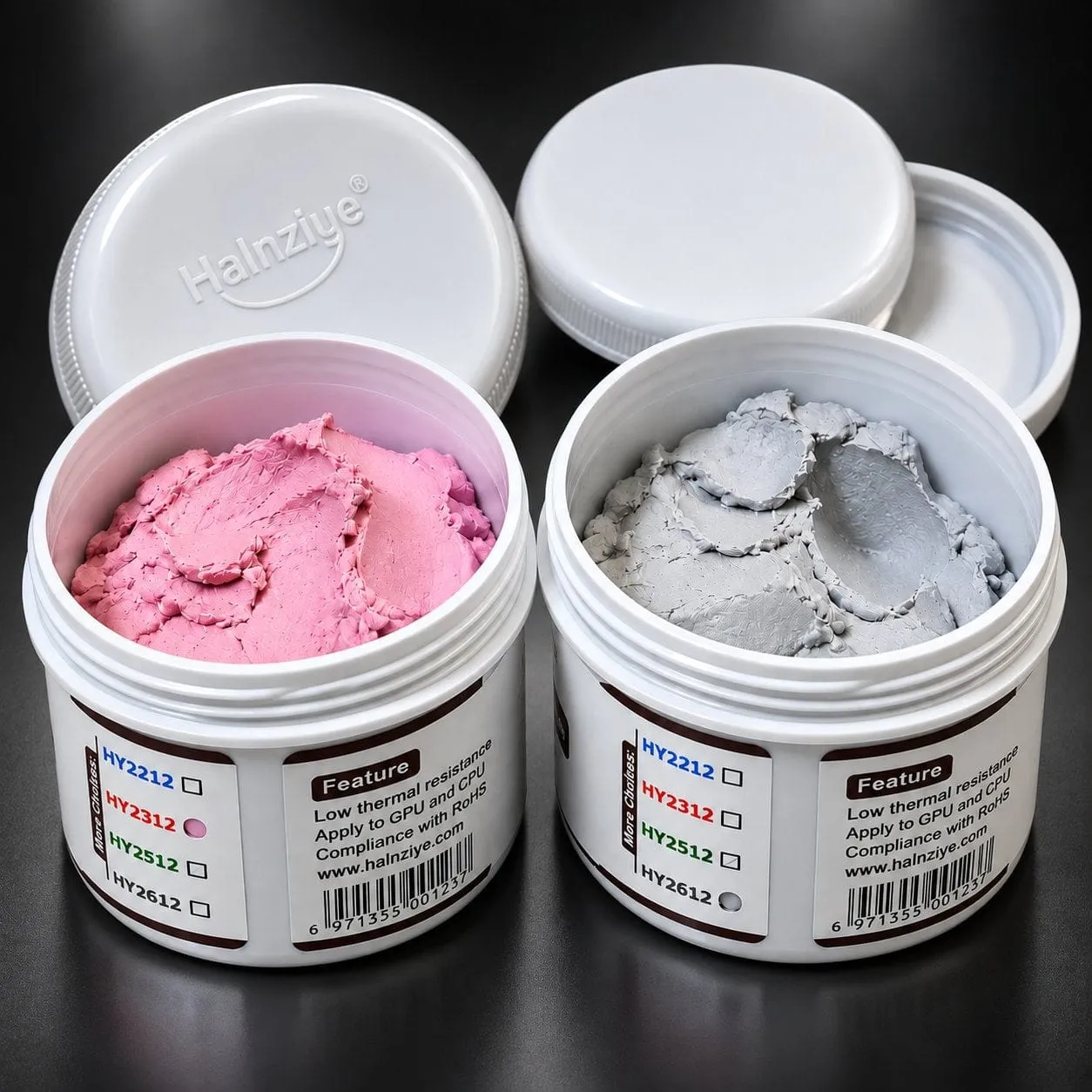
In the high-stakes world of thermal management, where precision and efficiency are everything, new materials are constantly being refined. A recent comparative test brought two exciting new thermal putties from Halnziye to the forefront of this discussion: the gray HY2612 and the pink HY2312.
These materials were put through a rigorous test, exploring their performance across a range of bond-line thicknesses, from approximately 3,000 to 250 micro-meters, to see how they handle real-world thermal demands. The goal was simple: to determine which putty offered the best thermal conductivity while managing residual pressure effectively.
The results immediately highlighted a clear leader. The gray HY2612 demonstrated exceptional thermal performance across the tested range. At a 1-millimeter bond-line, it achieved a remarkable 15.078 W/mK. As the gap widened to 2 millimeters, its conductivity climbed to 19.138 W/mK. Furthermore, when tested at an intermediate distance of approximately 2.75 millimeters, the HY2612 reached a measured maximum of 21.559 W/mK, all while successfully maintaining comparatively low residual pressure.
This superior performance positions the HY2612 as a standout material, proving its capability to handle complex thermal junctions with both high conductivity and stability.
The pink HY2312 showed equally impressive improvements, particularly when dealing with larger thermal gaps. While the newer formulation has seen substantial gains in handling wider separations, it is worth noting a nuance in its performance. For applications involving extremely thin layers, the older pink formulation still managed to deliver better results in those finer tolerances.
Ultimately, this comparison underscores a key takeaway for engineers and manufacturers: material selection is not just about raw conductivity. It involves a delicate balance between thermal performance, pressure management, and application-specific constraints. Both the HY2612 and HY2312 represent significant advancements, offering powerful, tailored solutions for demanding thermal challenges.
Credit
