360mm AIO Straps Cool Laptop Temps Below 40°C
The Frankenstein Laptop: How One Modder Unleashed Extreme Cooling and Performance
In the world of extreme PC modification, some builders dream of pushing hardware to its limits; others, like TrashBench, dream of fundamentally rethinking how laptops cool. This is the story of a spectacular, almost absurd, engineering feat involving a Metabox laptop that was transformed into a thermal powerhouse, proving that sometimes, the most outrageous solutions yield the most impressive results.
The starting point was a seemingly ordinary Metabox laptop, built on an Nvidia GTX 1060 and an Intel Core i7-8750H. But for TrashBench, this machine wasn’t just a laptop; it was a canvas for radical thermal experimentation. The goal? To tackle the inherent cooling limitations of the system by installing a custom, complex water-cooling setup.
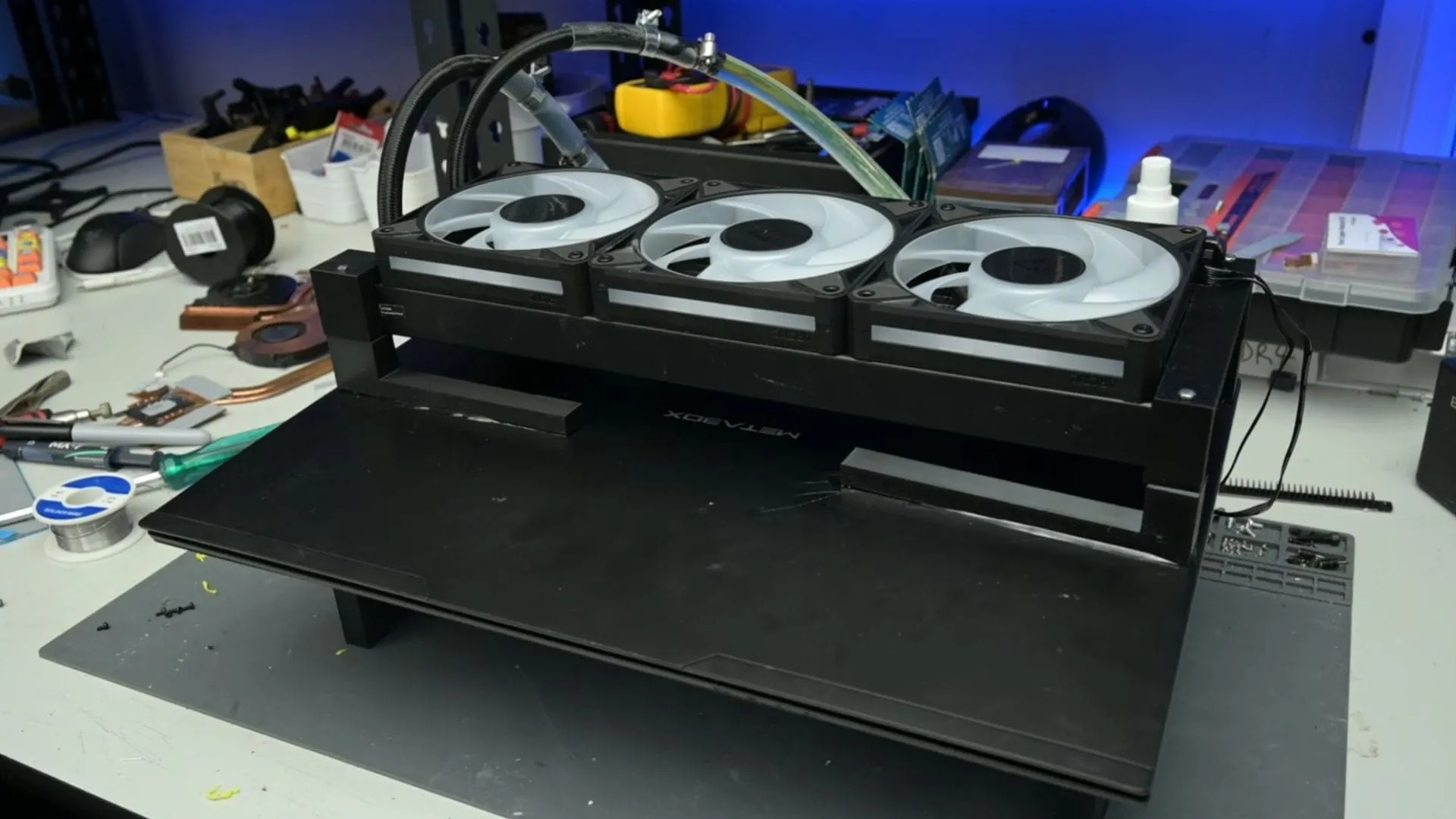
Instead of simply adding a standard cooler, the modder decided to integrate a custom 360mm All-in-One (AIO) unit sourced from another project. This required serious engineering. To successfully merge this component with the existing system, TrashBench didn’t just swap parts; he created custom mounts using 3D-printed holders, meticulously screwed into the laptop’s existing heatpipe locations. Since the clearance was too tight to fit the radiator directly behind the screen, he employed a touch of industrial strength, using Loctite 2-part epoxy to secure the radiator mounting—a necessary step in turning a concept into reality.
The complexity didn’t end there. To ensure optimal thermal transfer, the modder extended the custom cooling philosophy to the laptop’s core components. He fitted custom heatsinks for the RAM and VRMs, ensuring these clusters shared a single cooling path, reinforced by careful application of thermal pads. These modifications were permanent, sealed with thermal paste and epoxy, turning the laptop into a carefully integrated, high-performance system.
Managing the flow of liquid and power introduced further challenges. The setup required a separate, larger pump, necessitating a new, standalone pump system. Furthermore, integrating the power supply required custom electrical work, including soldering a DC-DC step-down converter to the original blower fan contacts. To ensure the system only engaged under heavy load, a clever toggle switch, mounted on a custom 3D-printed plate, was installed on the bottom shell.
The final touch was elevating the masterpiece. A custom 3D-printed riser was attached to the base, lifting the laptop into a commanding posture. Despite the chaotic, industrial appearance, the performance metrics were stellar. The results were remarkable: the system achieved an average temperature of 60℃ below stock, with both the CPU and GPU remaining well under 40℃ even under full load. This dramatic thermal improvement was the foundation for the final, exhilarating step.
With such superior cooling in place, the modder was ready to push the limits. The performance gains weren’t just about temperature reduction; they were about unlocking true potential. Benchmarks showed conservative but clear improvements, and TrashBench decided to see how much further he could push the boundaries. The payoff was significant: a game like Forza Horizon 5 jumped from 75 FPS to 83 FPS after the system was pushed into the overclocking zone, cementing this project as a triumph of extreme DIY engineering and thermal mastery.
Buy on Amazon
Credit
