Aerospace engineers steer Mars rover with Steam Deck
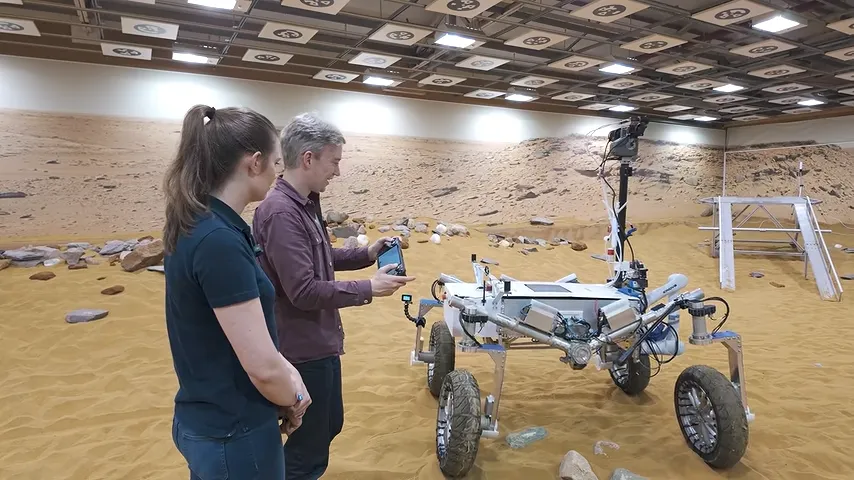
When you think about exploring the vastness of Mars, you probably picture complex engineering and multi-billion dollar budgets. But sometimes, the most revolutionary solutions to the toughest problems come from the most unexpected places. In the quest to design intuitive interfaces for deep space exploration, a little bit of gaming technology has proven to be a surprisingly powerful stepping stone.
Airbus, a heavyweight in aerospace engineering, recently showcased its ExoMars rover and the ingenious remote control system they developed. This system brilliantly bridges the gap between human operators and robotic explorers, demonstrating that the future of remote control might just involve a handheld gaming PC.
During demonstrations, the aerospace company allowed documentarian Tom Scott to take the controls, revealing that the remote device used was a modified Steam Deck. Whether the operator chose the LCD or OLED model, the result was a straightforward and effective interface for piloting the rover.
The control mechanism is simple yet effective. The rover is driven forward via the handheld gaming PC, and a simple “bumper” press allows the operator to execute a ninety-degree turn. This method eliminates the need for complex steering circles, making navigation smoother and more efficient on the challenging Martian terrain.
Beyond the demonstration, the team developing the ExoMars platform is focused on making the future truly autonomous. Engineers are currently working on developing custom software that enables the rover to navigate its test bed independently. This autonomous navigation system, running custom software from the Steam Deck, is a critical step toward true self-sufficiency for the mission.
This innovative approach is part of a massive, decades-long effort. Airbus aims to send the Rosalind Franklin rover to Mars by 2030, positioning the entire project as the culmination of more than twenty years of dedicated work. This mission involves not only navigation but also developing the complex mechanical, thermal, and propulsion systems necessary for a successful landing platform.
The synergy between advanced space exploration and gaming technology is a reminder that innovation often thrives at the intersection of seemingly unrelated fields. While the final destination is the Red Planet, the journey there has been paved by unexpected digital tools, proving that the lessons learned in interactive entertainment can indeed feed into the most serious of engineering challenges.
Buy on Amazon
Credit
