AMD cuts ray tracing memory by 98% for hardware-sapping trees
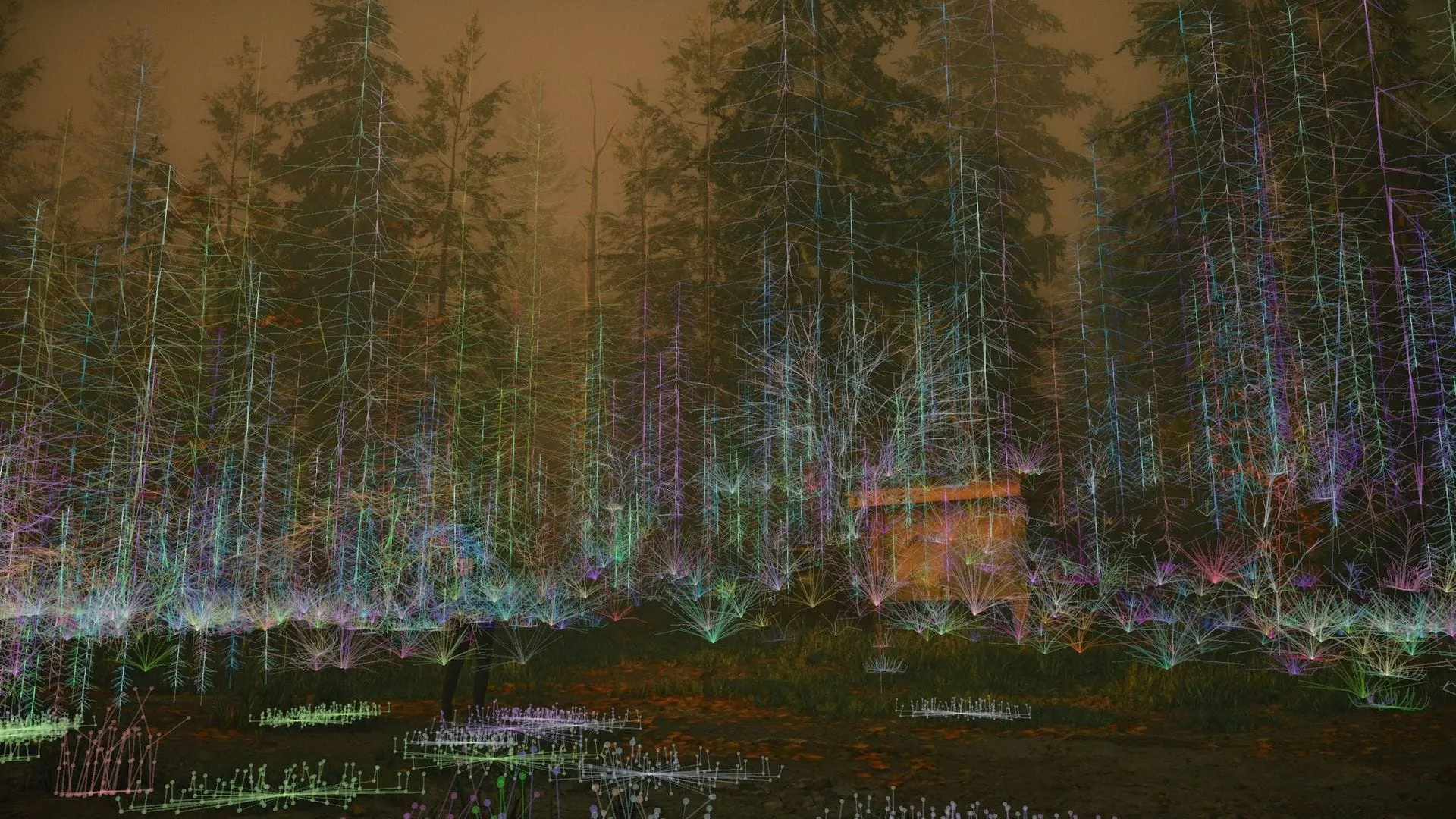
When we think about rendering vast, realistic landscapes in video games, the sheer complexity of nature—think forests and foliage—presents a massive computational challenge. But what if the solution wasn’t just about rendering more polygons, but about rendering smarter? Researchers at AMD are exploring a revolutionary approach to solving this, using a concept called ‘tetrahedral cages’ to redefine how massive amounts of animated geometry are handled.
The traditional method of rendering dense environments is incredibly demanding. To simulate a scene filled with thousands of independently animated plants, the system must manage incredibly complex data structures, like the Bounding Volume Hierarchy (BVH), which organizes geometric information. For a dense scene of 25,000 animated plants, this traditional approach could swallow up 80 GB of GPU memory and require a staggering 300 milliseconds per frame just to check which surfaces intersect with a ray of light.
This massive overhead is rooted in the need to track every wibbly-wobbly vertex, leading to slow and choppy performance. To tackle this, the team introduced a clever geometric workaround. A tetrahedral cage essentially wraps around the dense mesh of the plant matter. Instead of tracking every individual polygonal leaf, the system only has to calculate the deformation of this simplified cage during runtime.
This structural shift delivers dramatic performance gains. By focusing on the simplified cage, researchers managed to cut the potential ray tracing memory usage by an astonishing 98%. In a demonstration, this method resulted in significantly lighter computational demands, requiring only 1.7 GB of BVH memory and approximately 3.3 milliseconds for all BVH updates per frame.
How does this trick work? Rather than tracing rays across the numerous, complex vertices of the plant, rays are traced along the simplified surface structure of the tetrahedral cage surrounding the foliage. This means the animation cost scales with the complexity of the cage itself, rather than the sheer number of individual triangles. While this approach means sacrificing the fine-grained control over every single vertex—a trade-off that might be less critical for a field of foliage—it drastically simplifies the rendering process.
This innovation is a powerful step toward making the next generation of highly detailed, animated natural environments feasible on current hardware. While the technology is still in the research demonstration phase, the team is already hard at work developing tools, including DXR samples and a header-only C++ library, to bring the power of tetrahedral cages to a wider audience in the coming months.
Credit
