AMD debuts Helion design for agentic AI servers
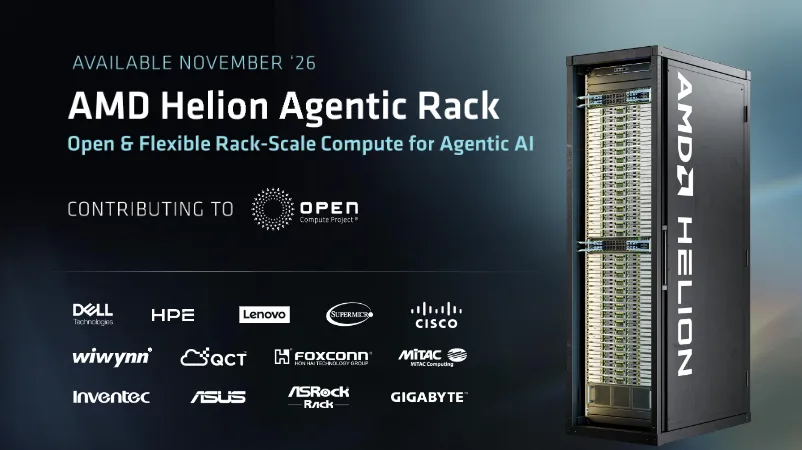
The data center is undergoing a radical transformation, driven by the insatiable hunger of artificial intelligence. To feed this demand, hardware isn’t just getting faster; it’s getting smarter, more integrated, and, crucially, more standardized. Enter AMD with Helion, a revolutionary approach to designing the infrastructure that will redefine how powerful computing systems are built and serviced.
AMD has introduced Helion, a new rack-scale design that aims to bring much-needed standardization to the complex world of data center hardware. This isn’t just a new chassis; it’s a standardized, 21-inch rack reference design built to complement the broader Helios rack ecosystem AMD revealed at the OCP Global Summit. By adhering to the Open Compute Project’s ORv4 specification, Helion ensures that data center components can communicate seamlessly, fostering the interoperability necessary for the next generation of infrastructure.
What makes Helion truly game-changing is its focus on density and serviceability. Designed to meet the needs of hyperscale operations, the design supports up to 44 OpenU trays, which are slightly larger than standard trays, allowing for optimized component placement. Furthermore, Helion is engineered to support both traditional air-cooled and advanced direct liquid-cooled deployments, offering flexibility that traditional systems often lack.
The core innovation lies in pushing computational density. In a CPU-only deployment, Helion is designed to house an astonishing 32,768 Zen 6 cores. This immense capacity is made possible by utilizing the dense 256-core design, demonstrated with CPUs like the EPYC ‘Venice’ 9996. This density is set to unlock unprecedented performance within the confines of a single rack.
This architectural leap is perfectly timed for the rise of agentic AI. Imagine an environment where large-scale AI models don’t just sit idle, but actively interact with their systems. The Helion design is ideally suited for this vision, facilitating the creation of agentic AI sandbox systems—environments where personal AI agents can run and execute complex terminal commands, connected to a powerful inference backbone. This model is already being explored in emerging AI applications, such as Meta’s Muse and OpenAI Dots.
Helion’s flexibility extends beyond CPU density. While optimized for CPU workloads, the rack design can also support hybrid configurations, accommodating up to 16 MI350P GPUs and 102 Tbps of networking. This hybrid capability positions Helion as an all-in-one solution, providing enterprises with a unified platform for data management, networking, and advanced AI usage.
By focusing on standardized, dense, and flexible hardware, AMD is not just releasing a product—it is laying the groundwork for a new era of data center architecture. With the Helion rack set to become available in the first half of 2027, AMD is positioned to lead the charge, ensuring that the physical infrastructure keeps pace with the exponential demands of the artificial intelligence revolution.
Buy on Amazon
Credit
