ASRock B860 Motherboard Review: Great Price, Real Drawbacks
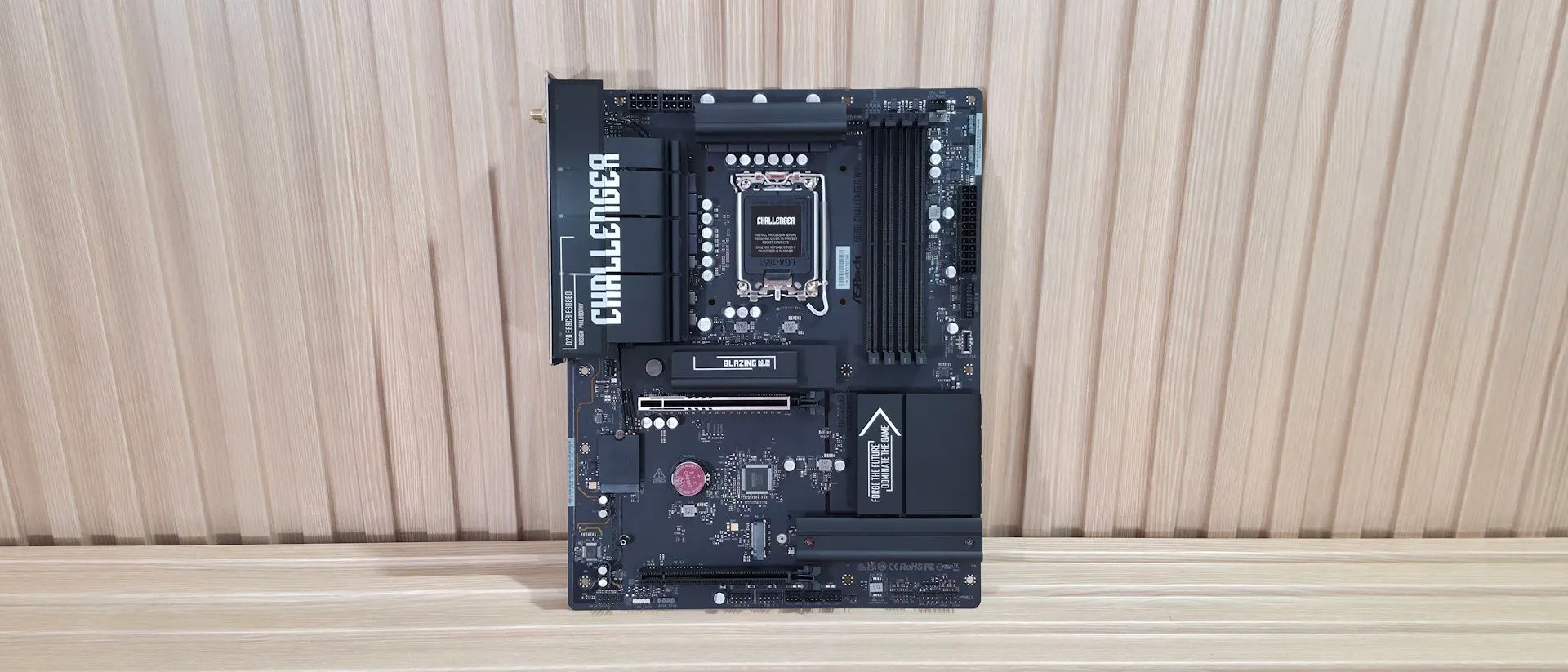
This text appears to be a detailed benchmark and review of a specific computer build, heavily focusing on the performance of a motherboard, likely the ASRock B860 Challenger, in conjunction with a high-end GPU.
Here is a structured summary of the key information:
1. System & Component Overview
GPU: Asus TUF RTX 4080 16G
PSU: EVGA Supernova 850W P6
Operating System: Windows 11 64-bit (25H2)
Driver: NVIDIA Driver 595.97
Integrated Features: Integrated HD audio and Integrated Networking (up to 10 GbE).
2. Benchmark Testing Details
The review utilized a comprehensive set of software to test synthetic performance and real-world gaming:
Synthetic Benchmarks: Procyon (Version 2.8.1352), Pugetbench (v1.4.20), 3DMark (Version 2.29.8294.0), Cinebench R26, and Blender (Version 5.0.0).
Application Testing: LAME MP3 encoding and HandBrake CLI were also included.
Gaming Tests:
Cyberpunk 2077: Ultra settings at 1920×1080 resolution with DLSS enabled.
F1 2025: Ultra High preset at 1920×1080 with 16xAF/TAA.
3. Benchmark Results & Analysis
Synthetic Performance: The reviewer found the B860 Challenger to be “average to above average” in tightly packed synthetic tests, suggesting it performs well across a variety of workloads.
Game Performance: In the gaming benchmarks, the board performed “average” in tests like Cyberpunk 2077 and F1 2025.
Conclusion on Performance: The text concludes that there is “nothing to worry about regarding performance” for this board in both work and play scenarios.
4. Overclocking & Memory
Memory Testing: The review tested memory kits, with the G.Skill kit at DDR5-8200 working flawlessly.
Limitation: The reviewer notes that while the board can handle memory well, it does not offer the absolute fastest memory speeds, suggesting it’s not ideal for extreme overclocking.
5. Power Consumption & VRM Temperatures
Stress Test: Using the flagship CPU (270K Plus) and DDR5-7600 memory, the system drew a peak of 339W at the wall.
VRM Temperatures: Temperatures were noted as fine, peaking at nearly 57°C on the sensor, even under ~230W loads, indicating adequate power delivery for the tested components.
6. Bottom Line Verdict
The review concludes that the ASRock B860 Challenger ($149.99) is an interesting board for the price and a worthwhile base for an Intel system.
Pros:
Excellent value at the entry-level B860 price point.
Capable of handling most mainstream tasks and demanding games.
Features three M.2 sockets and a PCIe 5.0 slot.
Cons:
Lacks features found on more expensive competitors (e.g., at least one 10 Gbps USB port).
Does not compete with premium options (like the Asus TUF Gaming B860-Plus Wifi or MSI models) which offer superior connectivity and features for a higher cost.
Credit
