Asus ROG Rapture Router Performance Review
The world of wireless networking is perpetually evolving, and while the current generation, Wi-Fi 7, has pushed the boundaries of speed, the next evolution promises something deeper: unmatched reliability. This shift isn’t about chasing raw gigabits; it’s about conquering the chaos of crowded wireless environments to deliver a signal that doesn’t just travel farther, but performs better, no matter where you are.
The highly anticipated Wi-Fi 8 standard, expected to be officially ratified in late 2028, signals a fundamental change in how we connect. Unlike previous generations focused purely on increasing top speeds, Wi-Fi 8 is engineered to solve the real-world problems faced by everyone—from demanding gamers and remote streamers to households stuffed with smart devices in dense apartment blocks.
The true power of this new generation lies in innovation that targets signal integrity. By utilizing technologies like Unequal Modulation (UEQM), which ensures a smoother performance drop-off over greater distances, Wi-Fi 8 tackles the challenge of signal degradation. Furthermore, concepts like Enhanced Long Range (ELR) and Distributed-Tone Resource Unit (DRU) are designed to bolster weak connections and extend network reach, ensuring low-powered IoT devices and remote endpoints connect reliably, even in challenging locations like basements or garages.
The underlying architecture employs sophisticated strategies for network coexistence. Features such as Coordinated Beamforming, Coordinated Spatial Reuse, and Coordinated Time-Division Multiple Access allow multiple routers to work in harmony, dynamically adjusting transmission power and sharing spectrum without interference. This complexity ensures that networks in high-density settings are not just faster, but significantly more stable and resilient.
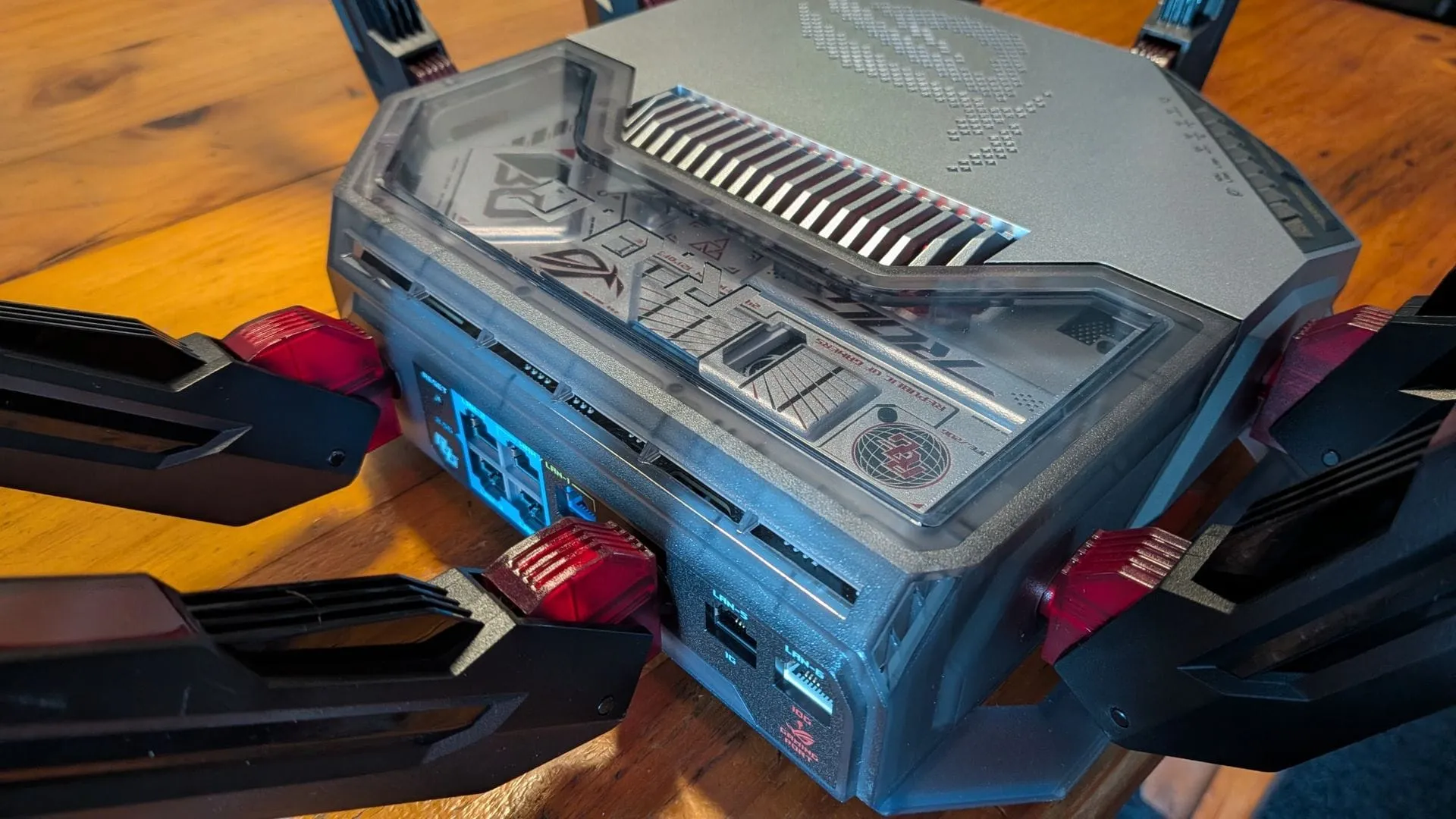
But what does this advanced technology look like in practice? Testing the flagship Wi-Fi 8 router, such as the Asus ROG Rapture GT-BN98 Pro, revealed compelling real-world results. When tested across varying distances—up close, across rooms, and outdoors—the Wi-Fi 8 system demonstrated a markedly better performance drop-off curve compared to its Wi-Fi 7 counterparts.
In scenarios involving large data downloads and streaming 4K content, the difference became stark. While some Wi-Fi 7 solutions struggled to maintain performance at distance, the Wi-Fi 8 system showed its strength in ensuring stable data flow, even when reaching the edges of the network. This resilience is particularly beneficial for demanding applications like high-speed gaming, where low latency and consistent connection quality are paramount.
Beyond superior performance, the hardware is loaded with feature-rich capabilities. The router integrates market-leading tools for security, parental controls, and game acceleration, often without requiring expensive subscription services. It also offers extensive media and file server functionality, making it a true network hub.
This comprehensive feature set positions the Wi-Fi 8 router not just as a speed booster, but as an all-in-one, highly secure, and flexible network command center. While the initial investment is substantial, when weighed against the breadth of advanced features and the focus on future-proof reliability, the Wi-Fi 8 standard delivers significant long-term value.
Buy on Amazon
Credit
