Biwin M560 2TB SSD Review The DRAM-less drive to beat
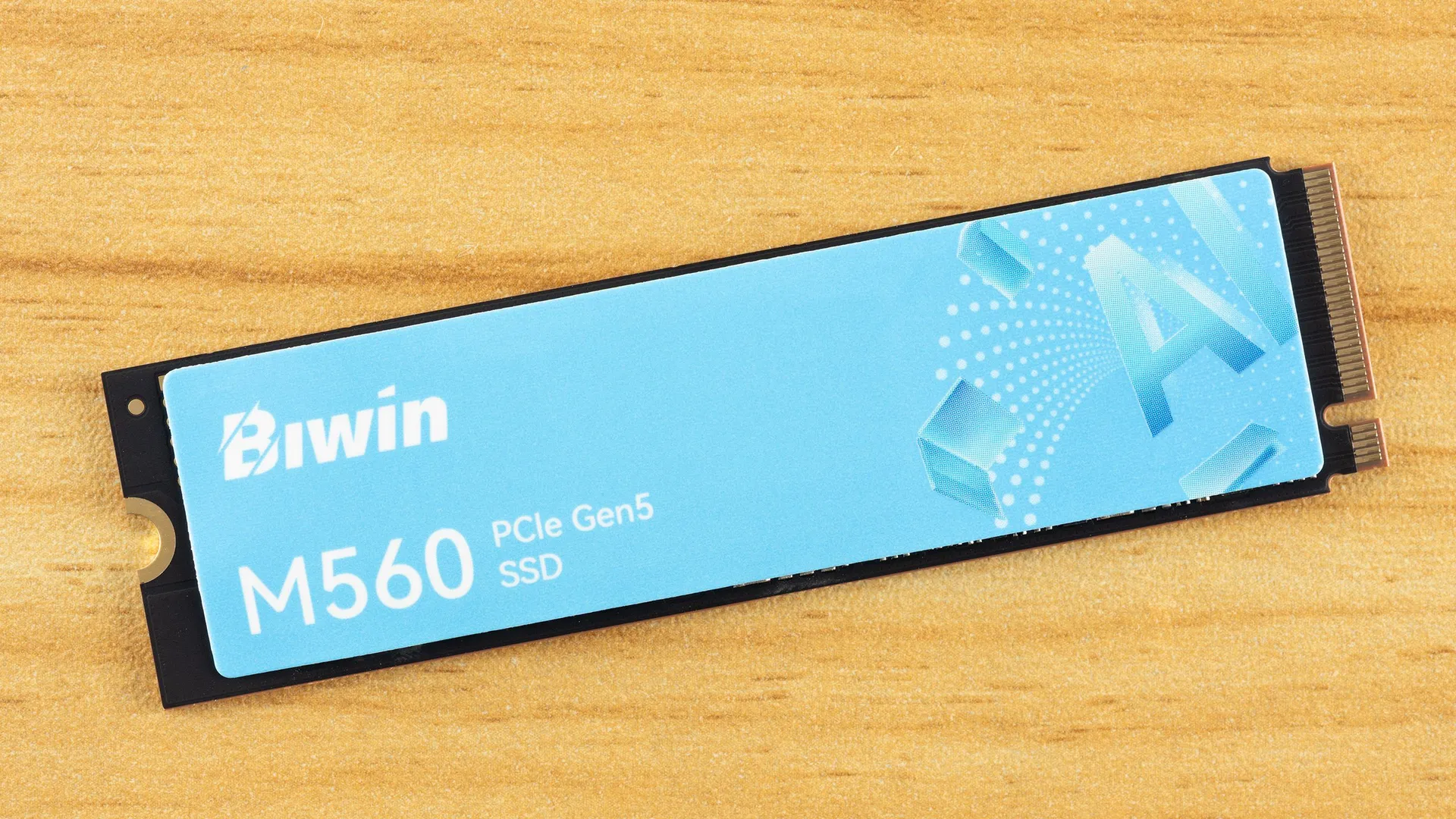
This article provides a detailed, real-world performance analysis of the Biwin M560 SSD, focusing on its transfer rates, synthetic benchmarks, sustained performance under heavy load, power consumption, and thermal behavior.
Here is a structured breakdown of the key findings:
—
🚀 Performance Benchmarks
1. Real-World Transfer Rates (DiskBench)
The testing involved a real-world workload (copying and reading a 50GB dataset of various files).
Observation: The drive performed reasonably well for this type of workload, though the comparison with competitors (like the SM2504XT) showed that the controller implementation (Phison with BiCS8, CS2150, etc.) played a significant role in the final speed.
2. Synthetic Benchmarks (ATTO / CrystalDiskMark)
The drive’s performance across different workloads varies significantly based on the queue depth (QD) and block size.
Sequential Writes: The M560 showed good sequential write performance, although it fell behind drives with more flash channels and DRAM (like the T700).
Sequential Reads: Performance was generally better than many drives, but the T700 outperformed it at higher queue depths (QD1 for 4KB reads).
Random Performance (4KB Latency & IOPS):
Latency: The M560 excelled in QD1 latency against other drives.
IOPS: Maximum IOPS at QD256 lagged behind some competitors.
Overall Impression: The reviewer concludes the M560 is a “monster drive for its class” when considering its responsiveness for daily use, despite not being the absolute fastest.
—
⚡ Sustained Performance & Cache Behavior
The review heavily focused on the SSD’s write cache mechanism, which dictates sustained performance.
Write Cache Dynamics: The drive features a substantial write cache (around 611 GB in the tested scenario). When the workload exceeds the cache capacity, the drive must “fold” data out of the cache into the native TLC/QLC flash, which significantly increases latency and lowers the write speed.
Sustained Write Speeds:
Cache Mode: When utilizing the cache, the drive can achieve speeds over 10.3 GB/s for short bursts.
Native Mode: When the cache is exhausted, sustained write performance drops, often falling below the expected speed. However, the article notes that the drive’s raw flash capability is still “incredible,” achieving over 4 GB/s when utilizing the flash directly.
Conclusion on Writes: While the large cache hinders true sustained performance under heavy, continuous writes, the raw underlying flash speed remains very high.
—
🔋 Power and Thermal Performance
Power Consumption: The drive demonstrates excellent power efficiency. It consumes manageable power, and its idle power consumption is superior to some competing drives.
Temperature: The drive ran relatively cool. Peak temperatures were recorded at 61°C and 76°C.
Efficiency: The drive is deemed very efficient when compared to drives using similar flash technology (like Phison E31T).
—
⭐ Biwin M560 Bottom Line (Verdict)
The reviewer highly recommends the Biwin M560, positioning it as an excellent all-around drive that balances performance, responsiveness, and efficiency.
Best For: Acting as a fast, capable, and efficient primary or secondary drive for general use, gaming, and work on a PCIe 4.0 platform.
Trade-offs: It is not designed to be a “monster” 14+ GB/s drive with DRAM, but it provides exceptional performance for the price point.
Final Advice: If the user prioritizes a solid, high-end experience over chasing the absolute fastest theoretical speeds, the M560 is an outstanding choice.
Buy on Amazon
Credit
