Cadence unveils Maestro AI for chip design agents Q4 2026
Cadence Unveils Maestro: Bringing AI Super Agents to the Chip Design Frontier
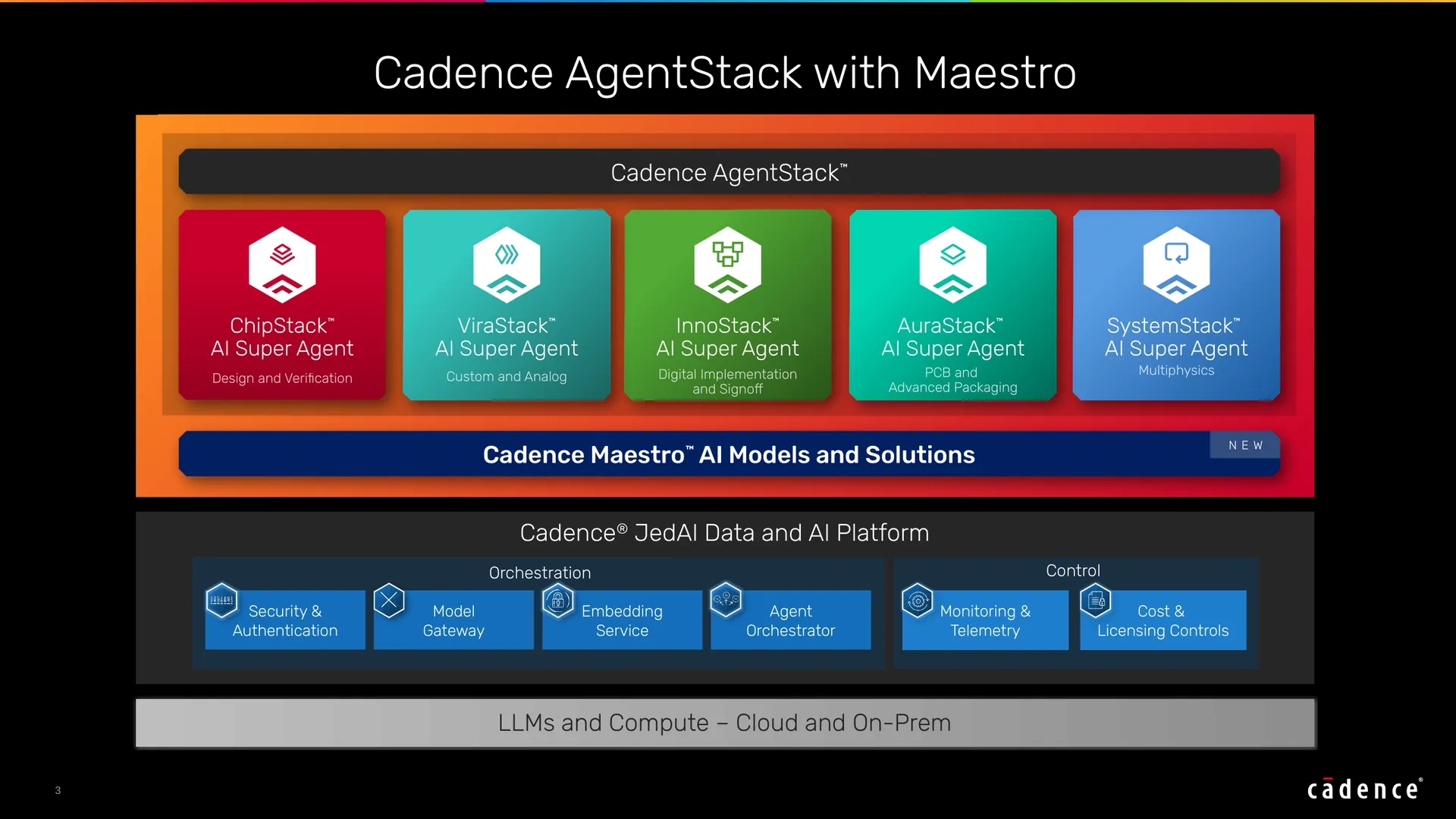
The landscape of semiconductor design is being fundamentally reshaped by artificial intelligence. Cadence, a titan in electronic design automation (EDA), has stepped up this revolution by introducing Maestro, a new portfolio of domain-specialized AI models designed specifically for its chip design agents. This announcement, made ahead of earnings, signals a pivotal shift: moving beyond general-purpose AI to create specialized, hyper-efficient intelligence that can accelerate the most complex engineering tasks.
Maestro isn’t just another large language model; it functions as an AI Super Agent capable of interpreting design intent, decomposing complex tasks, and orchestrating a suite of leading frontier and open-weight models. To achieve this, Cadence integrated reinforcement learning (RL), allowing its deterministic solvers to evaluate outputs against strict engineering objectives and ground truth. Crucially, the results of these evaluations feed directly back into the models, ensuring continuous improvement and smarter decision-making.
The real magic of Maestro lies in efficiency. Initial results comparing these specialized models against general-purpose AI reveal significant advantages. Cadence claims up to a 30% improvement in the quality of results while simultaneously achieving up to 5x the token efficiency compared to a general-purpose foundation model. This efficiency is achieved by intelligently balancing the interaction between EDA tool calls and LLM invocations, allowing engineers to focus on the architecture rather than the tedious mechanics of process.
Flexibility is central to Cadence’s approach. Maestro is designed to be deployable wherever the engineer needs it. Customers have the choice to run these models on Cadence’s cloud, public clouds, or even in customer-controlled on-premises environments. Furthermore, the system allows users to fine-tune the models using their own proprietary data, designs, and workflows, ensuring the AI remains deeply tailored to specific industry needs.
This specialized approach contrasts with other industry players. While competitors are developing specialized models, Cadence is focusing on integrating agentic AI natively into its vertical. This strategy differs from models like Synopsys’ GPT-Synopsys, which operates on OpenAI infrastructure without utilizing customer design data for training. Cadence’s goal is to bring the AI directly into the engineering workflow, rather than simply embedding the vertical into general-purpose agents.
The economic driver behind this innovation is clear: agent costs have started to explode. By integrating iterative agent processes directly into the models’ weights, Cadence aims to reduce operational costs. As one executive put it, the goal is to ensure engineers use the right model at the right time for the right task, optimizing both runtime and cost. While the exact financial impact of the token savings is still being measured by customers, the promise of reduced operational costs is substantial.
With an ambitious roadmap spanning through 2026, Cadence is accelerating its agentic vision. This includes developing models like Nvidia’s Nemotron and integrating advanced security protocols, such as Nvidia’s OpenShell Reference Architecture, to protect sensitive intellectual property. The journey toward full agentic autonomy is underway, positioning Maestro and its portfolio to define the next generation of autonomous engineers in the semiconductor industry.
Buy on Amazon
Credit
