Cray-1 Replica with 30 Mac Minis and 1.5 TFLOPS
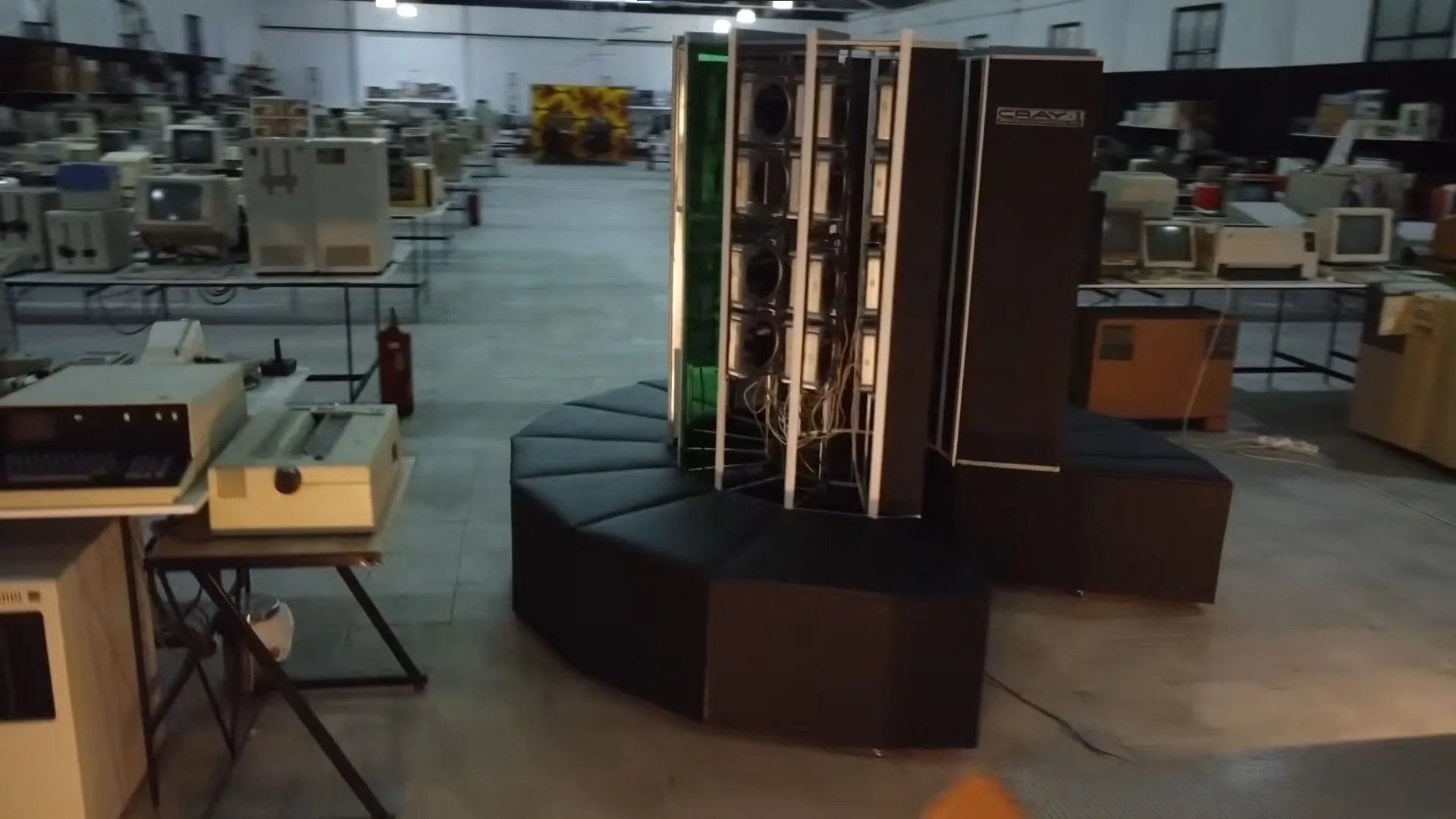
History is made of silicon, and Spain’s Museo de Historia de la Computación is currently building a breathtaking monument to that fact. The museum has launched an ambitious 18-month project designed to celebrate a colossal milestone: the 50th anniversary of both the legendary Cray-1 supercomputer’s first operational use in Los Alamos and the founding of Apple.
This isn’t just a static display; it’s a dynamic bridge between the groundbreaking early days of supercomputing and the hyper-parallel processing of today. The team has engineered a replica that doesn’t just look like history, but actively demonstrates the dizzying evolution of technology over half a century.
At the heart of this project is a remarkable feat of modern ingenuity. The replica is powered by a collection of 70 cores drawn from systems dating back to 2012-2014, including 30 Mac Minis, 25 dual-core i5 units, and five quad-core i7 processors. This assembly packs an impressive theoretical performance of 1.5 TeraFLOPS, representing a staggering 9,375-fold leap from the original Cray-1’s 160 MegaFLOPS.
To put the scale into perspective, the original Cray-1 was a revolutionary commercial success, powering critical scientific endeavors ranging from intense weather predictions and aerodynamics to nuclear physics. It achieved this power through the brilliance of vector processing—a technique that allowed the supercomputer to crunch massive datasets in parallel, fundamentally changing how computation was done.
The museum’s goal is to showcase how far we have come. By resurrecting the concept of parallel computing and embedding it within a modern framework, they aim to highlight the dramatic shift from a single-core processor to a system leveraging 70 “modern” cores and fifty years of relentless technological innovation.
Beyond raw power, the design itself is a masterclass in minimalist engineering. Where the original supercomputer required massive, noisy refrigeration systems, this replica is coolly efficient, utilizing a passive convection-tower design. The entire system operates with near-silent efficiency, with noise largely limited to the Ethernet switches. The museum plans to further silence the machine by installing silent switches.
Visitors can step into this timeline and see the architecture in action. They will witness the machine tackle complex matrix multiplication problems, a perfect demonstration of the computational heavy lifting it was designed for. For an immersive experience, the museum has also created a retro-style control terminal—a large metal desk with multiple screens spanning a panel, complete with the sleek silhouette of the 1970s.
Remarkably, the team managed to run the simulation on macOS Mojave, leveraging the Message Passing Interface (MPI) to orchestrate the instructions across the multiple Mac Minis. This integration of historical hardware with contemporary operating systems showcases the adaptability of computing.
The journey is far from over. The museum is now embarking on a new phase, planning a crowdfunding campaign to acquire 70 to 80 new M4 Mac Minis, aiming to push this historical replica into the ranks of the TOP500 supercomputers. It is a testament not only to computing history but to the limitless potential of modern design and collaborative innovation.
Those interested in witnessing this technological narrative are invited to plan their visit. The exhibit is on permanent display, available to the public on Saturdays from 11:30 AM to 2:00 PM. Please note that tours require a guide, and the museum observes closures during the summer, Christmas, January, and February months.
Credit
