Design massive LEGO builds with open-source tools
Pixel Perfect: How AI is Designing the Next Generation of LEGO
The realm of artificial intelligence is rapidly moving from generating text and images to creating tangible, physical designs. Now, AI models are diving deep into the world of physical construction, leveraging sophisticated language understanding to design elaborate LEGO builds with thousands of real pieces. This isn’t just digital art; it’s the birth of an agent capable of thinking like an architect, prompting complex structures from pure imagination.
At the heart of this innovation is the ability of large language models, such as GPT-6 Astra and Claude Opus 5.5, to translate abstract concepts into concrete plans. Using open-source tools like LDraw Nova, these models act as master designers. A user can simply provide a prompt—like asking for “the most beautiful model that comes to your mind”—and the AI agent works through a fascinating process, generating detailed CAD files and programs that map out the exact placement of every brick needed.
The magic happens through an agentic workflow. Instead of struggling with complex geometry math, the AI agent uses Python tools to write the necessary program. This allows the system to generate the LDraw source output, detailing the position of every single piece without needing to place physical bricks. This approach lets the agent focus on generating logical code, proving that AI agents can be remarkably adept at generating the programming required to build.
The process is incredibly flexible. The AI agent can inspect its own generated design, adjust the layout, and render the result iteratively until the structure is complete. This loop of generation and refinement allows the AI to navigate complex design challenges with unprecedented creativity.
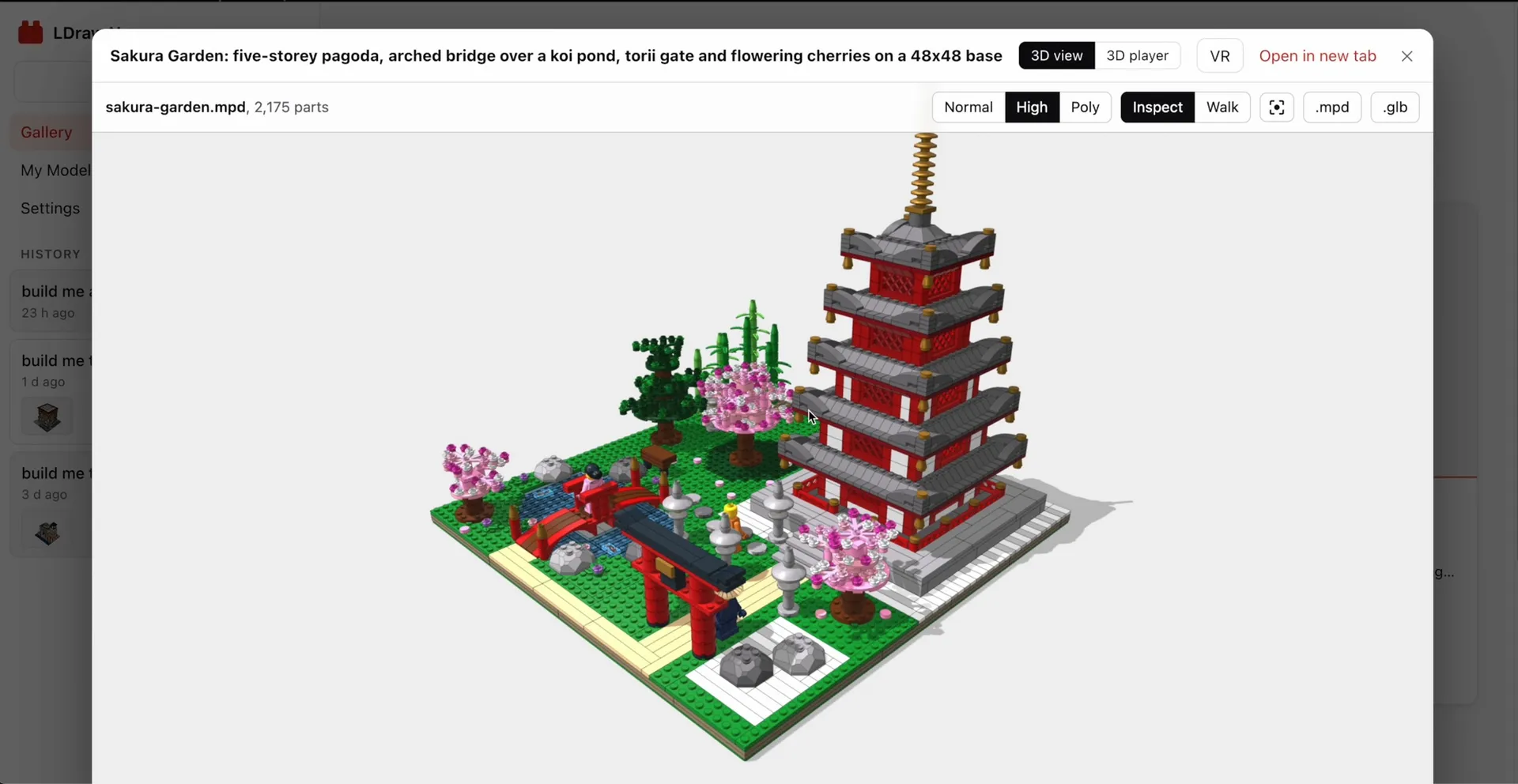
The tools are powerful, running as a Docker web app that connects to major AI providers like OpenAI, Anthropic, and OpenRouter. This system allows for incredible variety, with gallery features crediting the specific models—whether it was Opus 5.5 for a charming Sakura Garden or Astra for a grand Cathedral.
However, building physical reality from code comes with inherent challenges. While the designs are stunningly detailed, current systems still lack robust physics modeling. This means while the models handle collisions, stability remains a current hurdle, meaning the physical integrity of the final structure is not yet fully guaranteed.
Furthermore, the process is currently quite demanding. Building large and accurate builds requires immense computational power, and the cost associated with using frontier models for these complex tasks can be significant. This highlights the immediate need for tools that can be used by lower-end agents to iteratively build, moving beyond just the use of the most expensive models.
Looking ahead, the vision extends beyond digital files. Researchers are exploring ways to bridge the gap between code and physical production. Systems are being developed that can interface with 3D printing services, allowing an AI agent to not only design the blueprint but also manage the printing process. The ultimate goal is to evolve from designing lines of code to orchestrating the physical construction of tangible objects, paving the way for truly physical AI agents.
Buy on Amazon
Credit
