Engineer builds tiny 3D printed drone in bedroom
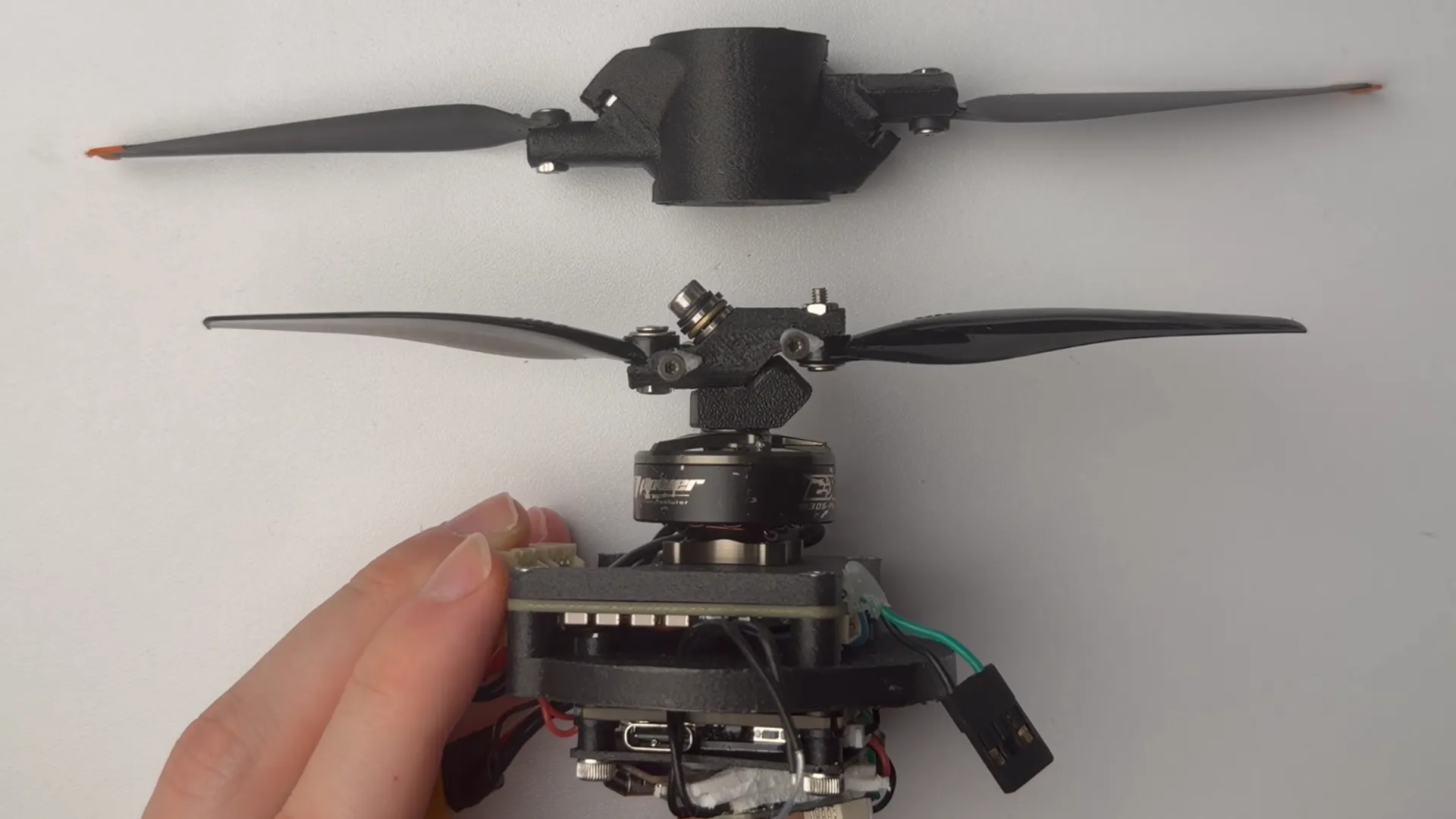
For some engineers, the lab is just a backdrop for their next great idea; for Joshua Bird, it was the testing ground for a drone built entirely from passion and 3D-printed parts. He didn’t just build a drone—he engineered a radical solution to the fundamental mechanical challenges of rotary-wing flight, proving that complex aerodynamics can be achieved through clever physics and rapid iteration.
Bird’s project centered on a single-motor drone housed within his home, which he tested right on his bed. The real magic wasn’t just the assembly; it was the unique, high-speed control system he devised. Traditional multi-rotor aircraft rely on complex mechanisms, like swash plates, to counteract the massive torque generated by the motor and adjust direction. Bird’s approach was far more elegant: instead of fighting the torque with a separate plate, he made the motor itself the steering mechanism.
By rapidly accelerating and decelerating the motor, Bird could generate opposing reaction torques—speeding up to increase reaction torque while slowing down applied the opposite. This delicate balancing act essentially reduced the reactive torque on the drone body to a manageable level, achieving superior stability with incredible precision, reacting in under 0.2 milliseconds.
The control system extended to the rotor blades themselves. The drone featured a hinged propeller design, with each blade pivoting on a 45-degree hinge as the motor accelerated. This pivot allowed for dynamic pitch adjustments: one blade would pitch up to increase lift while the other pitched down to reduce it, effectively controlling the drone‘s roll and pitch. This system, combined with adjustments to the main rotor torque and 3D-printed stabilizing fins, provided comprehensive yaw control.
The journey from theory to flight was filled with real-world engineering hurdles. While the core mechanics were sound, Bird faced practical issues, including inevitable crashes and wall damage during fine-tuning. To diagnose a critical issue—the propellers were proving too soft—he had to pivot and use his own tech. He built a homemade high-speed camera system, using a Sony camera and a microcontroller linked to the drone‘s motor controller, to capture the movement. This visual feedback revealed the need for sturdier material, leading him to 3D-print new, reinforced propellers.
Despite the setbacks, the persistence paid off. Bird eventually managed to get the drone airborne, although its fixed-base IR beacon navigation limited its initial flights to the confines of his bedroom. Looking ahead, he plans to integrate linear cameras to expand the drone’s operational envelope, allowing it to venture into new environments.
Joshua Bird’s work offers a compelling counterpoint to ongoing research into smaller, quieter drones and even mosquito-sized flying robots. While other engineers explore ultrasonic propulsion and miniaturization for stealth missions, Bird’s project highlights a unique, hands-on approach to solving complex mechanical problems, demonstrating that the most innovative solutions often come from brilliantly tackling the practical challenges of the build itself. For those eager to dive into the deep end of DIY robotics, the solutions are waiting in the open-source community.
Buy on Amazon
Credit
