FADU bypasses CPUs by hiding filesystem in SSD flash
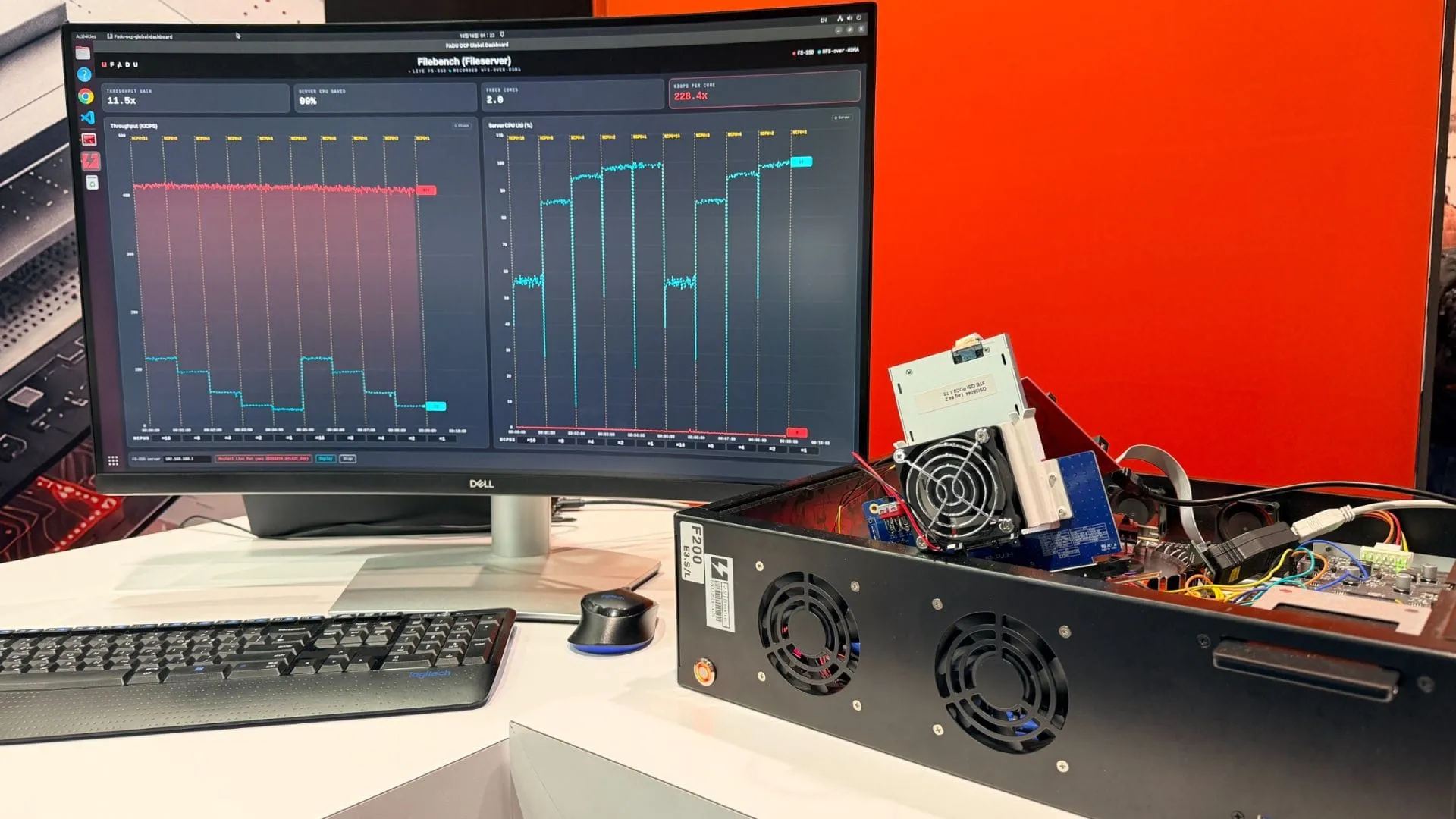
The future of data access is shifting from complex host systems to the storage device itself. A team of engineers in Seoul, South Korea, is leading this revolution with a groundbreaking approach to storage: the File-Semantic SSD, or FS-SSD.
Announced at the 2026 OCP Global Summit, FS-SSD technology fundamentally redefines how data moves. Instead of routing every file request through traditional operating system filesystems and block layers, this new architecture embeds the entire file system directly within the SSD controller. This change is designed to unleash the true potential of modern accelerators, allowing components like GPUs, DPUs, and Network Interface Cards to read and access files with a seamless, host-free experience.
Imagine a scenario where data access is liberated from the bottleneck of the host CPU. FS-SSD achieves this by handling file lookup, access control, and mapping directly on the drive. This eliminates the need for a separate host filesystem or block layer in the data path. This architectural leap promises to drastically improve performance by removing unnecessary overhead.
The performance metrics validate this vision. In preliminary testing, the FS-SSD demonstrated remarkable efficiency. When handling demanding random-read workloads for GPUDirect Storage, the file system and block layers only consumed about 30% of the CPU cycles. This efficiency is further amplified by smart design choices, including a highly optimized file map that uses minimal DRAM—just about 0.1% of the NAND capacity—leaving the vast majority of memory available for hot-path caching.
The gains extend to system efficiency. The solution incorporates advanced garbage collection techniques that eliminate the “double GC” problem plaguing traditional host file systems, resulting in a 63% reduction in write amplification compared to host solutions. This means less wear on the drive and greater longevity for the entire system.
The real game-changer lies in the path to acceleration. By enabling host-free access, FS-SSD facilitates revolutionary use cases. Data can now flow directly from the SSD to accelerators via PCIe peer-to-peer DMA, bypassing the host CPU entirely. This opens doors for applications like GPU file reads and checkpoints, DPU-served content delivery, and advanced file serving solutions.
While the initial implementation utilizes established protocols like NFSv3 for flexibility, the technology is designed to evolve. FADU’s long-term vision is to deliver a completely server-less storage solution—a Just a Bunch of Flash (JBoF) system. This involves combining FS-SSDs with PCIe switches and DPUs to create a highly dense, cost-effective infrastructure with significantly lower power consumption and five-year total cost of ownership.
The roadmap is clear: FADU is targeting Gen6-host results by early 2027 and aiming for partner samples in the third quarter of 2027. The ultimate goal is to push the boundaries of storage, offering a cohesive, high-performance solution that frees data access from the limitations of the traditional host architecture.
Credit