Gigabyte X870 Extreme Overclocking Motherboard Review
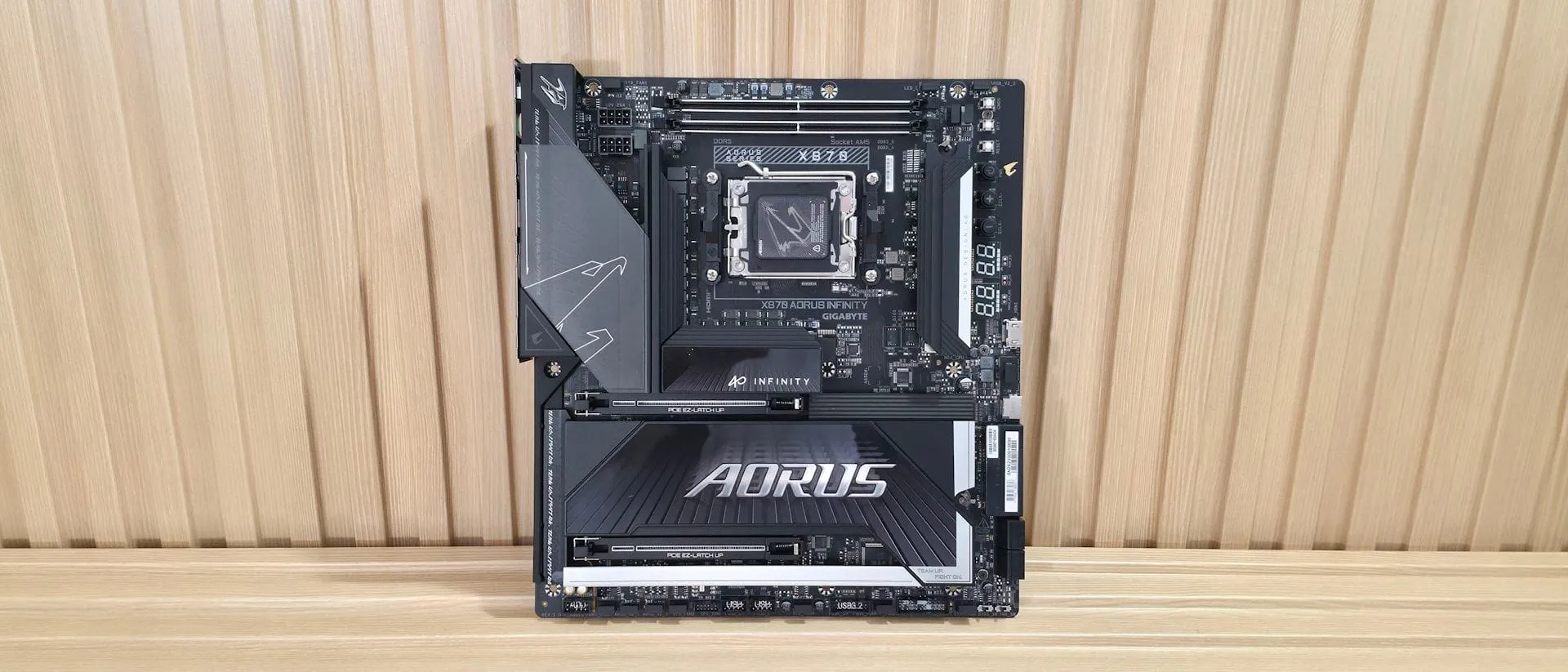
This text appears to be a detailed review and benchmark summary for a motherboard, specifically the Gigabyte X870 Infinity, focusing on its performance, memory support, and value proposition.
Here is a structured summary of the key information:
1. System & Component Overview
The review tests a system configuration featuring:
RAM: Teamgroup T-Force Delta DDR5-7200 CL34 and a Klevv DDR5-8000 kit.
GPU: Asus TUF RTX 4080 16G.
PSU: EVGA Supernova 850W P6.
OS: Windows 11 64-bit.
2. Benchmark Findings
The benchmarks cover synthetic tests, timed applications, and gaming performance.
Synthetic Benchmarks (3DMark, Cinebench R24, Blender): The Aorus Infinity performed average to above average in these tests.
Timed Applications (HandBrake, Corona, LAME): Results were generally average, with no significant performance deficiencies noted.
Gaming Performance (Cyberpunk 2077 & F1 2024): The board performed very well in synthetic 3DMark benchmarks and was average to above average in games. The testers found the performance difference between boards in these tests to be minor.
3. Memory and Overclocking Capabilities
The review places significant emphasis on the motherboard’s ability to handle high-speed memory:
Memory Support: The board successfully completed stress tests on a DDR5-8000 kit with the Ryzen 9 9900X CPU, demonstrating it is ideal for pushing memory speeds.
Overclocking: The board is considered robust and has excellent power delivery (VRMs). While it is designed for extreme overclocking, the review ultimately decided not to overclock the CPU for this test, focusing instead on stability.
4. Power Consumption and VRM Temperatures
Power Draw: Under stress testing with the DDR5-7200 kit, the board showed a peak draw of 263W (averaging around 177W), which was noted as slightly higher than the running average of tested boards.
Temperatures: VRM temperatures were excellent, peaking at 46°C on the sensor and 48°C on the hottest internal sensor, indicating good thermal management under load.
5. Bottom Line & Verdict
The reviewer concludes with a mixed but ultimately positive assessment:
Performance: The Gigabyte X870 Infinity does everything well overall and handles performance needs effectively.
The Main Issue (Price): The biggest drawback is the price ($799.99), which is considered prohibitive for an X870 board compared to competitors.
Recommendation: While it offers excellent performance and robust power delivery suitable for high-end use, the reviewer suggests that for most users, saving a couple hundred dollars by choosing alternative X870E-based boards (like those from Asus, Gigabyte, or MSI) that focus less on extreme overclocking might be a better financial decision.
In short: The motherboard is a solid performer with excellent stability and power delivery, but its high price makes it expensive for the average consumer.
Buy on Amazon
Credit
