MIT engineers build shape-sensing skin for VR
The Soft Revolution: MIT Engineers Weave Motion into Wearable Fabric
Imagine a garment that doesn’t just cover the body, but actively understands it. This isn’t science fiction; it’s the tangible reality being developed by engineers at MIT, who have successfully created a soft, wearable sheet capable of tracking movement in three dimensions using embedded optical fibers.
This groundbreaking technology moves beyond simple touch sensors. By leveraging optical waveguide arrays, the sheet tracks bending and twisting in both directions, achieving astonishing precision. In laboratory tests, the system maintained an error margin below half a centimeter, proving that soft textiles can possess sophisticated, real-time spatial awareness.
The secret lies in the design. The researchers adapted traditional fiber technology by replacing rigid materials with flexible rubber cores and specialized black-dyed cladding. To achieve directional sensing, they intentionally roughened one side of the fiber, causing bending toward one side versus the other to disrupt the light output in distinct ways. This innovative setup allows the sheet to sense complex 3D shapes, making the sensing elements more resilient and efficient.
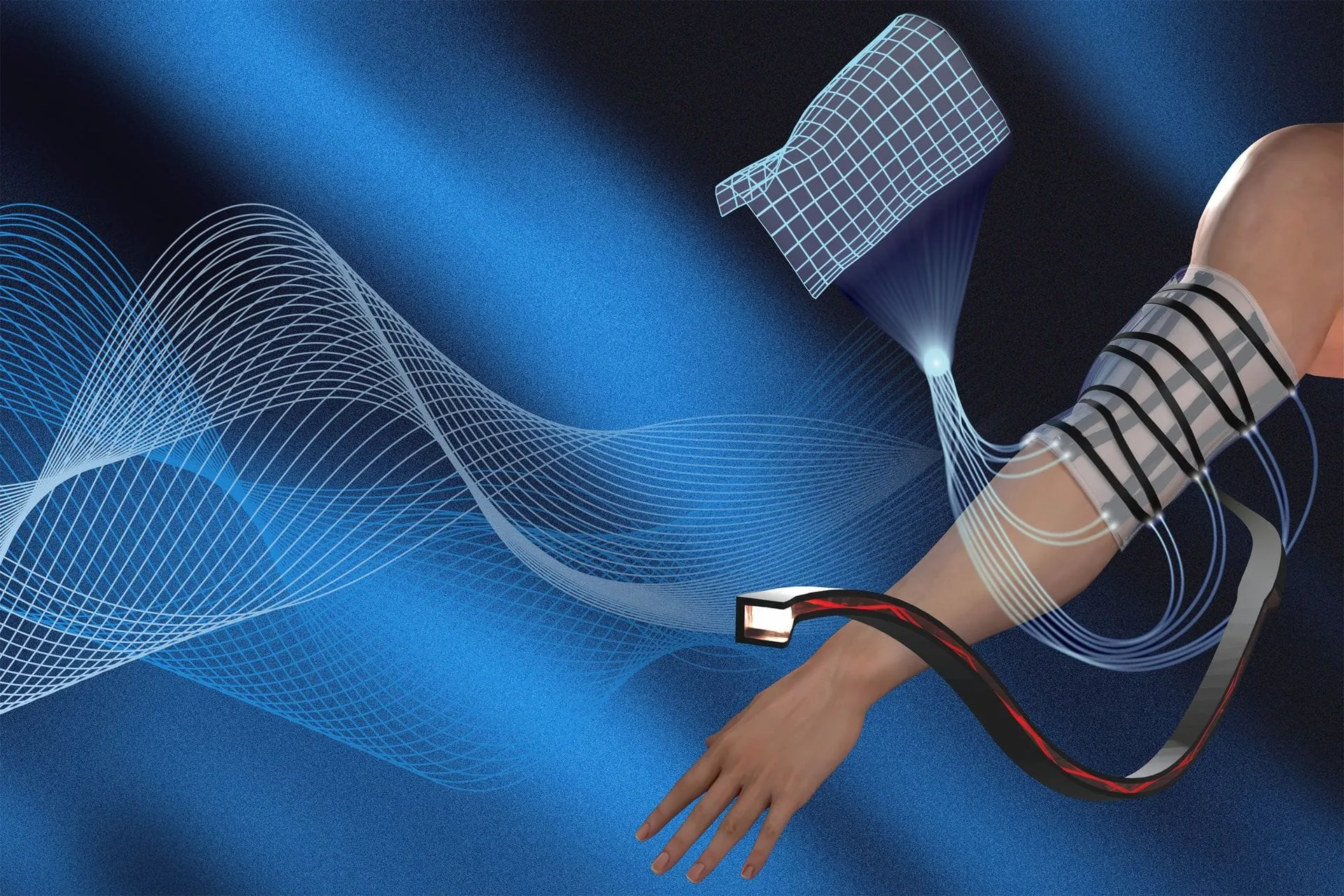
These flexible fibers are embedded within a silicone sheet, acting as the body’s skin. Each fiber contains an LED and a light sensor, feeding data to an external circuit board. An algorithm translates this complex light data into a complete 3D shape of the sheet, providing a dynamic map of its form in real-time.
The math behind the magic is complex, relying on simulations to determine the optimal fiber layout. By analyzing how different waveguide arrangements affected light output, the team discovered that angling the waveguides proved to be more accurate than simply adding more sensing elements. This optimized approach allowed them to achieve outstanding accuracy even when testing resilience.
Furthermore, the system isn’t just a shape tracker; it’s a force sensor. Because the fibers respond to pressure, the sheet can detect external forces, offering a pathway to understanding physical interactions. This dual capability means the technology can monitor both the geometry of an object and the physical forces applied to it, opening doors for applications like physical therapy, where precise tracking of a patient’s progress is essential.
The potential applications are vast and exciting. Beyond therapeutic uses, this soft sensing technology could revolutionize how we interact with the digital world. Picture virtual reality systems that can mimic physical motion with flawless accuracy, or the teleoperation of advanced robots guided by soft, adaptable clothing. This technology paves the way for truly smart garments and the future of soft robotics.
Looking ahead, the team is already plotting the next evolution. While the current system is impressive, researchers plan to focus on making the fibers even thinner—potentially down to tens of micrometers. This pursuit of ultra-thin materials could unlock the potential for truly smart, invisible clothing. Future work will also focus on faster processing methods and developing stretchable electronics, promising a wearable technology that is not just smart, but seamlessly integrated with our physical world.
Buy on Amazon
Credit
