Modder injects leaked DLSS 5 4x Multipass on 1996 Quake
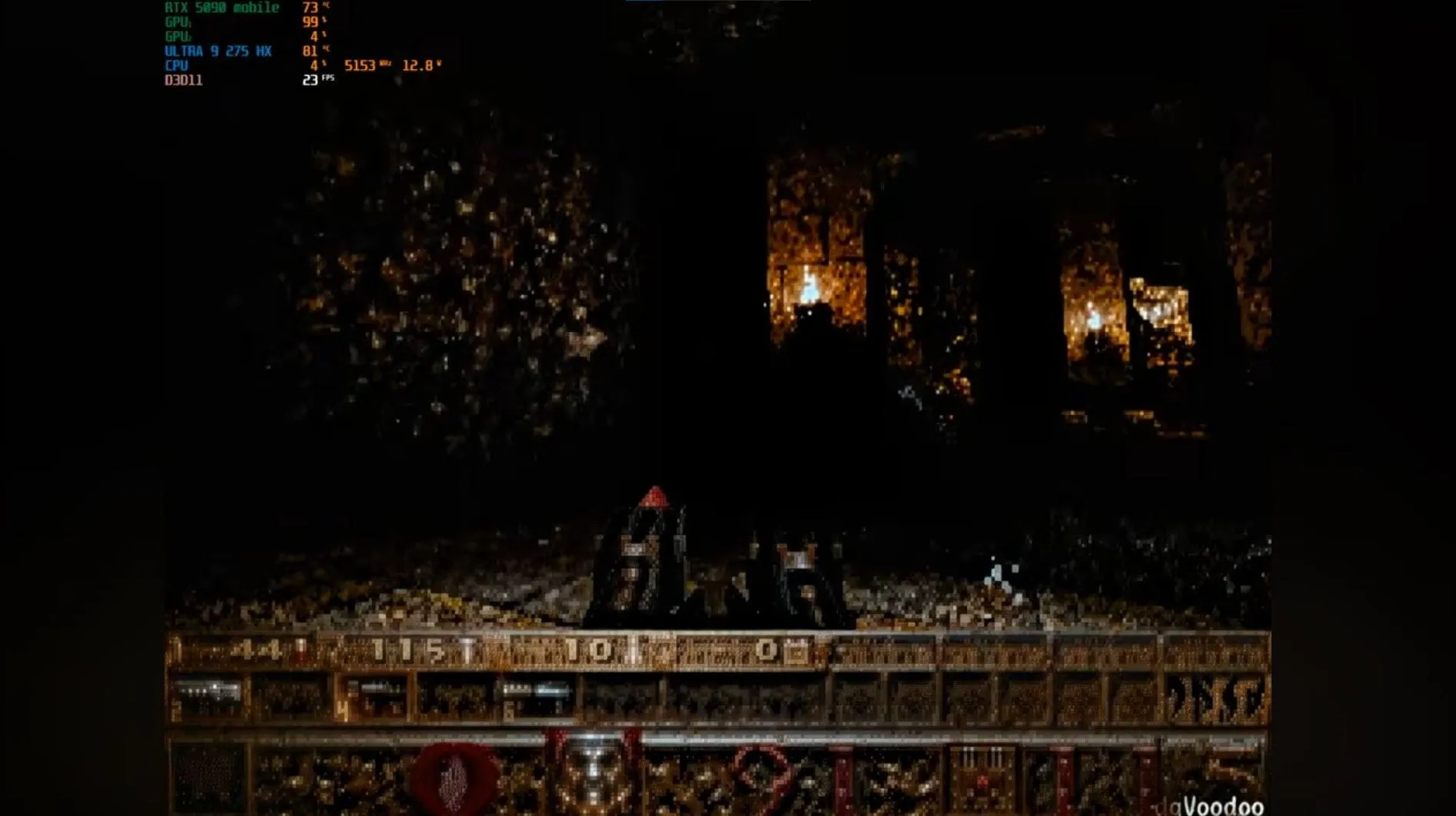
The quest for the next generation of graphics is often best tested in the weirdest places. Recently, a Ukrainian enthusiast named Valery Kryzhanovsky dove headfirst into the deep end of AI upscaling with DLSS 5, applying it to games that were never meant to host such a technological makeover: the legendary 1996 masterpiece, Quake.
This wasn’t just a casual test; it was a deep dive into the capabilities and limitations of the new technology. Valery didn’t simply apply DLSS 5; he used it as a post-process, leveraging fourx Multipass to enhance the image effect, running the algorithm on a pre-rendered frame. This setup involved injecting the effect onto DOSBox’s rendered output using tools like ReShade and RenoDX. The result, however, was less polished brilliance and more psychedelic distortion.
While other experiments with DLSS 5 on simple 2D games, such as Duke Nukem and Pac-Man, led to bizarre and “cursed” imagery, the attempt on the foundational 3D environment of Quake produced a different kind of visual oddity. The core issue, as Valery pointed out, is that DLSS 5 is not natively integrated into the game engine. It’s an AI filter layered on top, and when applied to a game engine that wasn’t built with modern visual enhancements in mind, the results can be jarring.
This experimental setup highlights a key difference between upscaling and true graphical fidelity. In contrast, previous demonstrations, such as Nvidia‘s RTX demo of Quake II, used ray tracing to enhance lighting and reflections directly within the game engine, resulting in stunning, realistic visuals. DLSS is an upscaling technology designed to run efficiently on RTX cores, not a replacement for advanced ray tracing. The lack of engine integration explains why the results weren’t immediately spectacular.
Valery noted that the leaked DLSS 5 build itself seemed undertrained. He speculated that the image darkens significantly, possibly because the upscaler struggled to handle the sparse distribution of light sources and highlights in the older game environment. It seems the algorithm prefers more obvious three-dimensional elements to work with.
The potential for DLSS 5 is clearly tied to deep integration. If the technology were woven directly into the game engine—much like community efforts have done to introduce ray tracing into older titles—the visual payoff would be immense. For instance, modded versions of Quake have successfully incorporated ray tracing capabilities into the engine, proving the power of internal integration.
The underlying technology driving this push is incredibly efficient. Nvidia recently announced that its DLSS 5 model improves performance by 2x while dramatically reducing the VRAM footprint by 24%. This massive efficiency gain suggests that even when applied to older or less optimized titles, the potential for performance and visual quality is enormous.
Credit
