Modder tests a trash AC radiator to cool a PC
In the realm of PC hardware, where optimization is king and heat is the ultimate enemy, some practitioners believe that the conventional rules simply need to be broken. Australian hardware examiner TrashBench is one such practitioner, regularly engaging in high-stakes thermal experiments that push the boundaries of cooling technology and component limits. His latest endeavor demonstrated that sometimes, the most radical solution isn’t about brute force, but about clever spatial rearrangement.
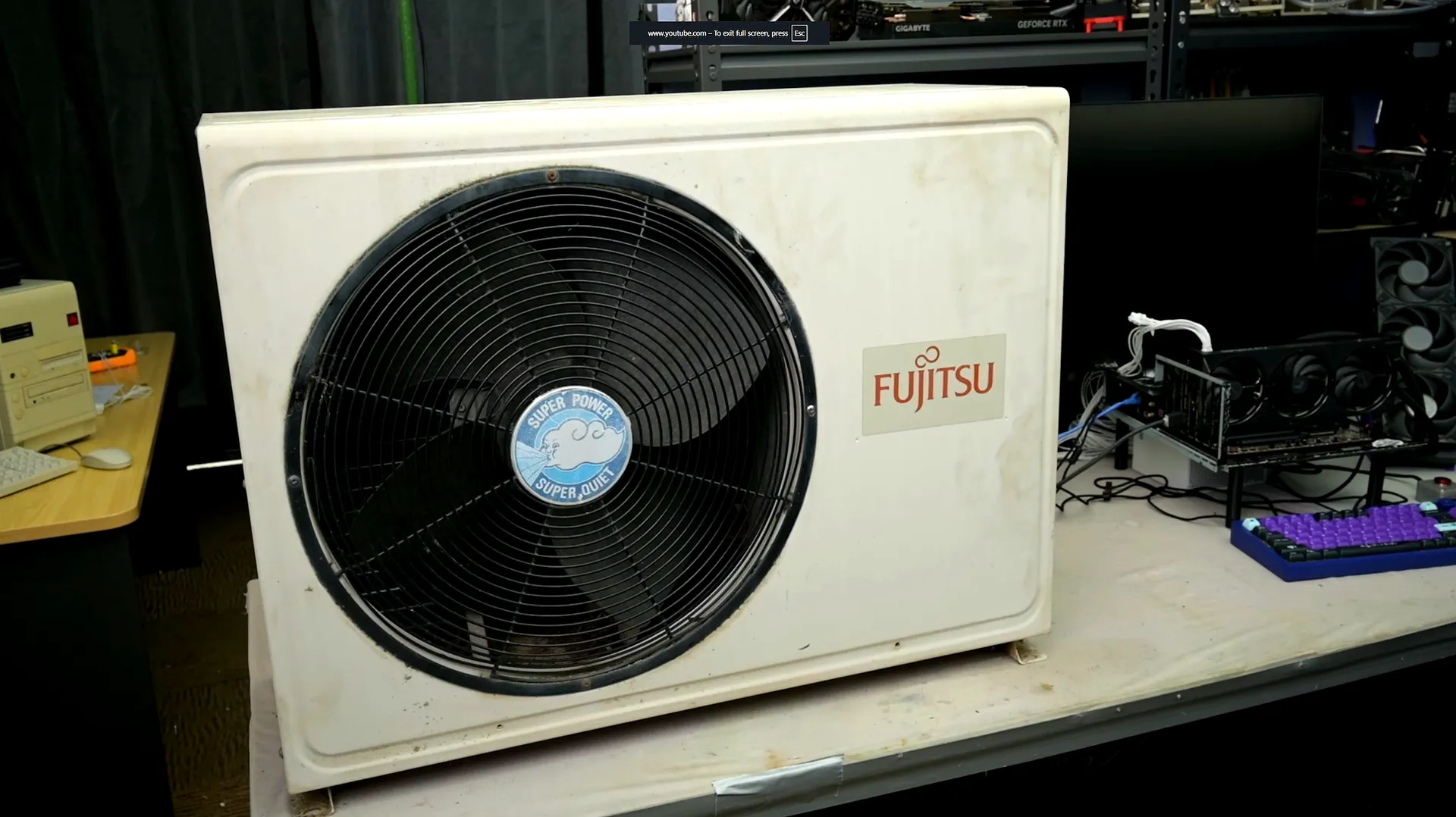
Recently, TrashBench decided to put his theories to the ultimate thermal test by hooking up an old 4-kW outdoor radiator-fan unit—the kind typically found in split air-conditioning setups—to a custom water-cooling loop. The goal was simple: assess the cooling performance under extreme conditions, proving that putting a graphics card in the “wrong” place could yield dramatically superior results.
The setup itself was a masterclass in improvised engineering. TrashBench didn’t just plug things in; he meticulously disassembled the unit, removing the superfluous guts and adding casters for convenience. To manage the complex flow, he designed and 3D-printed custom mounting brackets for the various cold plates, ensuring the components were perfectly positioned for optimal heat dissipation. The process required focus and ingenuity, demonstrating that success in hardware testing often comes down to creative problem-solving, and yes, a bit of elbow grease.
The real magic unfolded when the system was powered up and subjected to heavy loads. Taking a relatively power-efficient RTX 5060, which typically ran at a tame 52ºC with standard cooling, was cooled by the mighty four-kilowatt unit. The thermal difference was stunning: the GPU temperature plummeted to just 33ºC, a remarkable 16ºC reduction. This cooling capacity alone proved that the external radiator could handle far more than the hardware itself was designed for.
When it came time to overclock the 5060, the results were telling. Despite pushing the boost clock from 2902 MHz up to 3300 MHz, the clock speed increased by 14%, but the average frames per second (FPS) only saw a modest 3% uplift. This outcome underscored a crucial point: Nvidia has expertly balanced the power and performance curve since the RTX 2000 series, suggesting that pushing clocks further yields diminishing returns in real-world performance.
The experiment escalated when TrashBench tested a more demanding card, the power-hungry RTX 3080. This beast, which routinely hit 65ºC under standard conditions, was brought under the same cooling regime. The difference was even more dramatic: the 3080 dropped to a mere 28ºC. Although overclocking the 3080 also resulted in only a 3% FPS gain, the cooling prowess of the custom setup was undeniable.
The final challenge involved testing the system’s ability to manage a combined, intense load. TrashBench hooked up the graphics card alongside the scorching hot Intel Core i9 14900K processor. The result was a stark demonstration of thermal mastery: the CPU temperatures dropped significantly, reaching 76ºC, and the heat sensor on the graphics card remained completely static, suggesting the radiator had ample thermal headroom far exceeding the requirements of the hardware.
Ultimately, the experiment confirmed that superior thermal management isn’t just about bigger fans; it’s about intelligent design. TrashBench’s work serves as a powerful reminder that by thinking outside the box and applying creative engineering, even the most powerful computer components can achieve remarkable, cool-running performance.
Buy on Amazon
Credit
