Modders bring DLSS 5 Neural Rendering to AMD GPUs
The AI Arms Race: Bringing DLSS 5 to AMD Hardware
Nvidia has officially rolled out DLSS 5 Neural Rendering, bringing its cutting-edge AI-powered upscaling technology to games running on the RTX 50-series GPUs. While early tests showcased impressive leaps in image quality and rendering fidelity, the sheer computational demand of the technology meant that frame rates often took a significant hit. This resource intensity, however, didn’t halt the creative spirit of the gaming community, who immediately turned their attention to the challenge of bringing this powerful neural rendering capability to AMD Radeon GPUs.
The quest for cross-platform AI rendering led to a vibrant, unofficial project on GitHub. Developers have collaborated to create a solution, dubbed DLSS-NR-on-AMD, designed to run the DLSS 5 Neural Rendering technology on AMD architectures. This effort involves a full, ground-up reimplementation of the neural network runtime specifically tailored for AMD GPU designs.
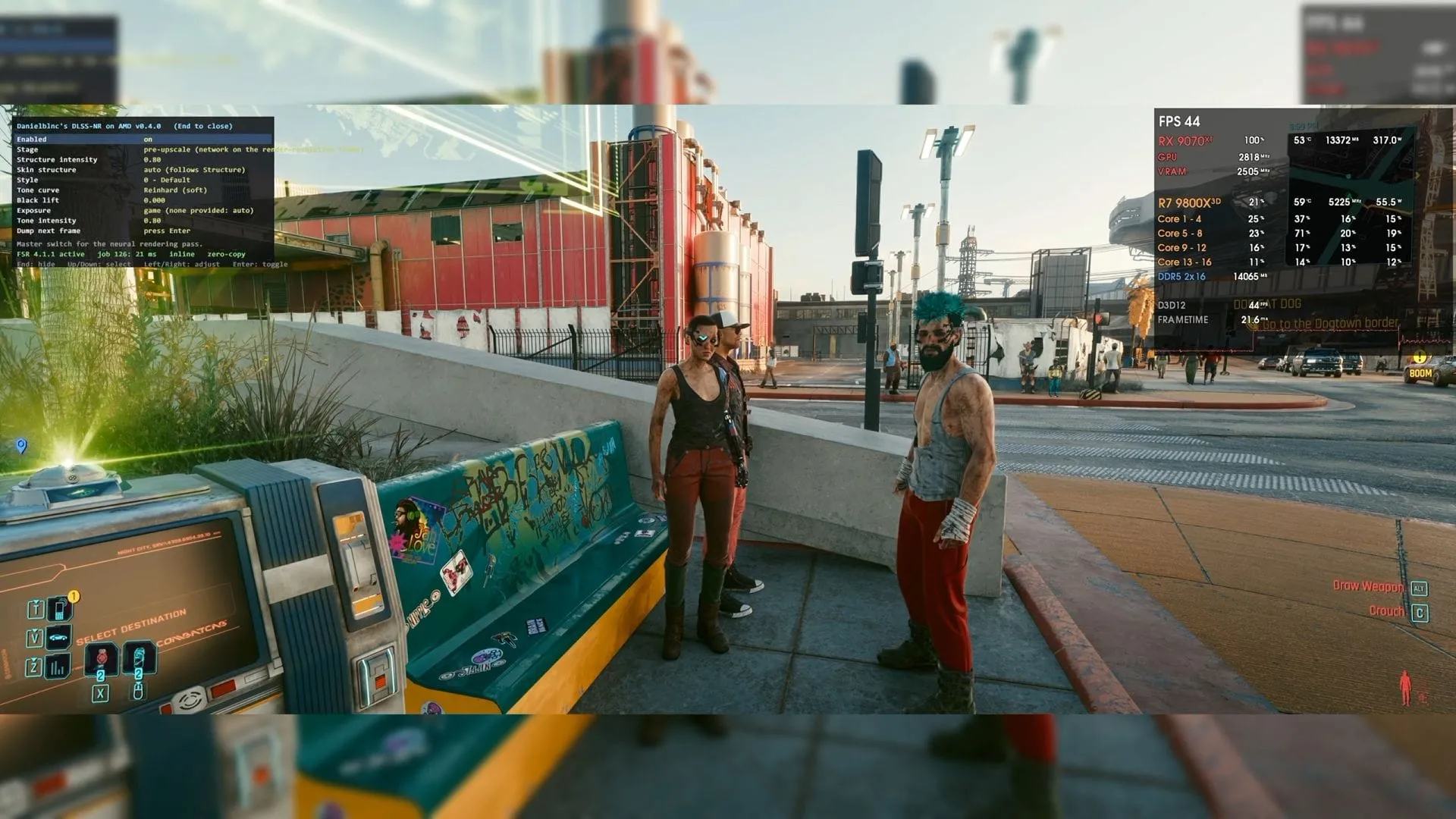
Testing early implementations immediately revealed the complexity of the task. For instance, when testing titles like Cyberpunk 2077 and GTA V Enhanced, results showed that while the feature was present, performance suffered substantially. One testing session with a Radeon RX 9070 XT demonstrated that enabling the unofficial implementation resulted in a noticeable performance drop of around 11-12 FPS, underscoring that optimization was still a distant goal for practical use.
Despite these hurdles, the development pace has been remarkable. The project moved quickly from its initial stages, with incremental updates leading to substantial gains. One iteration saw a claimed 23% performance improvement, followed by another version that reportedly added an additional 42% gain over the previous release—a total of roughly 74% improvement in just twenty-four hours.
To ease the burden on users, the project introduced tools that streamline the process. An automated AMDNR launcher now helps simplify setup, eliminating the need for users to manually manage complex DLL files for each game. This launcher also features an OptiScaler interface, offering additional settings to fine-tune performance.
In a recent test of the latest version, the performance gains were tangible. When running Cyberpunk 2077 at 3440 x 1440 resolution, the Radeon GPU managed to achieve around 50 FPS. While this result was a solid step forward from earlier alpha builds, it still fell short of the performance achievable without using any neural rendering technology.
The journey to making DLSS 5 a truly practical alternative on AMD hardware is still ongoing. The project remains in alpha, meaning performance and compatibility continue to vary depending on the specific game and GPU configuration. Nevertheless, the momentum is building, and the developer is actively working on major future updates aimed at delivering even more substantial performance boosts for Radeon users.
Buy on Amazon
Credit