PC runs Hannah Montana Linux on 192 AA batteries
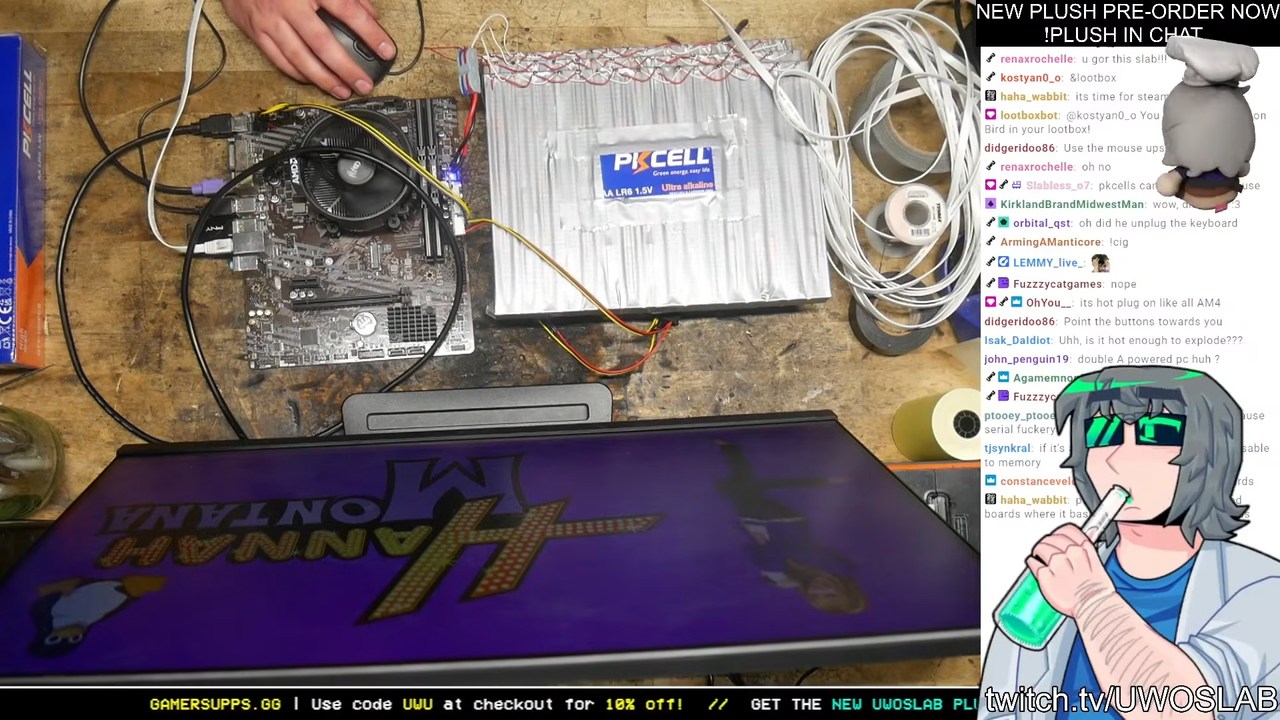
When it comes to fueling powerful desktop systems, the usual route involves cumbersome wall outlets and expensive inverters. But what if we told you that some of the greatest engineering breakthroughs happen not in corporate labs, but in a garage, powered by everyday components? Enter Uwoslab, a creator who recently redefined what’s possible by building an interconnected power bank capable of running a modern PC using nothing more than AA batteries.
This wasn’t just about assembling some spare parts; it was a masterclass in practical physics and resourceful design. Starting with four packs of 100 cells, the challenge was to harness the energy of 192 batteries to power an AM4 desktop system without compromising performance. The solution demanded ingenuity, transforming simple components into a highly functional power grid.
The foundation of the rig was built from practicality and structure. The creator utilized laser-cut wood to create rigid boxes that served as anchor points for the battery cells. These wooden frames not only provided structural stability but also facilitated the complex wiring needed to connect the batteries efficiently.
To ensure stability, Uwoslab made a smart switch in his component selection. While some attempted previous experiments with zinc-carbon batteries—which quickly failed to sustain even a few seconds of operation—he opted for Alkaline batteries. These cells, operating at a higher voltage of 1.5V, offered the stability and energy density necessary for running sensitive electronics.
The trick lay in the wiring strategy. Since modern PCs operate on 12V, combining eight 1.5V cells in parallel yielded the precise 12V needed for stable operation. Instead of relying on traditional bulky power supplies, the creator ran his battery grid directly into a 12V DC-to-ATX adapter board plugged straight into the motherboard, bypassing inefficient conversion layers.
The resulting machine was surprisingly capable. It powered an Hanna Montana Linux system—a modern, revamped version of the popular operating system—booting seamlessly from a flash drive. The ultimate test came when the setup ran the desktop for thirty minutes without failure. Furthermore, it successfully navigated the built-in CPU stress tests, pegging usage at 98% while maintaining a stable voltage reading.
This experiment wasn’t just an impressive feat of DIY hardware; it proved that with smart design and a willingness to explore unconventional power sources, even cutting-edge technology can be achieved outside the traditional confines. It turns common household batteries into a testament to creative engineering, showing that limitations are often just invitations to innovate.
Credit