Raijintek 850W Platinum PSU Tested ATX 3.1 Power
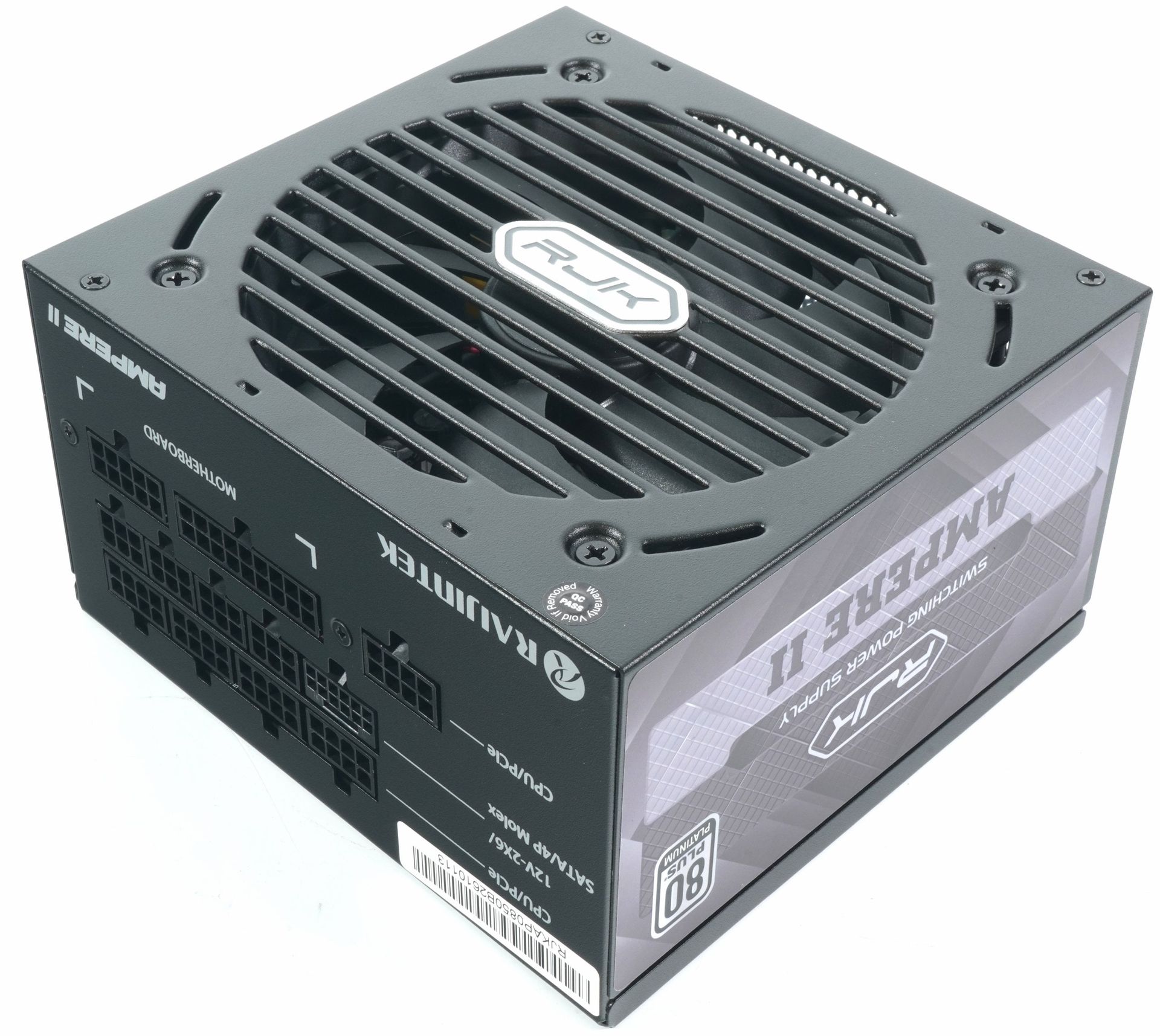
This document provides a detailed technical assessment and market analysis of the Raijintek Ampere II 850W power supply, focusing on its electrical performance, efficiency, transient response, acoustics, and competitive positioning.
Here is a synthesized summary of the key findings:
—
1. Electrical Performance and Regulation
The power supply demonstrates very tight regulation across its rails, particularly the critical 12-volt rail, establishing a strong foundation for stable system operation.
Load Measurement: The load and crossload measurements do not rise perfectly linearly with load, which is noted as typical for resonant switch-mode power supplies operating under changing modes. Crucially, no load zone showed an uncontrolled increase.
Rail Stability: Measurements indicate excellent regulation:
The 12V rail shows very tight values (0.32% to 0.34%).
Ripple is consistently well-controlled.
Transient Response: The power supply passed the 200 percent load step test. While the 12-volt rail dropped to 11.47 volts, this result is compliant but leaves less reserve than in some premium platforms. However, the hold-up time of 26.2 milliseconds is excellent, ensuring safe bridging during short interruptions.
Connectors: The unit includes native 600-watt 12V-2×6 connectors and provides two EPS leads and three separate PCIe cables, simplifying wiring for high-power systems.
2. Efficiency and Power Draw
The efficiency is competitive, especially when considering the power delivered under typical load conditions.
Overall Efficiency: The platform achieves the Cybenetics Platinum class at both 115V and 230V input voltages.
5VSB Rail Efficiency: Efficiency varies based on load and voltage. It reaches its peak efficiency of 80.502% at 115V and 0.55A. At full rated load (3.0A), efficiency is 75.920% at 115V.
Low Load Efficiency: Efficiency remains high even under light load, showing strong performance across the operating range.
3. Acoustics and Thermal Management
The acoustic performance is highlighted as a significant strength of the unit, particularly for a power supply in this segment.
Noise Classification: The unit achieves the Lambda A++ classification.
Noise Output: The noise level is remarkably low: it operates very quietly up to roughly 500 watts (around 20 dBA) and remains restrained even at just under 600 watts, reaching approximately 39 dBA at full load.
4. Fan and Physical Design
The fan system is functional but lacks detailed specification documentation.
Fan Details: The installed BOK BDM12025S operates at 1800 rpm with a low electrical draw of 0.15 ampere. However, the bearing technology, airflow, and static pressure remain unspecified, limiting long-term assessment regarding fan longevity or performance characteristics.
Form Factor: The power supply features a compact 140 mm ATX enclosure.
5. Market Positioning and Conclusion
The Raijintek Ampere II 850W is positioned as a technically sound, efficient alternative to premium competitors by prioritizing core electrical performance over extensive feature sets.
Competitive Standing: The unit competes strongly in the Platinum class. While it lacks the elaborate visual elements, digital monitoring, and detailed fan documentation found in some premium models (like ASUS or Corsair), it delivers convincing results in efficiency, ripple control, and noise output.
Target Audience: It is particularly well-suited for high-performance gaming and workstation systems drawing between 250 and 600 watts.
Final Verdict: The power supply is a technically balanced Platinum unit with notably good acoustic tuning at a fair price point. It excels in essential electrical disciplines and provides an excellent foundation for demanding systems, despite lacking some premium ancillary features.
Buy on Amazon
Credit