RTX Spark powers the new Surface Laptop Ultra launch
The AI Frontier: How Microsoft and Nvidia Are Redefining the Personal Computer
The future of computing just got a serious upgrade. At a recent event in San Francisco, the titans of technology, Microsoft and Nvidia, joined forces to unveil a new era of personal computing centered around cutting-edge AI and revolutionary hardware. The focus was the RTX Spark system-on-a-chip, paired with new Surface devices, setting the stage for a truly intelligent personal ecosystem.
This collaboration wasn’t just about new chips; it was about reinventing the personal computer itself. Microsoft CEO Satya Nadella, Nvidia CEO Jensen Huang, and Windows and Devices head Pavan Davuluri took the stage to share a vision that positions the new hardware at the heart of the next generation of AI agents and productivity tools.
“We’ve reinvented the personal computer completely,” Huang stated, hinting at a paradigm shift already underway.
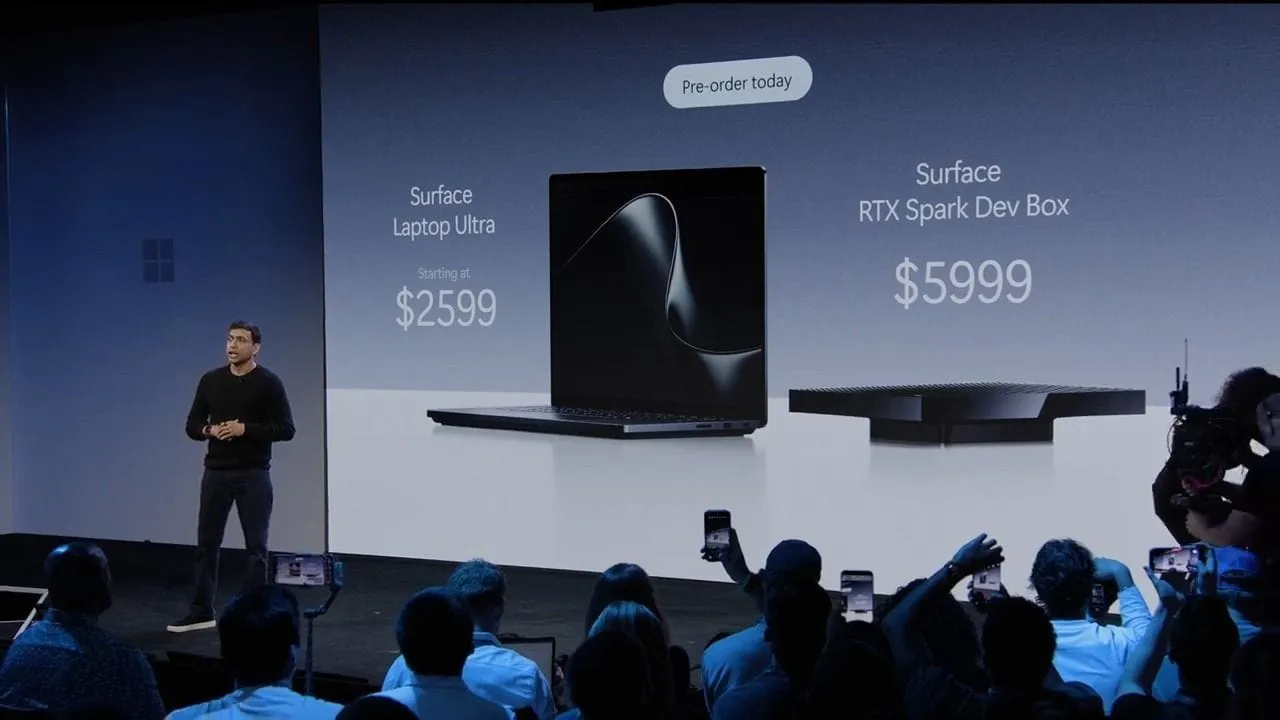
The new hardware lineup is available for pre-order today, with devices set to ship on October 16. Among the highlights are the Surface Laptop Ultra, starting at $2,599, and the Surface RTX Spark Dev Box, priced at $5,999. These devices, alongside PCs from major brands like Asus, Dell, Lenovo, HP, and MSI, promise performance and innovation for everyone.
The Surface Laptop Ultra is designed to be powerful and flexible, featuring the brightest peak HDR on a laptop and introducing the innovative “magnetic connect” charging system—a smooth, standardized alternative to older ports.
But the real magic lies in the integration of AI. Davuluri showcased how Windows 11 is evolving into the most secure platform for AI agents, focusing heavily on containment and security. This foundational security is critical for unleashing the power of advanced AI.
Windows 11 is getting smarter through new quick actions in the Search menu, allowing users to manage settings and arrange windows using natural language commands. Copilot is deeply integrated into the Taskbar, ready to launch based on your needs, bridging the gap between search and action effortlessly.
Beyond the surface features, the system is built to handle complex, multi-modal tasks with stunning speed. Demonstrations showed the Spark chip’s ability to process information and generate media with incredible efficiency. For example, the Spark demonstrated performance leaps—up to 2.1 times faster token generation and significantly faster image and video generation compared to previous architectures.
The system is also designed to leverage the power of local models. Microsoft is exploring hybrid intelligence, balancing local processing with cloud power through systems like HydraFusion. This allows agents to operate efficiently, reducing token budgets while maintaining high performance. Local models like Hermes, OpenClaw, and Perplexity are being integrated, making powerful AI accessible directly on the device.
Furthermore, Microsoft is building a robust framework for trust and accountability. Features like Microsoft Execution Containers act as secure sandboxes, ensuring that AI agents operate with necessary oversight. Agents will also be required to attribute their actions, giving enterprises the control needed to set agentic rules across their entire device fleet.
This approach is making AI accessible and controllable, whether it’s streamlining complex coding with Copilot, cleaning up code with an “Efficiency mode” that automatically selects optimal models, or using advanced quantization techniques to run powerful models locally on consumer hardware. The Spark ecosystem isn’t just about faster chips; it’s about creating a safe, powerful, and deeply intelligent computing experience for the future.
Buy on Amazon
Credit
