Sandisk SSD Endurance Test 1.92TB NAS Drive
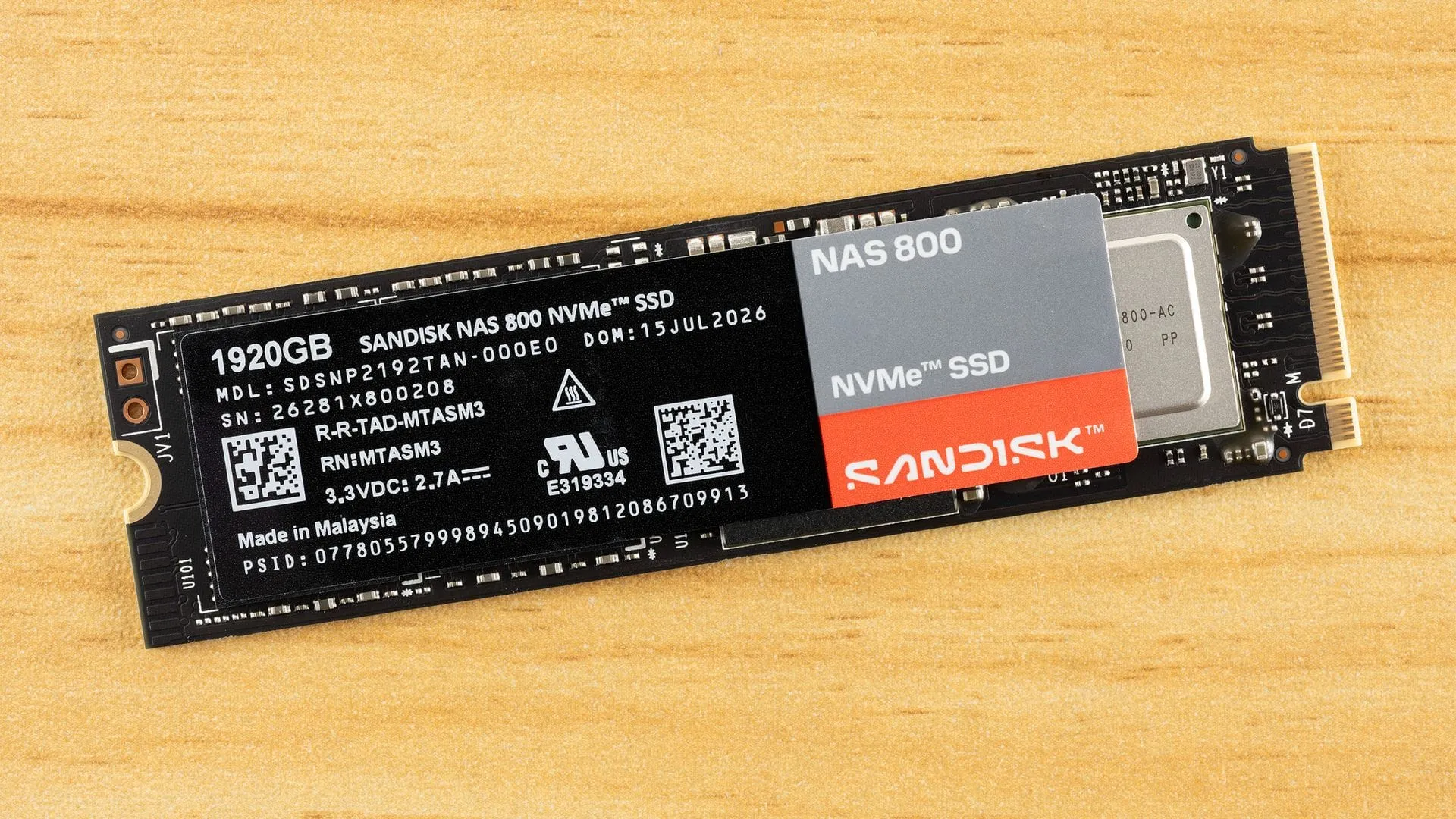
This article provides a deep dive and testing of an SSD (implied to be the Sandisk NAS 800) focusing on its performance, caching architecture, and suitability for various workloads, particularly in a NAS context.
Here is a summary of the key findings:
1. Performance and Workload Suitability
Gaming Context: The reviewer notes that the drive is overkill for PS5 gaming but leaves unused bandwidth potential. It is not optimized for the dynamic nature of PC gaming workloads.
Read Performance: The drive performs well in reading tasks, showing top-tier 4KB QD1 latencies, which is a significant strength.
Write and Copying Performance: Write performance and file copying (as tested with DiskBench) are constrained by the drive’s cache design. The drive lags in copying compared to other drives, as the cache limits how much data can be absorbed before hitting the native TLC flash.
Synthetic Benchmarks (ATTO/CDM): The drive performs well across general synthetic testing, particularly in random read/write latency.
2. Cache Architecture and Endurance
Static Cache: The drive utilizes a small 12GB pSLC cache. This cache is described as static, meaning it remains available and in a high-endurance region, which is beneficial for longevity.
Sustained Write Performance: When tested under sustained sequential writes, the performance drops significantly once the cache is saturated, demonstrating that the performance is dictated by the underlying TLC flash when the cache is bypassed.
Endurance (TBW): A major strength highlighted is the drive’s exceptionally high Total Terabytes Written (TBW), making it excellent for long-term, heavy NAS workloads.
Cache Benefit: The static cache helps manage write amplification by combining data efficiently, supporting overall drive endurance.
3. Power, Efficiency, and Thermal Performance
Power Efficiency: The drive is not exceptionally power-efficient compared to other Gen 5 drives, which the reviewer expects given its TLC nature and the cache setup.
Temperature: The drive performed well under testing, hitting a peak temperature below 70°C, indicating acceptable thermal management.
4. Overall Verdict
The Sandisk NAS 800 is not a drive for everyone.
Best For: It is the best retail option for NAS workloads, excelling where high endurance (TBW) and consistent, high-latency-sensitive reads matter most.
Trade-offs: It sacrifices peak raw sequential write performance and overall power efficiency compared to some competitors.
Conclusion: If you prioritize endurance, high latency sensitivity, and NAS functionality over raw, dynamic PC gaming speed, the NAS 800 is a solid, high-security choice. For extreme, dynamic workloads, other solutions (like a PNY LX3030 or a drive with a more flexible caching scheme) might be better.
Buy on Amazon
Credit
