Testing Gamemax RGB PRO 750G: Efficient power and RGB
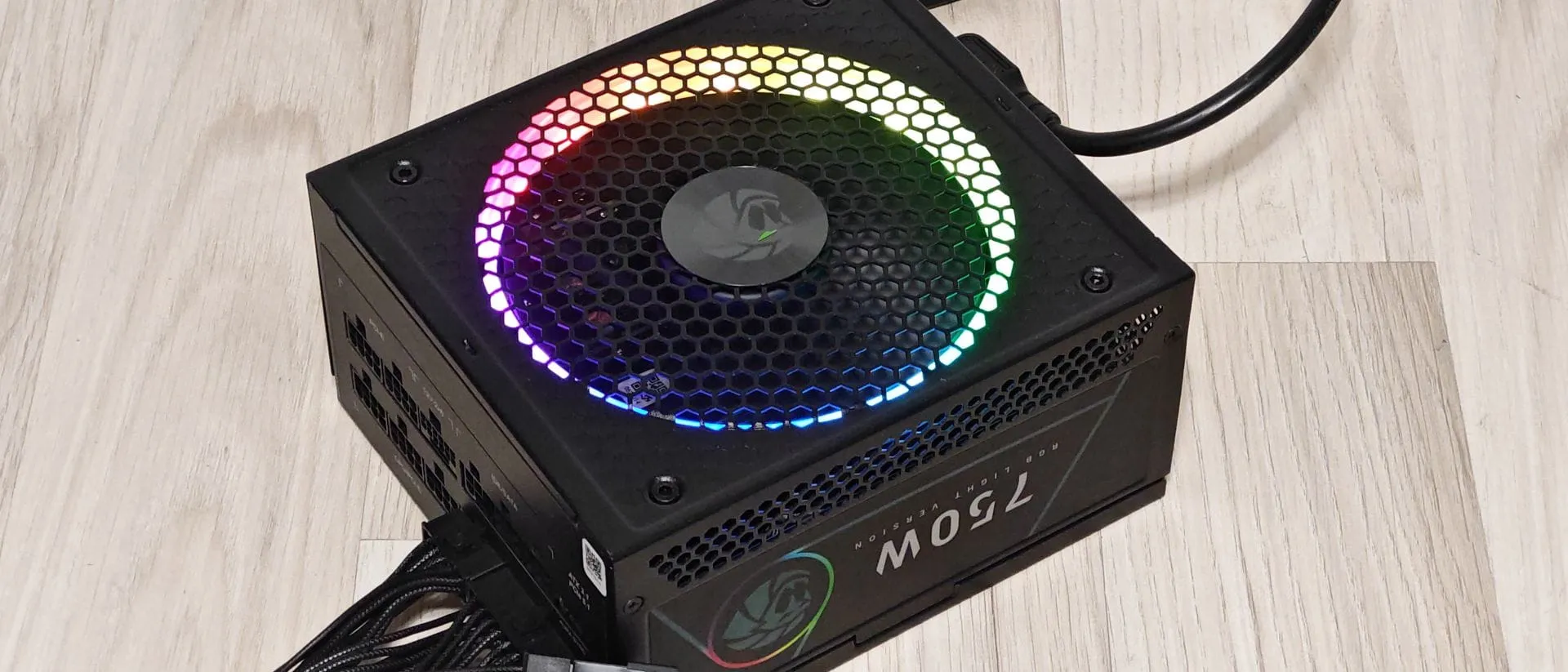
This review provides a detailed, technically grounded assessment of a power supply unit (PSU), focusing on efficiency, thermal management, power quality, and the overall value proposition compared to competitors.
Here is a summary of the key findings:
—
1. Efficiency and 80 PLUS Certification
Efficiency Levels: The review cites efficiency figures of 90.7% and 87.2% (at 230 VAC and 115 VAC, respectively) as “real Gold numbers.”
Gold Thresholds: The unit clears the 80 PLUS Gold thresholds of 87%, 90%, and 87% across tested loads, though only two points do so by a narrow margin.
Certification Status (The Caveat): The reviewer stresses that there is no independent confirmation of this certification, as the model does not appear in major testing databases (CLEAResult, Cybenetics, PPLP). The 80 PLUS Gold logo is treated as a marketing claim rather than a real certification.
2. Thermal Performance
Cooling Profile: Thermally, the unit is rated as excellent. The heatsinks remained well within component ratings under full load.
Temperature Delta: The exhaust air left at $39.7^\circ\text{C}$ against an intake of $25.2^\circ\text{C}$, resulting in a $14.5^\circ\text{C}$ delta.
Acoustics vs. Thermals: While the unit stays cool and reliable, the cooling profile is described as “a little aggressive,” and the thermal performance comes at an acoustic cost.
Fan Behavior: The fan is active immediately. It remains quiet below $300\text{W}$ but becomes noticeably louder, reaching up to $50\text{dB(A)}$ at a sustained $750\text{W}$ load.
3. Power Quality (Voltage Regulation and Ripple)
Voltage Regulation: Regulation is good, but not exceptional. The rails exhibited minor fluctuations across the load range:
$3.3\text{V}$ rail moved by $1.1\%$.
$12\text{V}$ rail moved by $1.4\%$.
$5\text{V}$ rail moved by $1.5\%$.
Ripple Suppression: This was highlighted as the strongest single positive result.
The $12\text{V}$ rail peaked at $48\text{mV}$ (well below the $120\text{mV}$ limit).
The $5\text{V}$ rail peaked at $28\text{mV}$ (well below the $50\text{mV}$ limit).
Load Behavior: A key observation was that the rails stayed “almost perfectly flat” across the load range, which is noted as “rather odd for a PC PSU.”
4. Protection Features
Functionality: All protection mechanisms ($\text{OCP}$, $\text{OVP}$, $\text{OPP}$, $\text{SCP}$) triggered correctly when the unit was hot.
$12\text{V}$ Rail Margin: The Over Current Protection ($\text{OCP}$) on the $12\text{V}$ rail tripped at $108\%$ of the rating ($67\text{A}$ vs. $62\text{A}$ rating), suggesting it has less tolerance for transient behavior than expected from an $\text{ATX } 3.1$ rated supply.
5. Bottom Line and Value Proposition
The review concludes that the $105 price point for the RGB PRO 750G is primarily justified by aesthetics and thermal competence, rather than superior certification or overall value against competitors.
Strengths:
Competent engineering on the Sohoo platform.
Excellent ripple suppression.
Good internal temperatures.
Long warranty (10 years).
Compromises:
Acoustics: The unit is among the louder $750\text{W}$ supplies at high load.
Components: Uses middle-budget secondary capacitors ($\text{Teapo}$).
Certification: Lacks independent, verifiable certification.
Competitive Positioning: Against established competitors like the MSI MAG A750GL or Corsair RM750e, the RGB PRO 750G lags in public certification and acoustics, though it matches or exceeds them in warranty length and ripple performance. The decision hinges on whether the buyer values the RGB aesthetic above all else.
Buy on Amazon
Credit
