Whiskered drones navigate dark dusty smoky spaces
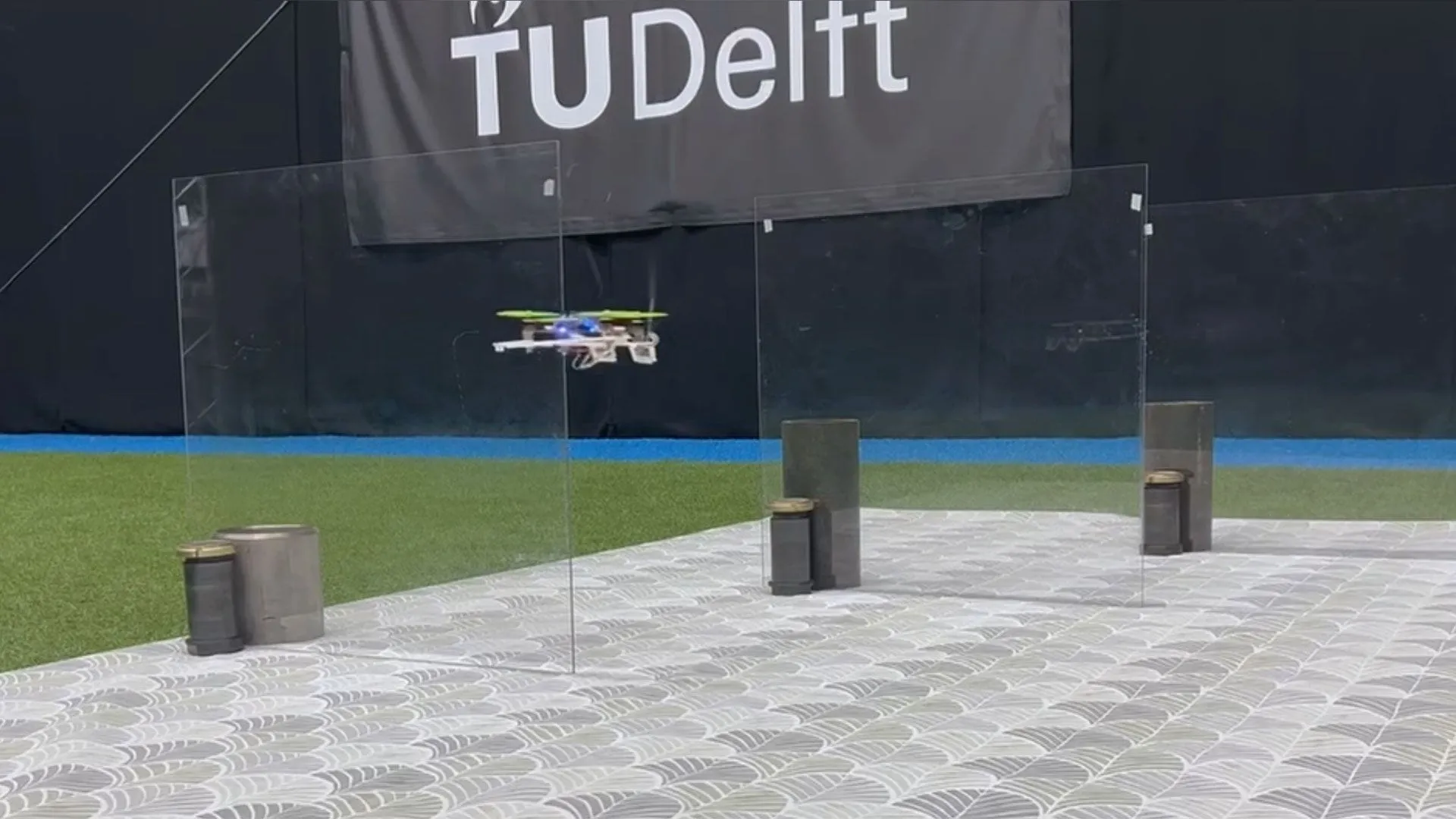
The future of drone navigation isn’t just about powerful processors and LiDAR; it’s about the subtle art of feeling. A team of researchers at Delft University of Technology, The Netherlands, has developed a groundbreaking solution that lets tiny autonomous robots navigate the world purely by touch, inspired by the natural world.
This innovation tackles a persistent challenge for micro-drones: the difficulty of gathering accurate tactile information in complex, real-world environments. Traditional sensors like cameras and rangefinders often falter in dark settings, dusty conditions, or smoke-filled areas. The new system offers a way around this limitation by mimicking a biological navigational tool.
The solution draws inspiration from small mammals, such as rodents, which use vibrissae, or whiskers, to sense their surroundings in tight, low-visibility spaces. The Delft team emulated this capability by attaching whisker-like sensors to the front of the drone. Each whisker is equipped with multiple miniature pressure sensors at its base.
When a whisker makes contact with a surface, the resulting changes in the pressure sensors allow the drone to estimate its relative depth and location. This sensory feedback enables the robot to perceive the surrounding surfaces, detect obstacles, follow trajectories, and effectively map unknown areas simply by feeling.
Achieving this level of sensory input requires incredible efficiency. The key hurdle was making tactile sensing lightweight, low-latency, and low-power enough for a tiny drone, presenting a major engineering challenge. The researchers found their answer in this natural design, which proved to be highly efficient.
To manage the complex data flowing from these sensors in real-time, the team developed a lightweight processing pipeline. This pipeline is remarkable because it can distinguish between surface detection and turbulence while operating with millimetric precision. Most impressively, the entire tactile perception system runs onboard using only 34 kilobytes of memory. This demonstrates that rich tactile perception does not have to come at the expense of computational power or size.
While this system may not be suited for high-speed applications, its potential is vast, especially for specialized missions. It is ideally suited for equipping tiny drones designed for critical search-and-rescue operations. Imagine rescue units deploying these miniature sensors into collapsed structures, allowing them to explore and assess damage safely without risking human or animal life.
This tactile navigation capability positions the technology as a powerful tool for disaster response, complementing other advanced technologies like 3D-printed remote-controlled devices and specialized underwater exploration systems. The research paves the way for tiny robots that can perceive their world with the sensitivity of a mammal, opening up entirely new possibilities for autonomous exploration and rescue.
Buy on Amazon
Credit
