AMD unleashes Instinct MI455X challenging Nvidia in AI hardware
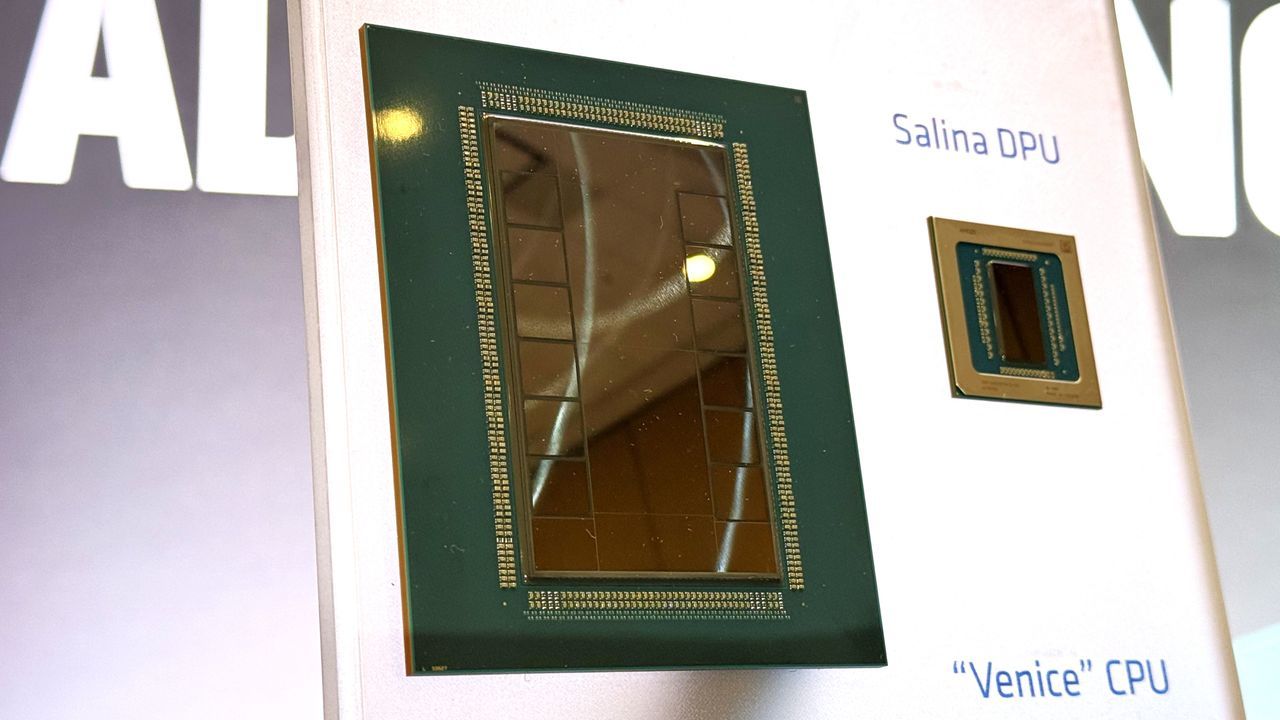
The battle for artificial intelligence supremacy is heating up, and AMD is stepping onto the field with a claim that sends ripples across the industry. At the recent Advancing AI event, AMD unveiled details of its next-generation MI455X GPU and the revolutionary Helios rack-scale architecture—a system designed to challenge Nvidia’s long-held dominance in the AI compute race.
AMD is not just releasing a new chip; they are presenting what they call the most advanced AI accelerator ever built. This new platform represents a significant leap forward, positioning AMD as an undeniable competitor at both the silicon and rack-scale levels against rivals like Nvidia’s Blackwell and Rubin generations.
Under the hood, the MI455X is a marvel of sophisticated design. It leverages a massive chiplet architecture, stacking four Accelerator Complex Dies (XCDs) on top of Fabric and Cache Dies (FCDs) using advanced hybrid bonding techniques. This structure allows AMD to utilize the cutting-edge TSMC 2N gate-all-around (GAA) process on the performance-critical XCDs, while utilizing TSMC N3P for other components, showcasing a masterful blend of process technology tailored for maximum power and performance.
The architectural shift, dubbed CDNA 5, fundamentally rethinks how instructions are processed. AMD has rebranded the fundamental building block of the Accelerator Complex Die from a “Compute Unit” to a “Work Group Processor” (WGP). This change is paired with a decision to reduce the wavefront size from 64 to 32. AMD argues this reduction improves instruction latency and reduces branch divergence penalties, offering greater flexibility for mapping compute kernels to hardware.
This focus on efficiency translates directly into massive theoretical performance gains. CDNA 5 theoretically doubles, and in some cases quadruples, the peak FLOPS achievable from the chip compared to its predecessor. Crucially for modern AI inference, this architecture excels with lower-precision formats like OCP MXFP8 and MXFP4, which are theoretically up to four times faster than their counterparts on previous generations.
Beyond raw computation, AMD has engineered a superior memory hierarchy. The MI455X moves to HBM4 memory, providing an impressive 432GB of high-bandwidth memory across the chip. This implementation offers significantly more capacity and bandwidth than Nvidia’s Rubin GPU, establishing a powerful advantage in data locality—a critical factor for AI workloads where moving data is often the bottleneck.
To support this massive memory pool, AMD dramatically overhauled the cache structure. They replaced the large Infinity Cache with smaller, higher-bandwidth shared L2 caches on each FCD, resulting in three times the aggregate L2 bandwidth compared to previous generations. Furthermore, scratchpad memory (LDS) has been doubled to 96MB across the chip, giving the Work Group Processors more room to operate efficiently.
Data movement efficiency is another area where AMD shines. The new CDNA 5 Tensor Data Mover (TDM) engine allows data to move directly from DRAM into the WGP scratchpad memory without unnecessary staging. This improved capability, combined with added multicast support for memory reads, ensures that AI workloads can access shared weights and activations across multiple processors simultaneously, drastically reducing traffic and power consumption.
When the MI455X is deployed within the Helios rack-scale architecture—AMD’s first coherent domain linking 72 GPUs—its memory advantage becomes exponential. This aggregate HBM capacity across the system surpasses Nvidia’s Vera Rubin by over 50 percent, solidifying AMD’s competitive edge in delivering massive AI data center capacity.
With pivotal deals secured with major players like Microsoft and Anthropic, the focus is now on software optimization. While the peak performance figures are stunning, realizing this potential hinges on optimizing applications to harness the new capabilities of the CDNA 5 architecture. The race for AI superiority just got infinitely more exciting.
Credit
