PC modder bolts heatsink to RTX 4060 for convection cooling
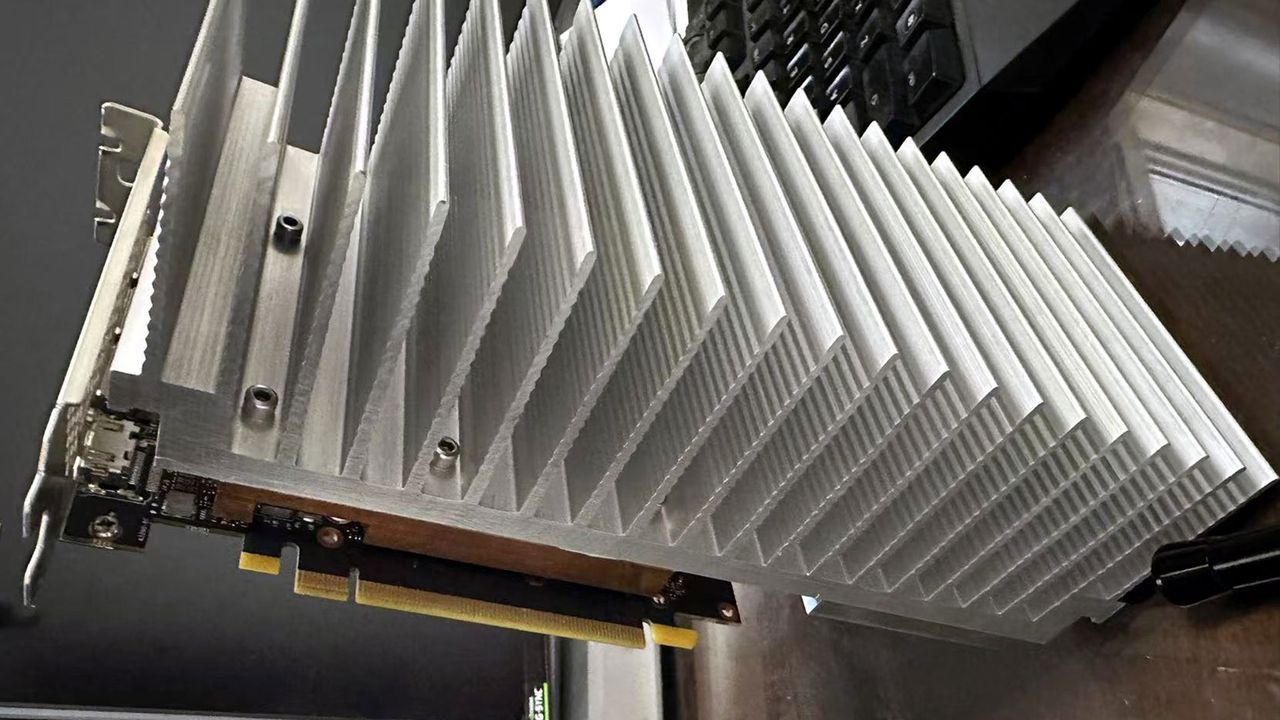
In the world of high-performance PC gaming, noise is often tolerated, but eliminating it has long been a dream for many enthusiasts. The quest for silent computing pushes builders toward innovative solutions, and lately, passive cooling systems are gaining serious traction as a way to achieve blissfully peaceful processing.
This pursuit of quiet efficiency recently led a Bilibili user known as NexFrame to undertake an ambitious DIY project: harnessing the power of passive heat dissipation for a high-end graphics card. NexFrame decided to test whether a custom aluminum heatsink could manage the thermal load of an Nvidia GeForce RTX 4060 without relying on traditional fans.
The experiment involved bolting this hulking, finned aluminum heatsink onto the RTX 4060. While the results offer a glimpse into the potential of passive cooling, they also raise fascinating questions about how real-world thermal management stacks up against theoretical expectations. The resulting system monitor data revealed that the GPU was operating at a temperature of 58C, with a hotspot reaching 71C. Crucially, the graphics fan remained at 0 RPM, confirming the entirely passive nature of the cooling method.
However, diving deeper into the metrics reveals complexity. The system reported pulling 198W under load. This figure seemed considerably higher than the expected power consumption for a standard actively cooled RTX 4060, which typically operates in the range of 115W to 120W. This discrepancy suggests that while the passive setup successfully eliminated noise, some data points warrant closer scrutiny regarding performance measurement.
The thermal challenge extended beyond the graphics card. NexFrame’s system also featured a passively cooled CPU, pairing a hexacore Intel chip with a Noctua NH-P1 Passive CPU cooler. This commercial passive cooler proved effective, keeping the CPU stable and cool while consumption ranged between 35W and 50W during testing. This demonstrated that eliminating fans for the CPU is achievable, provided the component itself can handle the sustained heat.
The broader interest in these solutions reflects a growing movement among PC enthusiasts seeking cleaner builds. While traditional gaming rigs often feature numerous moving parts—fans in the CPU cooler, GPU shroud, power supply, and case—passive cooling aims to eliminate the noise footprint entirely. The goal is a computing experience that is not just powerful, but profoundly tranquil.
Ultimately, this DIY venture showcases an ongoing technological evolution where engineers and hobbyists are continually pushing the boundaries of passive thermal management, seeking a future where high-performance computing can exist in true silence.
Buy on Amazon
Credit
