60 FPS QR streaming hits 190 KB/s using only the camera
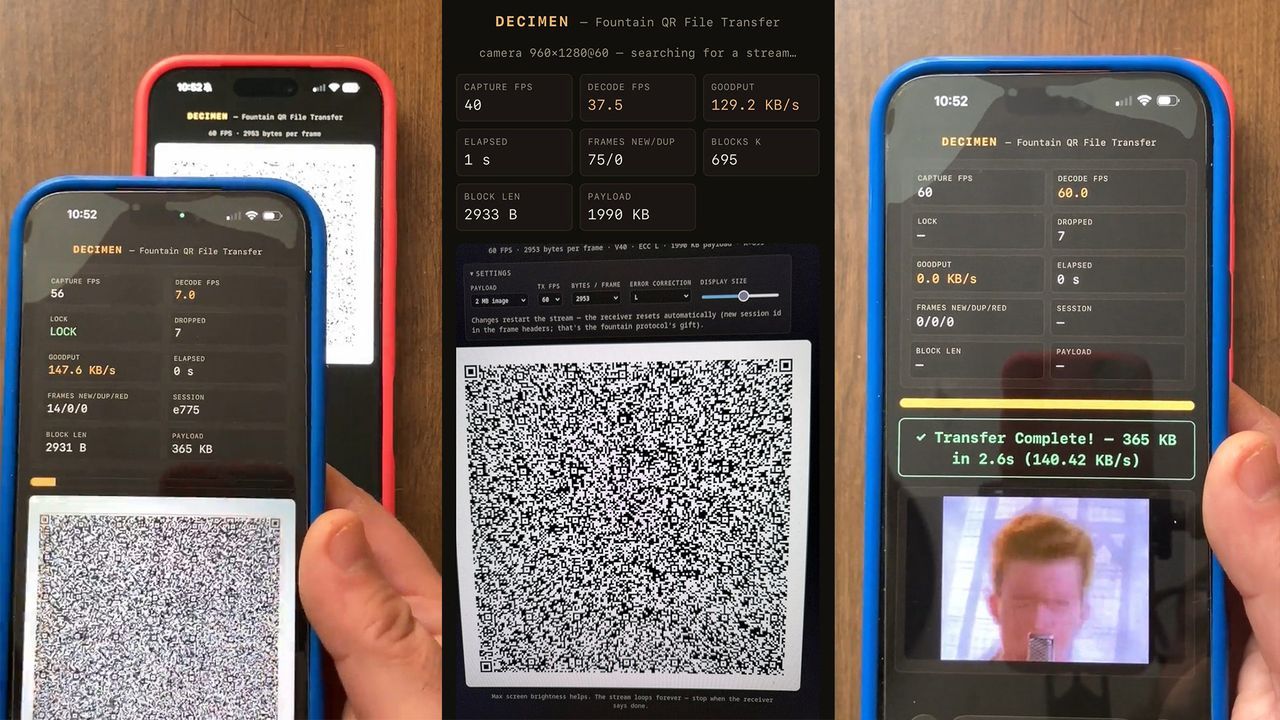
Imagine a world where transferring files between devices is seamless, immediate, and requires absolutely no complicated setup. A developer has recently unveiled a proof-of-concept system that promises this future, achieving highly ambitious goals by sidestepping traditional networking constraints and mandatory permissions.
This ingenious method, dubbed Decimen Optical Transfer: fountain-coded QR file transfer, revolutionizes how information moves between phones. Instead of relying on dedicated apps or complex Bluetooth pairings, the system uses rapidly updating QR codes to stream data directly via the device’s camera, leveraging technology already built into your smartphone.
The real magic lies in its ability to facilitate a phone-to-phone file transfer even when the devices are completely air-gapped—meaning they don’t need to be connected to the same Wi-Fi network. This capability addresses a long-standing frustration for users attempting secure, disconnected data exchange.
The core innovation hinges on using rapidly flashing QR codes as carriers for information. To ensure perfect reliability during this high-speed transfer, the system employs specialized “fountain codes,” which expertly manage missed frames and retransmission quirks, guaranteeing data integrity throughout the process.
How does this work? Every streamed QR code frame is not just a marker; it acts as a self-describing packet. A compact 20-byte header carries all the essential information—including the session ID, sequence number, block count/size, file length, and a cryptographic hash—making the transfer method inherently robust.
The potential speeds are genuinely impressive. Initial tests shared by the developer suggest these transfers can reach up to 190 KB/s. Further performance tuning demonstrated that by positioning both sender and receiver devices perfectly still, data rates could climb even higher, reaching approximately 186 KB/s.
The proof-of-concept was built using readily available tools, including the Claude Code platform, allowing the developer to focus purely on the novel concept. This approach demonstrates that highly sophisticated data transfer solutions don’t require access to complex infrastructure or excessive permissions; they only demand a camera and a bit of clever coding.
This work builds on a foundation of existing QR code technology, drawing parallels to other groundbreaking applications, such as how companies like Cerabyte utilize microscopic codes for incredibly durable storage. It showcases the untapped potential of simple visual data streams to unlock entirely new paradigms for digital communication and file sharing.
Buy on Amazon
Credit