Modder turns ZTE into a gaming PC with CPU coolers
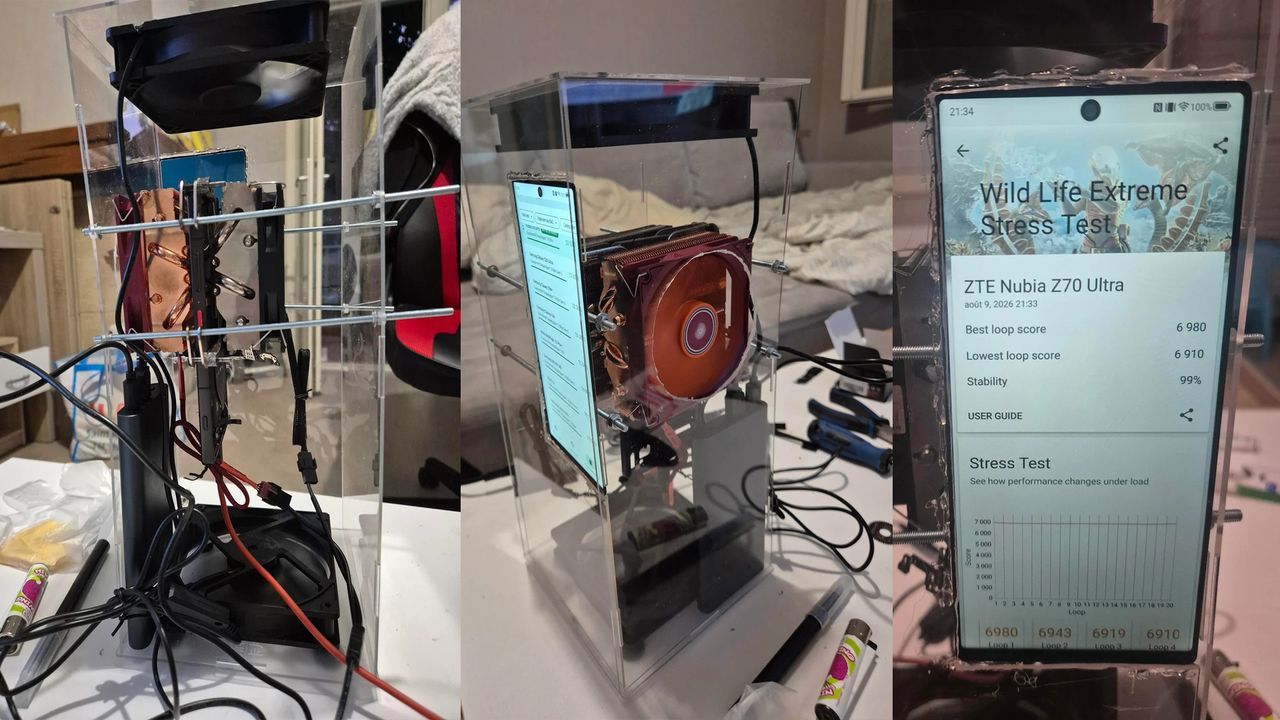
Modern smartphones are marvels of miniaturization, packing astonishing computing power into sleek devices. Yet, despite their raw potential, these mobile chips often hit a performance wall—a limitation known as thermal throttling—preventing them from achieving true peak speed under sustained load. But what if we could unlock that hidden desktop-level potential?
A hardware enthusiast decided to push the boundaries of mobile processing in the most delightfully absurd way possible. Instead of simply optimizing software, they decided to turn a smartphone into a miniature desktop PC. The experiment involved sandwiching a flagship device between two full-sized desktop CPU air coolers, turning a pocket-sized gadget into a thermal powerhouse.
The star of this engineering feat was the ZTE Nubia Z70 Ultra, powered by Qualcomm’s Snapdragon 8 Elite SoC. This particular chipset, which debuted in 2024, boasted prime CPU cores capable of reaching up to 4.32 GHz. While newer chips can clock even higher, the creator chose to explore the limits of this older flagship processor to see how much sustained performance it could truly deliver.
To achieve the necessary heat dissipation, the phone had to be completely stripped down. The camera hardware, mobile network components, and display were carefully removed, allowing space for two massive desktop heatsinks mounted on either side of the core phone components. This setup effectively bypassed the original chassis design, creating a custom system where heat could finally escape freely.
The results were surprisingly impressive. When subjected to rigorous testing in the 3DMark Wild Life Extreme stress test, the modified setup achieved a remarkable 99% stability score over twenty demanding loops. This demonstrated that by addressing the thermal bottleneck, the system could maintain performance far longer than conventional smartphone designs allow.
The sustained performance was arguably more telling than the peak benchmark scores. Most mobile chips are designed for brief bursts of speed; prolonged operation forces them to throttle power simply to survive the heat. By providing massive thermal headroom, this setup proved that a flagship smartphone SoC can deliver stability and endurance previously reserved for dedicated desktop hardware.
The creator’s vision extended beyond mere benchmarks. The ultimate goal was to create a single device capable of running Android at its core while seamlessly bridging into a full desktop environment—Linux, Windows applications, and PC gaming. They accomplished this by installing a custom Linux XFCE4 desktop environment using Termux, enabling hardware-accelerated Vulkan support via Turnip, and experimenting with compatibility layers like Wine and Box64 for running demanding titles.
The testing confirmed the potential: the system successfully ran demanding applications and games like The Witcher 3 at 1080p resolution. While performance still sits in the realm of entertainment—delivering around 20–30 FPS—the fact that a smartphone SoC can manage these complex tasks using compatibility stacks is a powerful testament to mobile chip engineering.
While the physical setup of desktop coolers made the phone form factor completely irrelevant, the impact on thermal management is profound. This project shifts the conversation from simply maximizing clock speeds to understanding how much performance modern mobile chips are leaving on the table. It shows that with clever engineering, the next generation of mobile hardware could redefine the line between smartphone and personal computing.
Buy on Amazon
Credit