30 Years of CPUs: From Pentium II to Ryzen
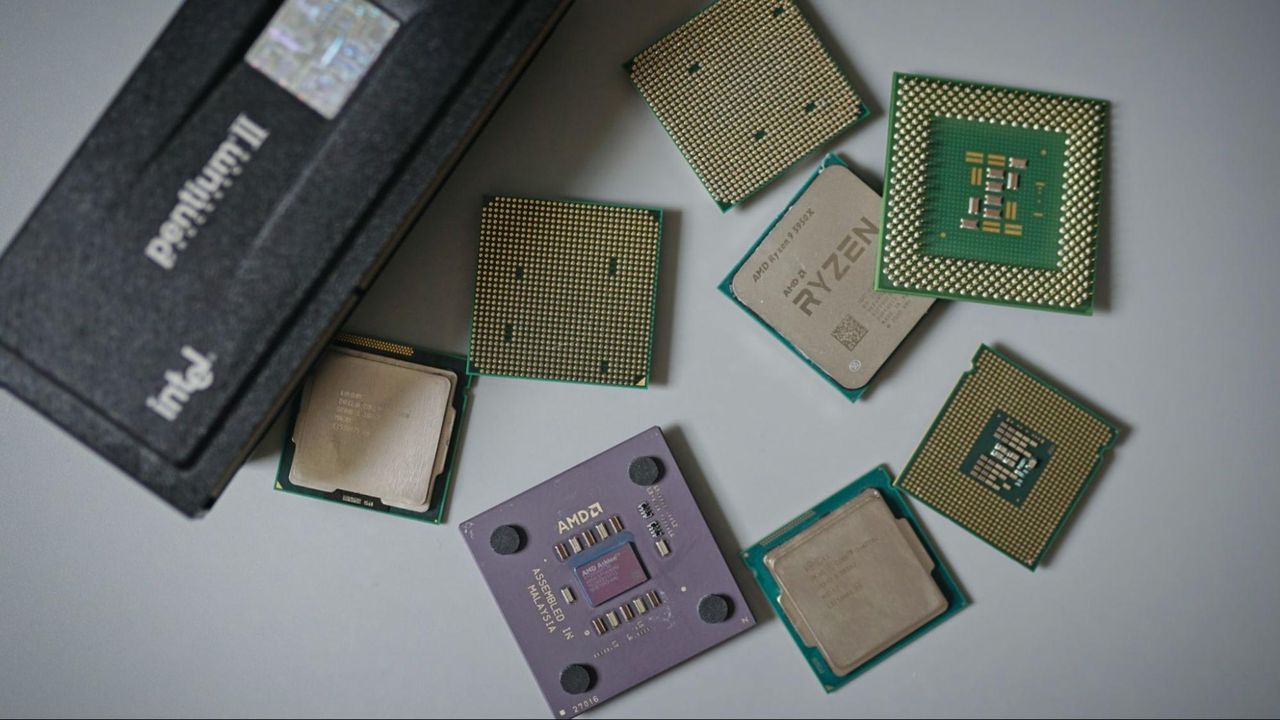
This article provides a detailed narrative of the intense and evolving rivalry between AMD and Intel in the CPU market, tracking their iterative improvements, strategic shifts, and eventual performance battles over several years.
Here is an analysis and summary of the key points:
—
Summary of the CPU Rivalry
The text traces the competitive history of AMD and Intel from the early days of Zen to the current era defined by 3D V-Cache and hybrid architectures. The overarching theme is a continuous race defined by process node advancements, architectural innovation, and market positioning.
1. The Early Race: Zen vs. Coffee Lake
AMD’s Entry (Zen/Zen+): AMD began with the Zen architecture built on the GlobalFoundries 12LP node, followed by Zen+, which focused on iterative improvements in frequency and latency.
Intel’s Response: Intel countered by launching Coffee Lake Refresh, introducing the Core i9-9900K, aiming to reassert dominance at the high end.
2. The Battle for Core Count and Multi-threading
AMD’s Aggression: AMD leveraged newer process nodes (like TSMC’s 7nm) to push core counts. With Zen 2, they introduced the Ryzen 9 3900X (12 cores), challenging Intel’s multi-threaded lead.
The HEDT Challenge: AMD demonstrated value by offering high core counts at competitive prices, pushing against Intel’s expensive High-End Desktop (HEDT) platform.
3. The Mid-Game: Maturing the Platforms (Zen 3 vs. Comet Lake)
Climax of Performance: As the rivalry matured, AMD released Zen 3 and subsequently pushed for further core increases (Ryzen 9 5950X). Intel followed with Comet Lake (Core i9-10900K).
The Eclipse: By late 2020, AMD’s Zen 3 lineup effectively eclipsed Intel’s performance dominance across gaming, multi-threaded, and single-threaded workloads.
4. The Cache Revolution: The Era of 3D V-Cache (2021–Present)
Architectural Split: In the period leading up to 2021, Intel embraced a hybrid architecture with Alder Lake, while AMD focused on Zen 4 and introduced disruptive technology.
The Disruption: AMD introduced the Ryzen 7 5800X3D, the first processor featuring 3D V-Cache. This demonstrated that extreme cache (V-Cache) could drastically improve gaming performance by sacrificing some pure application performance, fundamentally changing the benchmark for gaming CPUs.
The Final Iteration: Both sides adopted this trend. AMD delivered Zen 4 and further refined X3D chips (like the Ryzen 9 9950X3D2), while Intel introduced Raptor Lake and is now focusing on Arrow Lake.
5. The Current Realities
The final section acknowledges that while the generational leaps have been impressive, the market dynamics are shifting due to external factors:
Intel’s Shift: Intel outsourced manufacturing to TSMC and doubled down on its hybrid strategy.
Market Constraints: Challenges like overwhelming DRAM pricing and AI demand mean that future CPU performance gains may be tempered by real-world economic constraints rather than purely architectural superiority.
—
Key Analytical Takeaways
1. The Importance of Process Shrink and Strategy
The entire narrative is framed by the ability to shrink manufacturing nodes (moving below 14nm) faster and more efficiently. Both companies understood that whoever could lead in this area first would gain an insurmountable advantage. This forced a constant, rapid iteration cycle rather than long, stable platform releases.
2. The Shift from Clock Speed to Architecture
Initially, the battle focused on raw clock speeds (GHz). However, as process nodes tightened, performance shifted to multi-threading efficiency and architectural design (how cores communicate and manage data). AMD’s success in heavily-threaded workloads proved that this strategic focus eventually superseded raw clock speed in defining overall system performance.
3. The Game Changer: Cache Technology
The introduction of 3D V-Cache was arguably the most significant inflection point. It demonstrated that for a specific application (gaming), maximizing the amount of extremely fast, local memory (cache) could deliver massive real-world gains, even if it meant trading off some theoretical peak single-threaded or heavy application performance. This created a new performance paradigm in the PC enthusiast space.
4. The Enduring Scrappiness
Despite the clear dominance achieved by AMD in recent years, the text concludes on an optimistic note: both companies are now forced to be “scrappy.” In an era of supply chain volatility and shifting market demands (like AI acceleration), the competitive dynamic suggests a renewed push for innovation rather than settling into established hierarchies.
Buy on Amazon
Credit
