AGI AI828 SSD: The budget last resort review
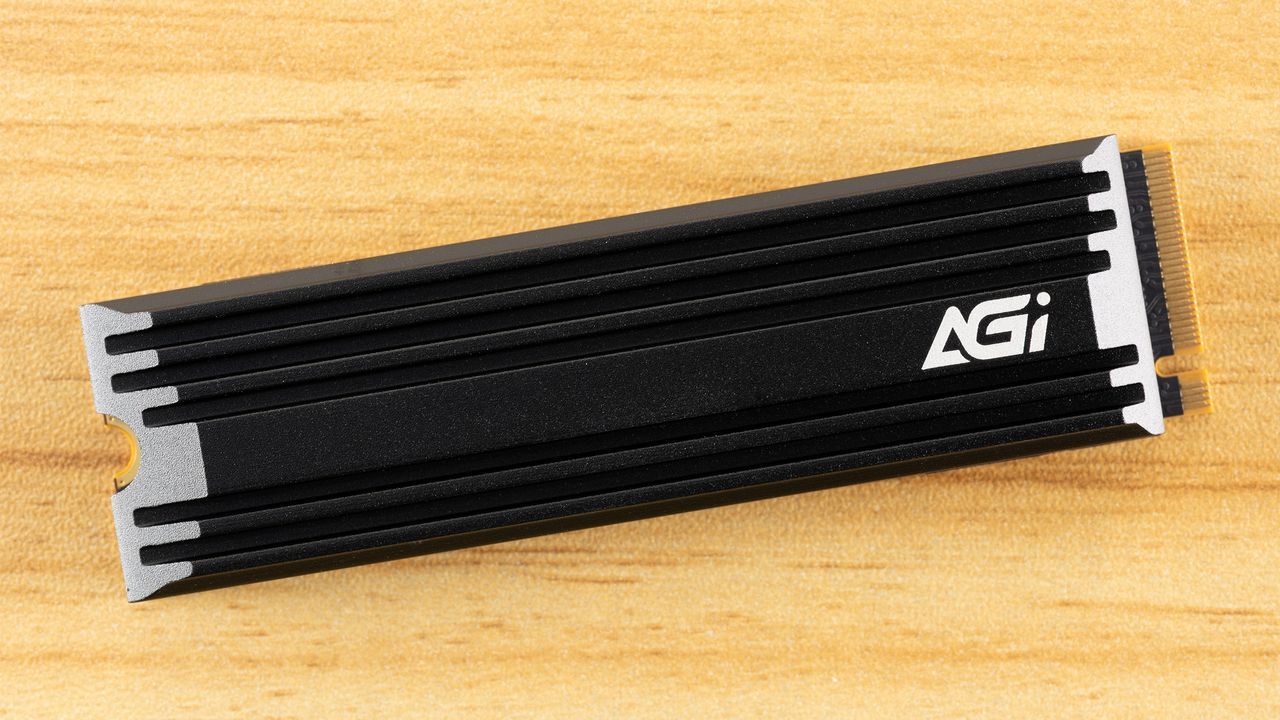
This review provides a detailed performance analysis of an SSD (specifically mentioning the AGI AI828, compared against drives like the Seagate X1070) focusing on capacity, I/O operations, sustained performance, and power efficiency.
Here is a synthesis of the key findings:
—
Performance Summary
1. Read/Write Performance (Sequential vs. Random)
Sequential Performance: The smaller 512GB SKU shows significant performance limitations compared to larger models, especially under realistic workloads like file transfers (Queue Depth 1). While the 1TB drive performs well sequentially, the 512GB model struggles to achieve speeds higher than approximately 4.1 GB/s.
Random Performance (4KB Operations): Latency for random 4KB reads and writes is relatively consistent across both capacities at a Queue Depth of 1, as the system only hits one die at a time. While the 4KB read latency isn’t great, it is still better than many tested PCIe 4.0 SSDs. The reviewer considers latencies around ~45µs to ~50µs to be excellent.
Capacity Impact: Performance issues are more pronounced in smaller drives (512GB), particularly when handling large file or block sizes, suggesting potential internal alignment or flash structure issues.
2. Sustained Write Performance and Caching
The review delves into the SSD’s write cache:
Cache Saturation: SSDs use a fast write cache (pseudo-SLC) to absorb data. Once this cache is saturated by heavy loads, performance drops significantly as the drive must write to the “native” TLC or QLC flash.
Post-Cache Performance: For the 1TB drive, performance after the cache is depleted can be very slow (averaging below 200 MB/s). However, the large cache effectively masks this slowdown in most real-world scenarios.
SKU Variation: The smaller SKUs (like the 512GB) have much smaller caches, which, counterintuitively, might allow for better steady-state write performance due to specialized static pSLC implementations, though they are generally less capable overall.
3. Power Consumption and Thermal Profile
Efficiency: Power efficiency is deemed rough, likely due to the controller limitations, especially when handling hard workloads. It consumes more power than highly efficient drives at idle.
Temperature: The drive managed to keep both tested models at a maximum temperature of 54°C, indicating sufficient thermal headroom and suitability for desktop or PS5 use.
—
Overall Verdict and Context
The review concludes that the AGI AI828 is not a great drive, but it is not entirely dismissible, especially when considering its newer hardware generation.
Pros:
Uses newer hardware technology.
Provides a wide capacity range (512GB to 1TB).
Runs cool and has good thermal management for desktop use.
Cons:
Performance is inconsistent across benchmarks.
It struggles against higher-end PCIe 4.0 competitors when adjusting for capacity.
Smaller SKUs perform significantly worse than expected.
Recommendation:
The drive is best suited if budget is the absolute primary concern, or if the user requires a smaller option (512GB) where older technology might make sense. For users prioritizing speed and efficiency in modern systems, newer options like the WD Black SN850X or Samsung 9100 Pro are recommended.
Buy on Amazon
Credit
