AMD splits Zen 7 into three EPYC families for AI CPUs
AMD Unveils Next Era of AI: Introducing Zen 7 and the Agentic Future
At AMD’s recent Advancing AI 2026 event in San Francisco, the company didn’t just show new silicon; they mapped out a future. They launched the sixth-generation EPYC “Venice” processors, the Instinct MI400 Series GPUs, and ambitious Helios rack-scale systems, setting a new pace for what high-performance computing can achieve in the age of agentic AI.
The overarching theme of the presentation was clear: AMD is not just catching up to the AI revolution; they are defining its hardware foundation. Extending their annual CPU, GPU, networking, and rack cadence out to 2030, AMD placed an audacious total addressable market at roughly $2 trillion by that time. This vision is underpinned by a groundbreaking performance yardstick—a claim of achieving the most AI agents per watt, per dollar, and per rack. While the exact agent counts are estimated from CPU thread resources used as a proxy, this metric signals AMD’s commitment to efficiency in the rapidly evolving AI landscape.
A Tripartite Vision for Zen 7
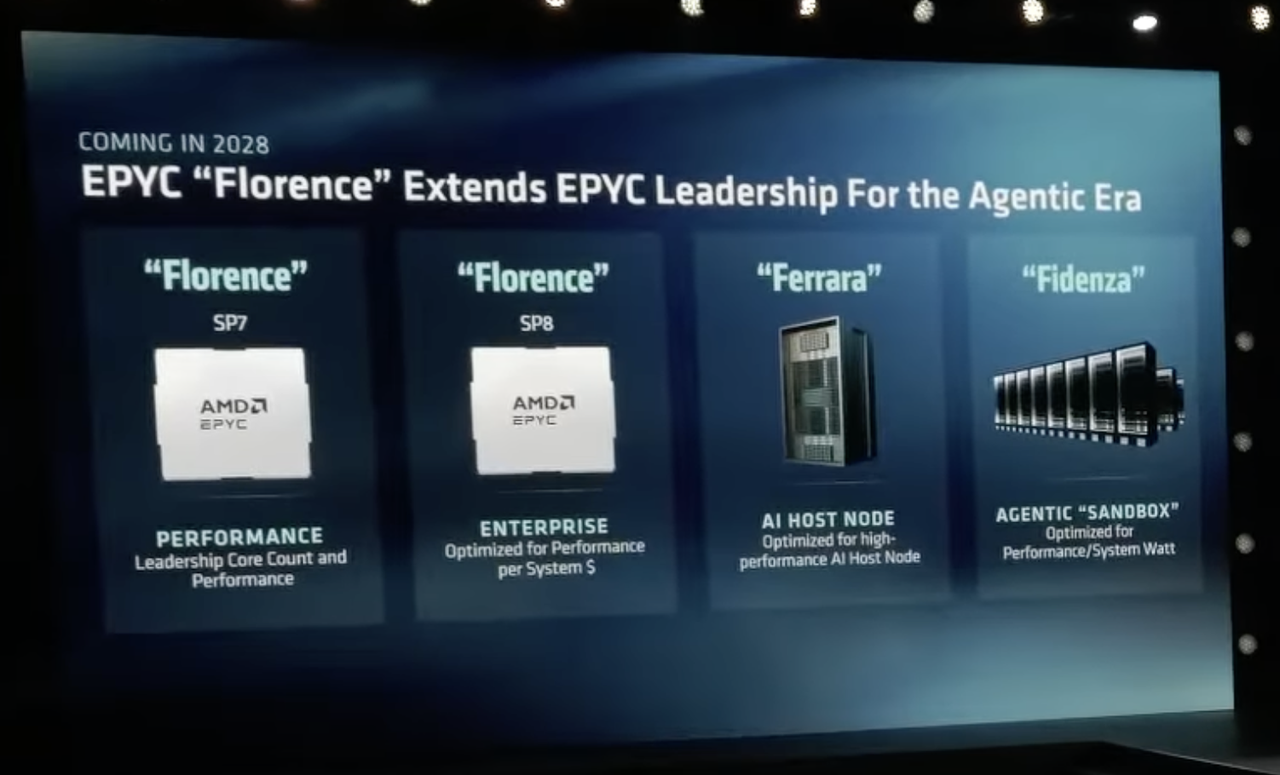
AMD confirmed a fascinating structural shift in their forthcoming architecture: the Zen 7 generation, slated for 2028, will launch not as a single monolithic family, but as three distinct EPYC families. These divisions are Florence, Ferrara, and Fidenza, each tailored to specific computational needs:
Florence carries the fresh Zen 7 cores, enhanced with new AI compute extensions and support for advanced memory technologies.
Ferrara is designated as the AI host node portion, integrating seamlessly within the Helios rack architecture alongside the MI600 Series GPUs and supporting networking solutions like Pensando “Palma” and “Levanzo“.
Fidenza serves as the specialized agentic sandbox product, providing a dedicated environment for complex AI deployments.
Pioneering Performance Metrics
This new architecture reflects AMD’s broader strategy to specialize its portfolio—covering general-purpose enterprise, cloud, telecom, SMB, and HPC systems, alongside distinct categories for sandboxed AI deployments. This move formalizes the path toward tailored computing solutions for emerging AI workloads.
The performance claims extended beyond raw speed. AMD demonstrated that their silicon can deliver significant computational advantages in data centers. For instance, estimates based on DeepSeek V4 Flash showed AMD achieving up to 30% more inference tokens per dollar than Nvidia’s Vera Rubin NVL72. Furthermore, in a direct rack-level comparison, the EPYC 9996 demonstrated an advantage over competitors like Intel Xeon and Nvidia Vera across core count metrics within a 100 kW power envelope.
AMD is pushing the boundaries of efficiency by redefining power consumption. Starting with the sixth-generation EPYC lineup, AMD introduced Default CPU Power, measuring total power consumed across compute and I/O dies against stated performance targets, allowing for comprehensive performance-per-watt analysis alongside traditional TDP figures.
The Road Ahead
The future roadmap is ambitious. The current Helios racks already feature 72 Instinct MI455X GPUs paired with Venice CPUs and massive memory bandwidth. Looking ahead, the plan involves the introduction of the MI500 Series GPUs in 2027 within a Helios 500 rack built on EPYC “Verano” components.
The momentum continues into the next generation: the MI600 Series GPUs are planned for 2028, housed in the Ferrara architecture. The long-term vision culminates with the Zen 8 Ravenna CPUs slated for 2030, solidifying AMD’s position as a central force driving the next wave of agentic and data-intensive computing.
Buy on Amazon
Credit