Build AI Chatbot in Minecraft with 445K command blocks
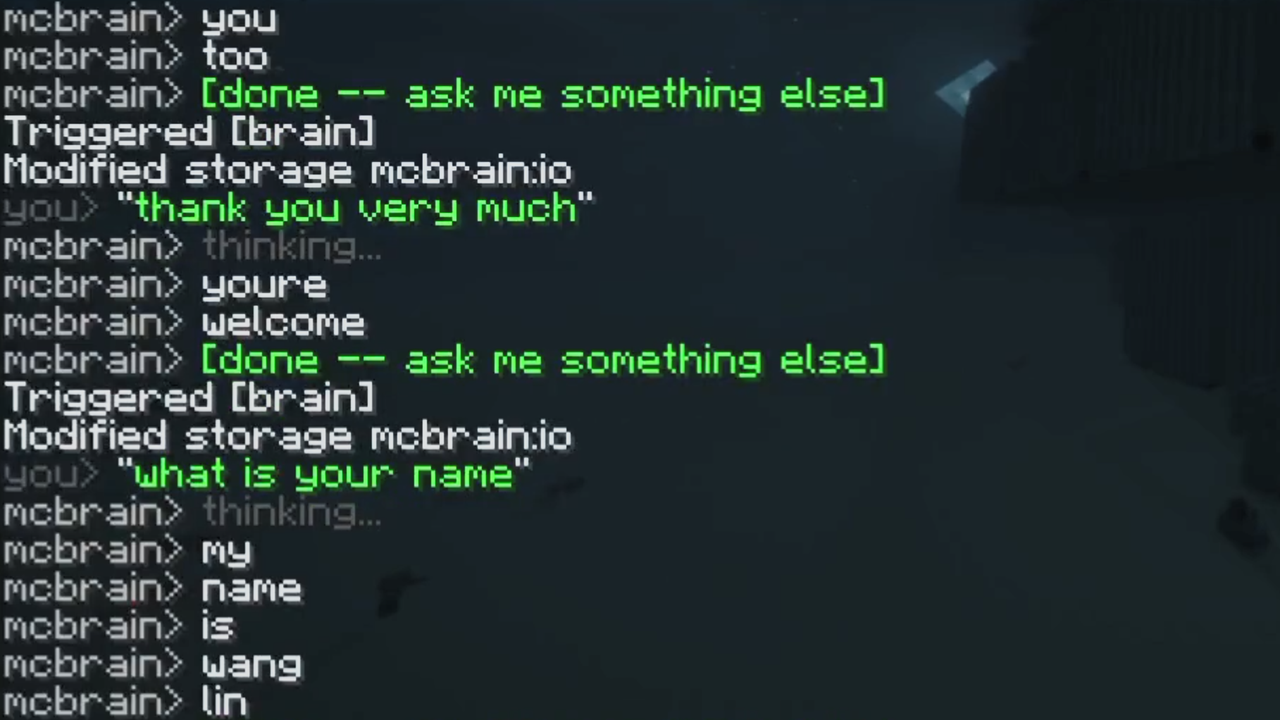
When you think of Minecraft, you probably picture crafting epic swords and conquering creepers. But lurking beneath the blocky surface of this beloved sandbox game is a surprisingly complex realm of computational creativity. Recently, a community builder took that raw, blocky environment and turned it into a laboratory for advanced artificial intelligence, proving that even the most constrained systems can spark extraordinary innovation.
This isn’t the work of a conventional software engineer; it’s the brainchild of a dedicated Minecraft player known as Objz, who managed to implement a Large Language Model (LLM) using nothing more than redstone command blocks. The result is a remarkable achievement: an LLM built entirely from game commands, requiring a staggering 445,782 command blocks, with zero reliance on mods, plugins, or datapacks.
While the project was described by its creator as “a headache,” the technical execution is undeniably impressive. This command-block LLM operates with a compact architecture, featuring a 64-dimensional embedding space, a 256-neuron hidden layer, and a vocabulary of just 2,048 words. Users interact with the model via the game’s native “/dialog” function, receiving the output word by word, much like a standard chatbot conversation.
Despite its impressive setup, the model operates within specific boundaries. It is conversational but lacks the broad knowledge or mathematical prowess of conventional AI, meaning it can’t solve complex equations or possess general knowledge. However, the ingenuity lies not just in the final product, but in how Objz navigated the physical limitations of the game environment to achieve it.
The real magic, however, is in the optimization. Implementing sophisticated mathematical concepts within the rigid constraints of Minecraft required a clever workaround. Since standard LLM weights are complex floating-point numbers, which are difficult to manage in the game, Objz opted for a ternary system, using only the values -1, 0, and +1 to represent the weights. This quantization strategy was crucial for making the model computationally feasible within the game’s limitations.
To further streamline the process, the creator ensured that quantization happened during the training phase, and utilized a straight-through estimator during backpropagation to update the underlying floating-point weights. This optimization significantly improved the model’s coherence, boosting the perplexity rate from 48.7 down to 38.8.
Even with these optimizations, the system still faced performance hurdles. Due to the restrictions on command execution, the LLM had to be split into smaller groups, and generating a single word required about 1.8 seconds on a 35-tick-per-second server. While making the model substantially larger would require immense computational power, the entire endeavor serves as a brilliant testament to the idea that strict constraints don’t stifle creativity—they force the development of uniquely ingenious solutions.
Buy on Amazon
Credit