DLSS 4.5 Ray Reconstruction improves visuals but path fidelity remains unsolved
Nvidia Cracks the Code on Visual Artifacting with AI-Powered Ray Reconstruction
For years, the most stunning ray-traced and path-traced games have been plagued by a frustrating flaw: visual artifacting. While the lighting and shadows might look breathtaking, the motion often introduced a distinct visual weirdness. This artifacting stems from the denoising process—the complex computational step that turns low-fidelity traced light into a cohesive frame. It’s the moment when the digital world struggles to smoothly assemble itself in motion, leaving behind ghostly trails and smeared details.
The core challenge lies in the sheer computational cost. To fully trace every photon and pixel in a scene is prohibitively expensive. To solve this, developers rely on tracking only a small sample of rays bouncing off geometry, which is incredibly demanding on the user’s hardware. This demand for graphical horsepower is often punitive, pushing the limits of even the most powerful GPUs, and leaving visual perfection just out of reach.
Previously, developers relied on manually tuned denoisers to fill in the gaps between these sampled rays. While this worked fine for static images, the issue emerged in motion. As objects moved, these hand-tuned methods struggled, resulting in noticeable trails and a loss of fine detail.
Enter Nvidia’s latest innovation: DLSS 4.5 Ray Reconstruction (RR). This feature replaces those older, manually tuned denoisers with an advanced, AI-based denoiser that works in tandem with Nvidia‘s upscaling models. The goal is simple: use artificial intelligence to generate more accurate pixels between the sampled rays, delivering a dramatically sharper and more stable image in dynamic scenes.
This new generation of Ray Reconstruction is built upon the sharper second-generation Transformer model, providing deeper spatial awareness and a superior understanding of game engine pixel sampling and motion. The results are immediately noticeable. In demanding titles like Cyberpunk 2077, the improvement is striking. For instance, in areas where the viewport shifts, the old methods left behind distracting ghosting, but the new system ensures temporal stability, making the scene look cohesive when you move around.
The enhancements packed into DLSS 4.5 RR are significant. The new model delivers 35% more compute capability while maintaining performance, and it is trained on an expanded dataset, allowing it to reconstruct scenes closer to reality. Furthermore, it offers finer developer control, giving creators better tools to fine-tune temporal accumulation for optimal quality.
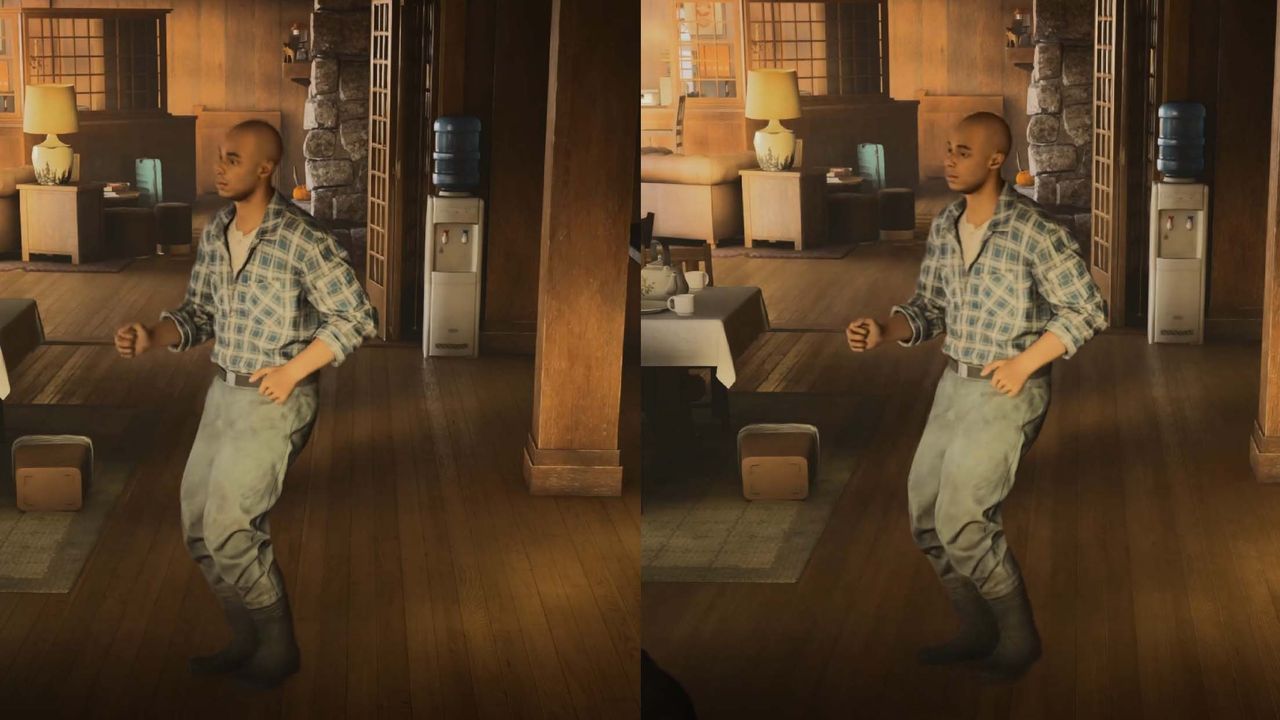
Beyond image stability, the new technology also brings back lost detail. The AI is exceptionally good at adding back details that would otherwise be lost in the denoising process. In examples from games like Alan Wake 2, this means that the artifacting trails around characters are almost entirely gone, while the underlying textures—like the wooden floorboards—are rendered with much greater clarity.
Nvidia has made the rollout straightforward. Users can implement this powerful feature by using the Nvidia App, where they can select the desired model preset—specifically Preset F—within the Ray Reconstruction dropdown menu for supported titles. This upgrade is available for a wide range of games, including titles like Call of Duty: Black Ops 7, Hogwarts Legacy, and Star Wars Outlaws.
While achieving perfect image fidelity across all ray-traced games is still a long-term goal, DLSS 4.5 Ray Reconstruction is a monumental leap. It doesn’t just reduce ‘boiling’ textures and trails; it actively adds back lost detail. It proves that by harnessing the power of AI, we can finally overcome the performance and visual compromises that have plagued high-end ray-traced gaming.
Buy on Amazon
Credit