Fly brain AI: 166k virtual neurons trade crypto charts for dopamine hits
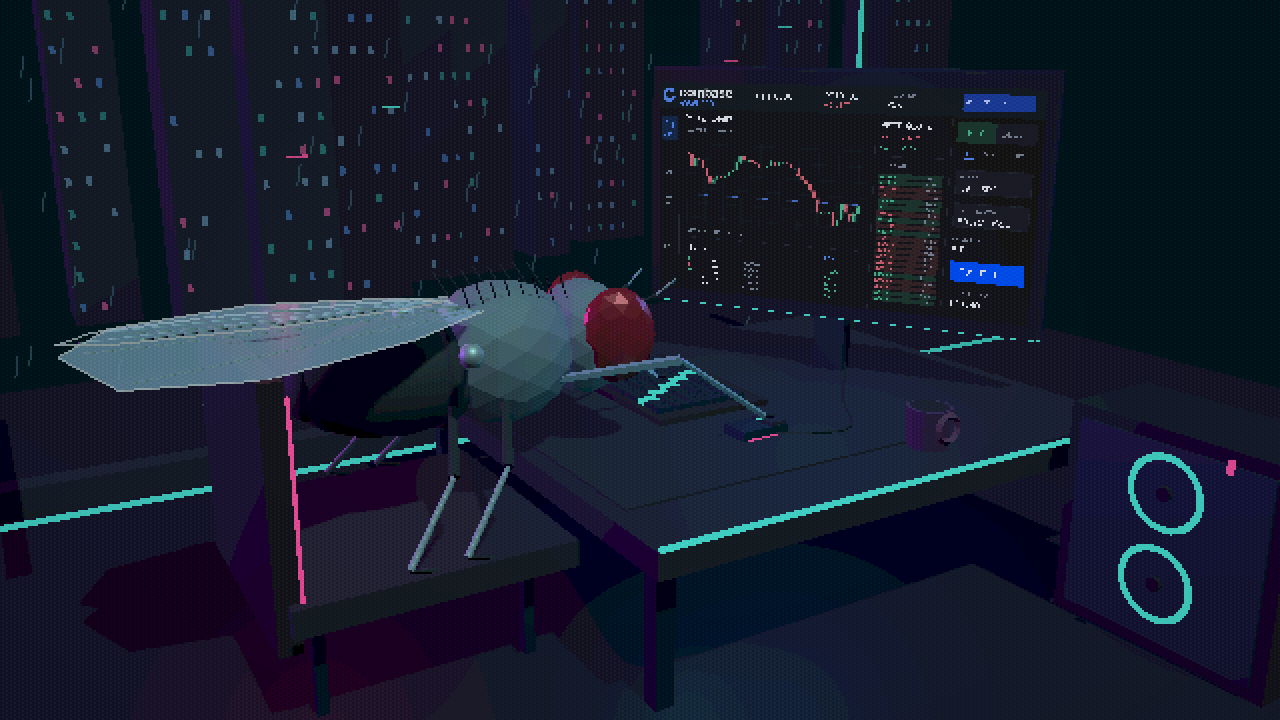
Trading Tactics: Teaching a Fruit Fly to Master the Markets
The future of finance often seems to live in the realm of complex algorithms and high-speed data, but what if the key to superior market intuition isn’t in human cognition at all? A fascinating experiment is challenging this notion, demonstrating that the neural pathways governing decision-making can be successfully simulated, even in the most unlikely of hosts: an insect.
A team of software engineers, including one from the cryptocurrency service Coinbase, has taken a radically different approach to understanding complex decision-making. Instead of relying solely on human psychology, they decided to map the neural architecture of a male fruit fly to simulate the behavior of a day trader. The resulting project, known as Stonkfly, throws the boundaries of biology and finance into a hilarious, yet deeply insightful, new arena.
The core of the experiment involves creating a virtual brain simulation based on the fly’s actual neural structure. The simulation models over 166,000 neurons and their 25.6 million connections, providing a biological framework for how sensory input translates into action. The virtual fly is given access to a display—a 320×180 screen projected across its eyes—where it visualizes standard candlestick graphs and historical pricing data.
The fly doesn’t just observe; it learns. By default, the simulation teaches the insect to react to market changes. When the virtual portfolio value rises, the system triggers a positive reinforcement signal, creating a dopamine rush in the simulated cells. Conversely, losses are registered by aversive cells, allowing the fly to learn the consequences of its trading decisions without the interference of human emotion or pain.
This process is a powerful demonstration of how the brain processes information and executes learned behaviors. Crucially, the simulation finds that the neural changes—the way the simulated synapses fire—are directly connected to the input mechanisms and the visual signals received. The fly, operating purely on these simulated biological signals, is shown to display a level of judgment that is strikingly effective in navigating the simulated market.
Of course, the experiment serves as a theoretical lens rather than a guarantee of real-world trading prowess. The researchers caution that while the connection between the inputs, visual signals, and synapse changes is clear, it does not automatically translate into actual human-level trading ability. The market is notoriously volatile, and any observed skill in the fly must be viewed as a fascinating byproduct of the experimental design.
Despite the theoretical caution, the project sparks curiosity about the fundamental mechanisms of intelligence. It suggests that the underlying wiring for complex judgment may be universal, regardless of whether the pilot is a human or a fruit fly. For those interested in diving into this intersection of neurobiology and finance, the open-source project provides the framework for exploring the fascinating, if absurd, pathways of simulated intelligence.
Buy on Amazon
Credit