Frankenstein card merges RTX 3070 and 3070 Ti components
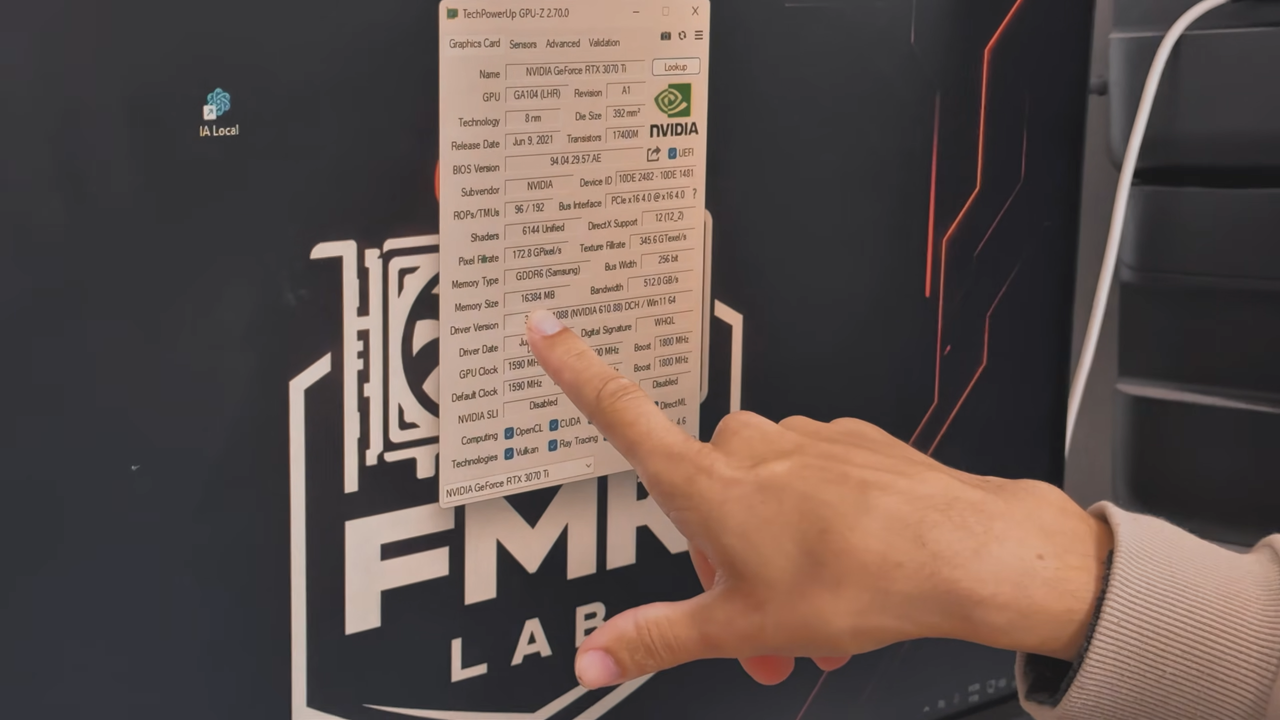
For years, the graphics card world was buzzing with speculation about a highly anticipated upgrade: an RTX 3070 Ti equipped with a generous 16GB of VRAM. While Nvidia certainly teased this potential upgrade, the mainstream market primarily received the standard 8GB configuration. Yet, whispers of a higher-spec version persisted, fueled by database listings and glimpses of physical prototypes that hinted at a more powerful memory configuration.
The mystery persisted until a dedicated creator stepped up to bring the concept to life. Brazilian YouTuber fmklab, known online as Fabian, decided to tackle this engineering challenge. Instead of waiting for official release, Fabian decided to build the card himself, essentially reverse-engineering the specifications to achieve the rumored 16GB memory pool.
The project was a technical puzzle. Fabian began by stripping down an existing RTX 3070 PCB and replacing the core with a 3070 Ti chip. The core issue lay in the memory: the standard 3070 Ti retail version uses the faster GDDR6X memory, whereas the custom configuration required GDDR6. To achieve the desired 16GB capacity, Fabian faced a crucial roadblock. He couldn’t simply swap out the memory chips, as this would have been prohibitively expensive. Instead, he utilized existing Samsung memory chips, swapping the 8GB GDDR6 chips for 16GB versions.
However, simply swapping the chips wasn’t enough. The system didn’t recognize the full memory capacity. The PCB’s memory straps needed precise reconfiguring to allocate the entire memory pool, presenting a complex compatibility issue. To solve this, Fabian turned to advanced tools like the Nvidia BIOS Reader to map the necessary adjustments before proceeding with the delicate soldering work.
After meticulous calibration, the results were impressive. MATS properly recognized the full 16GB VRAM capacity, and GPU-Z confirmed the card was operating with 16GB of GDDR6 memory, matching the theoretical prototype. The card was officially born.
To truly test the functionality, Fabian pushed the limits. He ran a local Large Language Model (LLM) on the GPU, finding that it effortlessly utilized nearly the entire 16GB pool. Furthermore, stress testing with demanding games, such as , showed stability, demonstrating that the high memory capacity did not come with performance instability.
When benchmarking the card’s raw power using the Unigine Superposition benchmark, Fabian scored 5,367 points. While this score was lower than what might be expected from a stock 3070 Ti, it perfectly illustrated the inherent tradeoff: moving to the higher capacity GDDR6 memory necessarily resulted in lower memory bandwidth compared to the flagship GDDR6X memory, a typical trade-off in high-capacity design.
Ultimately, Fabian’s experiment was a resounding success, offering a tangible, working 3070 Ti with 16GB of VRAM. While it proves the technical feasibility of the concept, it also highlights the point of diminishing returns. Current-generation Blackwell architecture, such as the RTX 5060 Ti 16GB, offers superior performance, efficiency, and future-proofing. For optimal performance and support, the industry is heading toward newer generations, suggesting that the next evolution in high-end graphics will be more than just more memory—it will be more efficient, powerful, and future-ready.
Buy on Amazon
Credit
