Frankenstein NAS turns into gaming PC with RTX 5060 and 828% FPS
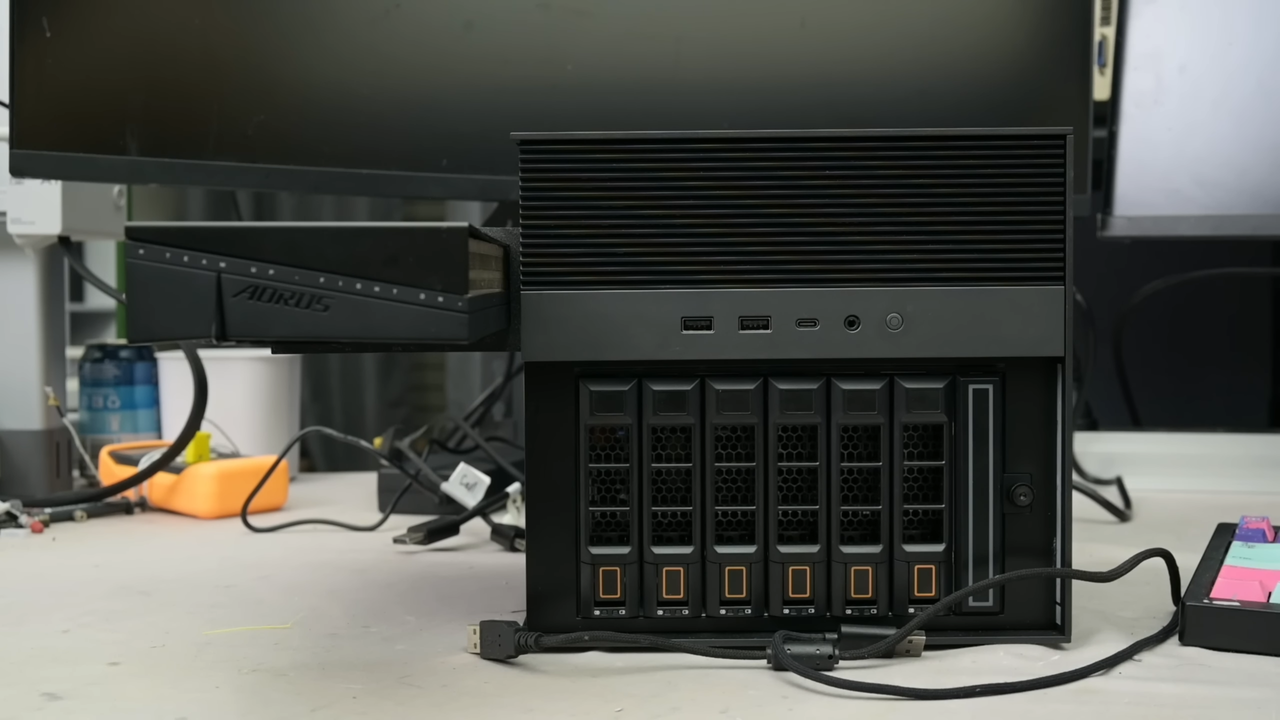
When global component shortages send prices soaring, some enthusiasts look not to replace hardware, but to reimagine it. The quest for creative utilization has led to some truly wild experiments, turning underutilized server components into unexpected gaming machines.
One such audacious project involved taking a ZimaCube 2 Network Attached Storage (NAS) unit and transforming it into a high-performance PC. The goal was simple: prove that even components designed for stoic data management could handle the demands of modern gaming.
The foundation of this transformation was the system’s CPU, an Intel Core i5-1235U—an Alder Lake chip featuring just two performance cores and eight efficiency cores. While this processor is perfectly adequate for running a server, it wasn’t designed for pushing graphical limits. However, the motherboard housed a vacant PCIe 4.0 x16 slot, providing the perfect open door for ambitious modders.
To unleash true gaming potential, participants introduced an RTX 5060 graphics card into this space. This wasn’t a simple plug-and-play operation; it required creative engineering. Since the GPU was too large for the NAS chassis, the team employed jury-rigging techniques, utilizing custom 3D-printed frames and riser cables to secure the card outside the case while maintaining necessary airflow.
The modifications were extensive, requiring the removal of hard drive caddies to free up space and creative management of power supply integration. The entire process highlighted how adaptable server architecture can be when pushed beyond its intended boundaries.
The results of this unconventional setup were nothing short of staggering. Performance benchmarks showed an astronomical leap in frame rates across popular titles. In some tests, games like Hitman 3 saw performance improve by over 827% compared to the integrated graphics, achieving speeds more than nine times faster.
For graphically intensive titles like Cyberpunk 2077, the boost was equally dramatic. Frame rates jumped from a struggling 13 FPS to an impressive 90 FPS, showcasing the raw power of the dedicated GPU. Even in less demanding games such as Shadow of the Tomb Raider, performance quadrupled, achieving an average of 124 FPS.
Despite the incredible gains, the experiment offered a final, telling lesson: hardware is only as good as its components. Although the custom build was a technical success in terms of pushing limits, the inherent limitations of the low-power CPU meant that further performance optimization was largely impossible. Ultimately, while this wild endeavor proves the potential for creative repurposing, purchasing a standard gaming PC remains the most straightforward path to true graphical mastery.
Buy on Amazon
Credit