GTX 1080 Ti cools 32°C and gains 9% FPS with custom mod
The Extreme Heat Hack: How Modders Found Hidden Power in GPU Cooling
In the world of PC hardware, where performance is measured in milliseconds and temperatures dictate longevity, some enthusiasts treat their components less like fixed machines and more like open-source projects waiting for a radical upgrade. Enter the experimental realm of hardware modding, exemplified by the work of TrashBench, who has repeatedly pushed the boundaries of thermal efficiency with some truly audacious methods.
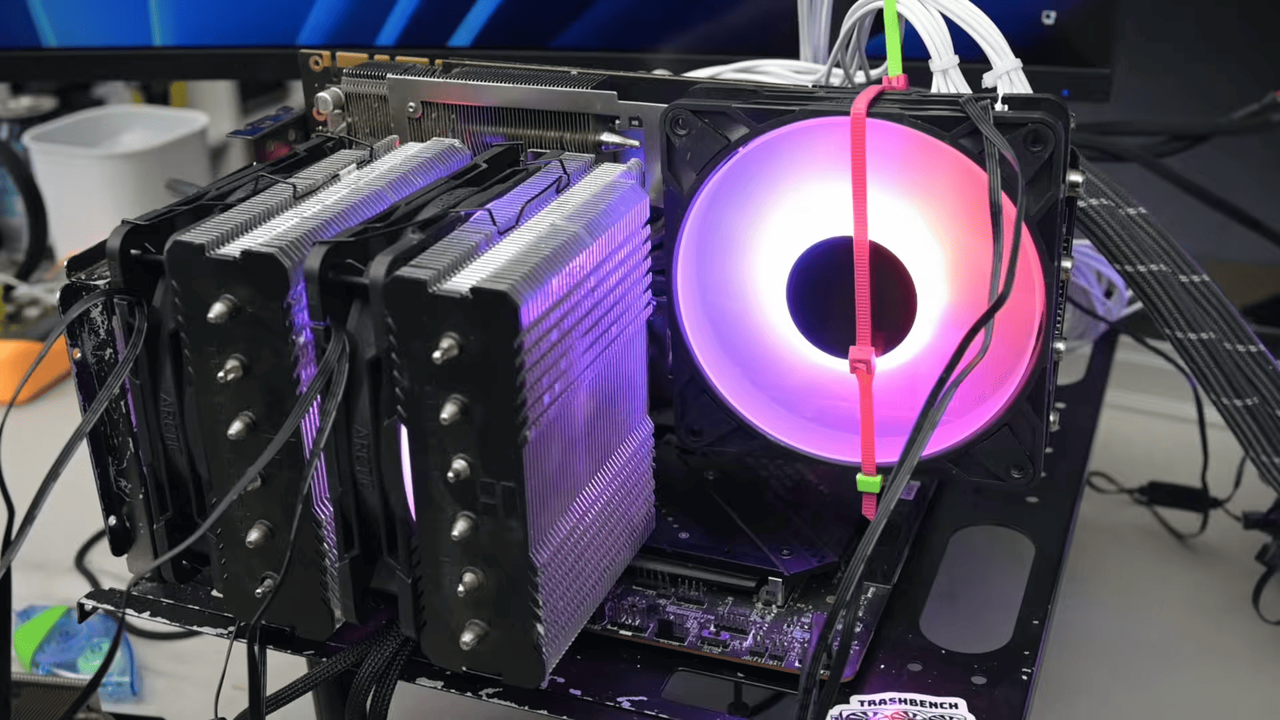
Recently, a project that might initially seem borderline deranged—grinding a CPU cooler to interface with a GPU—yielded stunning, practical results. The core idea was simple: why settle for factory thermal limits when you can engineer a superior cooling solution? The experiment involved attaching fully functional CPU coolers, complete with RGB fans, to the stock coolers of popular NVIDIA cards, including the GTX 1070, 1060, and 1080 Ti.
The methodology was precise. To achieve superior heat dissipation, the modder would modify the cooler assembly, exposing the back of the metal plate that touched the GPU core. This exposed surface was then used as a perfect mounting point for a CPU cooler. The results were nothing short of remarkable, demonstrating that thermal constraints are often arbitrary limitations rather than absolute physical barriers.
Testing the 1060 provided an immediate, tangible boost. By exposing the GPU die and integrating a CPU cooler, the temperature dropped from 46°C to 45°C under load. This seemingly negligible drop led to significant performance gains; the system achieved 9% higher FPS in games like Shadow of the Tomb Raider, alongside a 6°C overall cooling benefit.
The implications were even more pronounced when comparing the 1060 and 1080 Ti. Since the 1060 (120W TDP) and 1070 (150W TDP) share identical factory coolers, the specialized dual-tower cooler proved incredibly versatile. In the test against the 1080 Ti, the modded setup demonstrated incredible efficiency. The stock cooler reportedly pegged the hotspot at 72°C, while the dual-tower cooler managed to keep the temperature at just 42°C—a massive 30°C differential.
Even when pushing the limits of the GTX 1070, the modded cooler delivered. It ran a full 20°C cooler than the stock configuration and consumed 15W less power. This efficiency allowed the modder to push the clock speeds, resulting in a successful overclock to 2,177 MHz, securing a 7% performance uplift. This proved that advanced thermal management isn’t just about cooling; it’s about unlocking latent performance.
These high-performance experiments are not isolated events. Hardware modding has a long history of pushing boundaries, with previous feats involving attaching CPU coolers to GPUs, even achieving significant performance uplifts. This latest effort highlights a fundamental truth: when you strip away conventional constraints and embrace creative engineering, the potential for unparalleled efficiency and speed becomes surprisingly real.
Credit
