Material steers heat automatically breakthrough for AI chip cooling
Programming Heat: Scientists Unlock the Future of Thermal Control
The quest for smarter technology hinges on one fundamental challenge: managing heat. In the realm of high-performance computing, engineers are constantly battling thermal limits that dictate how fast and efficiently microprocessors can operate. Now, a team of researchers from Osaka Metropolitan University has taken a monumental step toward solving this puzzle, developing a programmable thermal device capable of controlling where heat radiates while retaining its configuration, even without continuous power.
This breakthrough addresses two long-standing obstacles that have kept nonreciprocal thermal devices out of the practical realm. Conventional physics dictates that if a surface absorbs heat in one direction, it must emit it equally across all directions—a principle known as Kirchhoff’s law. This limitation has meant engineers couldn’t precisely steer thermal energy where it was needed. The new research aims to shatter this conventional rule, offering an entirely new way to manage thermal energy.
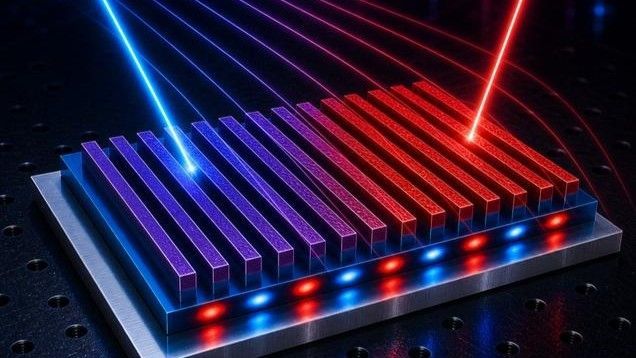
The solution lies in combining two specialized materials: indium arsenide (InAs), a magneto-optical semiconductor that responds to magnetic fields, and germanium-antimony-tellurium (GST), a phase-change material. By merging these elements, the researchers created a device that can independently steer how infrared radiation is absorbed and emitted.
The magic happens at the microscopic level. The team patterned GST into a grating layered above the InAs material, creating what they term a magneto-optical metagrating. This structure uses the magnetic field to introduce directional asymmetry—allowing the device to separate heat absorption from emission. Crucially, the GST layer acts as a non-volatile switch, remembering its programmed state even after the power source is removed. Essentially, the device can be instructed on how to release heat and hold that instruction permanently.
This innovative approach overcomes previous design limitations. Earlier attempts at directional thermal control required light to strike the surface at extreme angles or demanded constant energy input just to maintain functionality. The new device operates almost straight on, achieving remarkable nonreciprocity while retaining its programmed state without needing continuous power. This promises vastly more efficient radiative cooling and advanced photonic technologies.
The prototype demonstrated impressive results, achieving a nonreciprocity factor approaching 0.9 even at a modest incidence angle of just three degrees. This confirms the device’s ability to efficiently direct heat according to its programming, offering engineers a powerful new tool for manipulating infrared radiation.
Looking ahead, the implications are enormous. As processors continue to pack more transistors into increasingly dense packages, thermal management will become even more critical. Future thermal metasurfaces could help dissipate hotspots between chiplets, stabilize silicon photonic devices whose properties shift with temperature, and revolutionize systems like thermophotovoltaic energy conversion.
Beyond computing hardware, the potential extends to vast fields. Researchers envision applications in advanced radiative cooling systems, novel infrared emitters, secure thermal communication, and sophisticated photonic memory technologies. While this work remains a powerful laboratory demonstration, it marks an exciting step toward turning abstract physics into tangible, deployable technology.
Buy on Amazon
Credit