Mod boosts DLSS 5 FPS 127% using dual GPU power
Splitting the Load: How Developers Are Unleashing the Power of DLSS 5 with Dual GPUs
The world of PC gaming is buzzing with excitement surrounding Nvidia‘s DLSS 5 Neural Rendering technology. But beyond the hype of future visual fidelity, a more intriguing development is emerging: clever developers are finding innovative ways to push the boundaries of performance by splitting the processing load across multiple graphics cards.
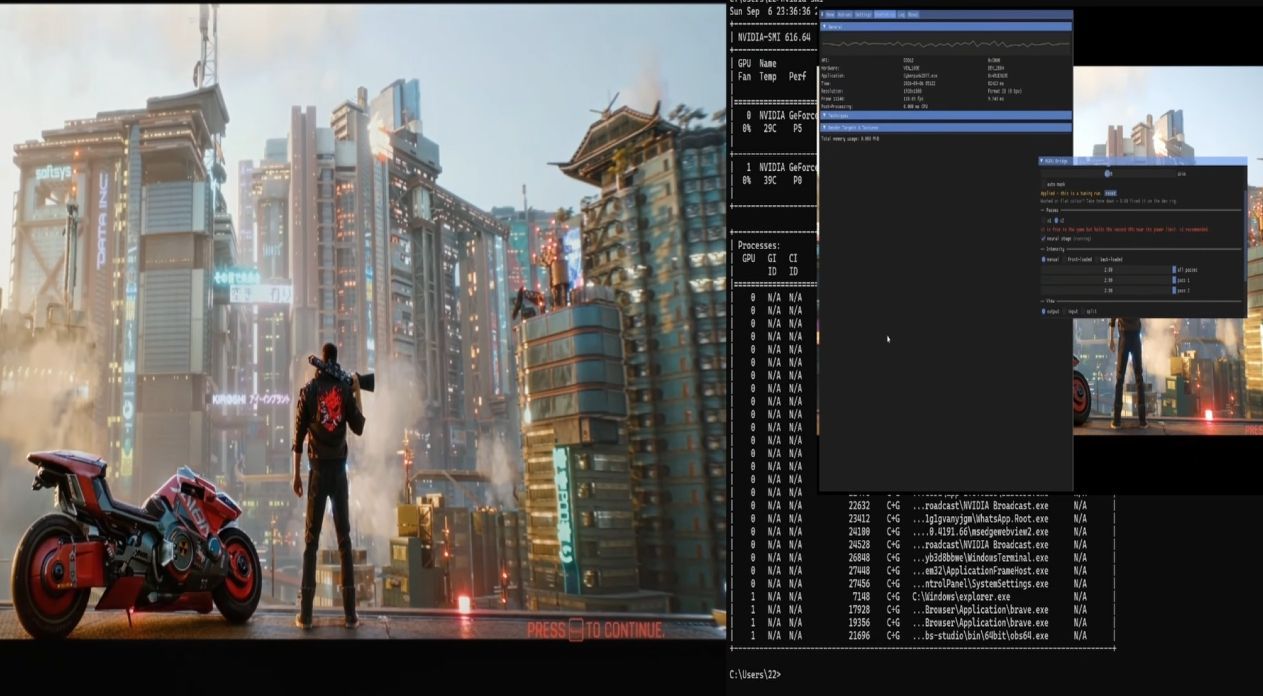
One developer has recently demonstrated a highly technical and impressive application of DLSS 5, showcasing how it can leverage a second GPU to handle the heavy processing. This method allows the system to render the game on one card and apply the complex neural rendering on the other, resulting in substantial performance boosts.
The demonstration, shared by Marcelo Guibout, featured cinematic scenes from demanding titles like The Blood of Dawnwalker and Cyberpunk 2077. While these were technical showcases rather than strict benchmarks, the results hinted at a genuinely game-changing way to manage graphical workload.
The secret to this trick lies in the timing of the rendering process. Instead of running the neural rendering step directly on the main rendering card, the technique involves running the initial frame rendering on the first GPU, and then applying the DLSS-NR at the end of the frame on a second card. This separation ensures that the primary rendering GPU can focus purely on frame creation, leading to smoother operations.
To make this happen, the demonstration utilized a robust setup, including a Ryzen 7 7800X3D processor, 32GB of DDR5 memory, and two Nvidia RTX 5060 Ti 16GB GPUs, all communicating via PCIe 5.0 x8. The setup required a dual-monitor arrangement, with each card connected to its own display, demonstrating the need for a dual-screen setup.
The system employed a specialized ReShade add-on dubbed MGPU Bridge to facilitate the process. This software acts as a bridge, reading finished frames from the rendering card and sending them across to the second GPU to execute the neural rendering, which is then displayed on that card’s monitor. This process allows the rendering GPU to run cooler and dedicate itself solely to rendering work, free from the intensive neural processing.
Performance figures from the demonstration highlighted the significant efficiency gains. By utilizing the dual-GPU setup, the system achieved notable improvements across various DLSS modes. In the tested scenarios, this approach allowed users to retain up to 86% of the potential performance gains, compared to a situation where the render card absorbed a disproportionate share of the workload.
Beyond raw performance, this method offered tangible thermal benefits. The primary rendering GPU experienced a noticeable reduction in temperature, running approximately 21 degrees cooler when the neural load was distributed, showcasing an added benefit for system longevity and cooling efficiency.
While this technique offers a compelling pathway for maximizing performance in demanding titles, it is important to note that it is not an official integration by Nvidia, nor is it a return to previous technologies like SLI. It remains an advanced, community-driven solution, offering an exciting and sophisticated new approach for high-end PC gamers seeking ultimate performance.
Buy on Amazon
Credit