Modded RTX 5090 ditches 16-pin for triple 8-pin power and 3400 MHz
In the quest for pushing the boundaries of PC hardware, some innovation comes not from factory blueprints, but from the ingenuity of modders. A team of creators on the YouTube channel TecLab recently conducted a compelling experiment that challenges long-held assumptions about power delivery in high-end graphics cards.
They successfully demonstrated that a cutting-edge RTX 5090 graphics card could be powered using traditional 8-pin PCIe connectors, proving that the older standard is surprisingly capable of handling the extreme power demands of modern GPUs. This wasn’t just a theoretical exercise; it was a hands-on deep dive into the mechanics of power management.
For the test, the modders selected a high-performance component, the Galax GeForce RTX 5090D HOF OC LAB XOC, which is equipped with dual 16-pin connectors. To see if an alternative route existed, the team undertook a significant process: they completely dismantled the graphics card, removing the dual 16-pin power connectors to expose the bare PCB.
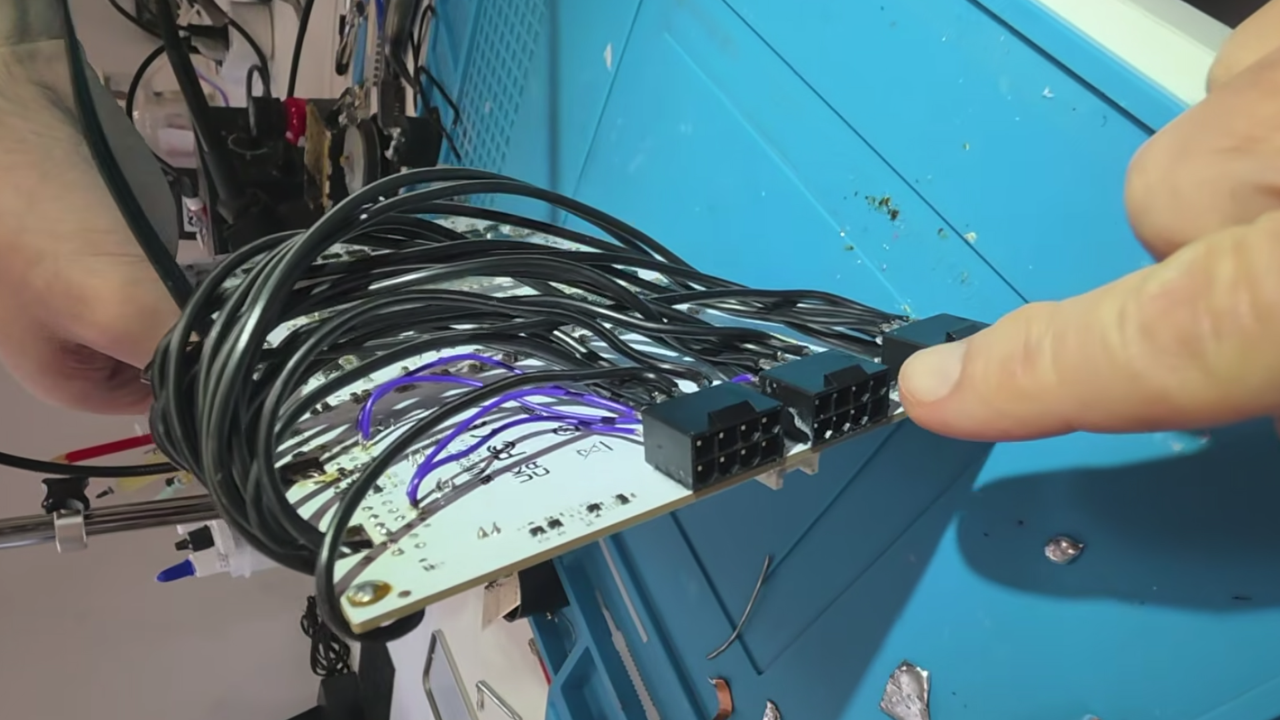
The next phase involved ingeniously rerouting the power flow. They installed three 8-pin power connectors at the rear of the card, soldering each one directly to the power regulators on the PCB using heavy-gauge cables. To ensure maximum performance, they also had to rewire the sense pins, allowing the card to draw its full potential without restriction. To manage the intense heat generated during this process, they incorporated a liquid cooling system with a dedicated GPU block.
The results of the livestream tested the limits of this modified setup. By gradually increasing the power draw—from 400W up to 900W using the three 8-pin cables—the modified RTX 5090 was clocked up to 3,400 MHz. At its peak, the card pulled more than 120A, confirming the viability of the 8-pin configuration for extreme power delivery.
The experiment further explored efficiency. When tested with only two cables, the power draw was measured at 66A, maintaining a respectable 3,200 MHz clock speed. Even more impressively, testing with just a single 8-pin cable resulted in a power draw of 65A and a clock speed of 3,100 MHz, demonstrating remarkable adaptability in the power architecture.
This demonstration comes at a crucial time, as industry concerns surrounding high-end GPUs persist. Despite PCI-SIG’s efforts to revise the 16-pin connector standard, reports of melting GPU connectors remain a serious headache for gamers. This issue is particularly prevalent with high-performance models, and concerns extend to other high-end hardware, suggesting that GPU manufacturers might need to reconsider the tried-and-tested 8-pin connector as a highly viable and robust option for future high-end graphics cards.
Buy on Amazon
Credit