
Modder pumps liquid over GPU silicon drops RTX 2060 Super temps to 28C
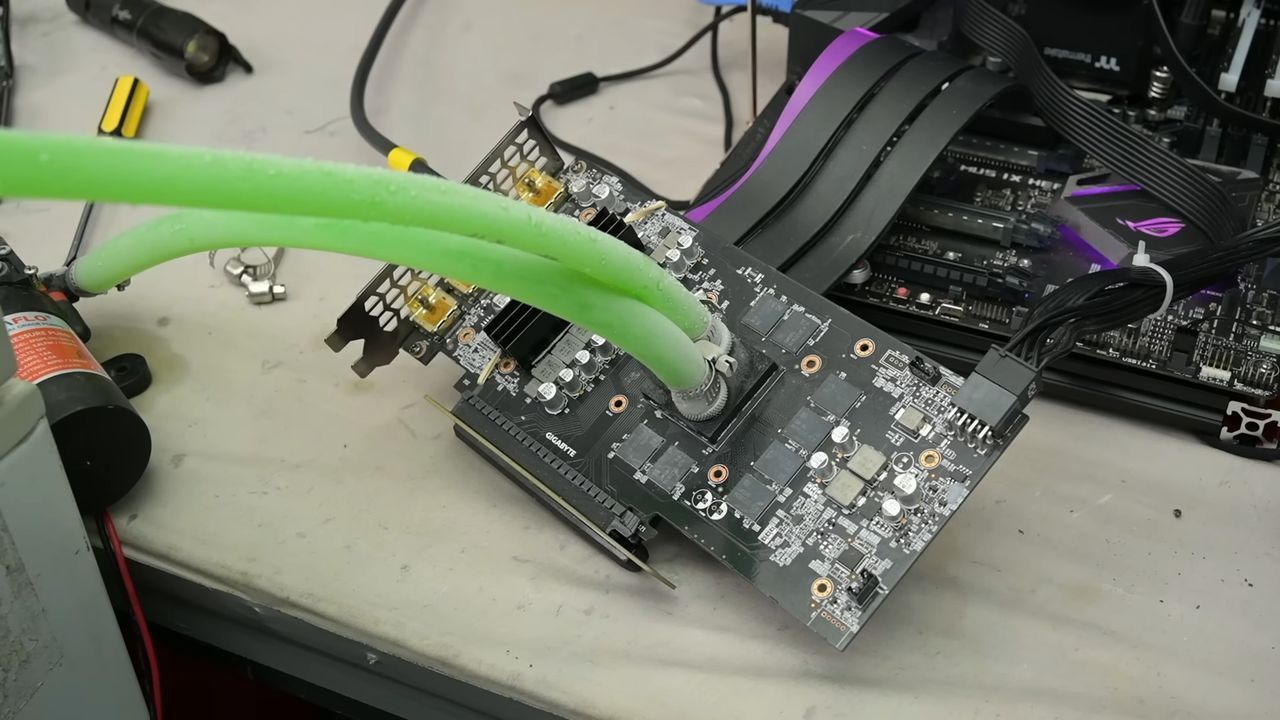
In the relentless quest for cooler, more efficient graphics processing, some hardware adventurers decided to throw out the rulebook entirely. The fearless collective known as TrashBench recently embarked on an audacious experiment: testing direct die water cooling for graphics cards, stripping away the traditional metal waterblock in favor of pumping coolant directly over the bare silicon.
The philosophy behind this radical shift was simple: why rely on a bulky metal block when you can simply pump water straight onto the chip? As one member of the group mused, “In my pursuit of the perfect water block, I realized, why do we need metal at all? Why can’t we just pump water directly over the bare silicon?”
This wasn’t a casual hobby project; it was an engineering challenge demanding extreme caution. The team began feasibility testing using components like the GeForce RTX 3060, setting up a 3D printed water block to manage the flow. The initial hurdle was immediate: leaks were inevitable during these first attempts.
To mitigate potential damage to the expensive components, the hardware explorers took precautions, coating all surface-mount parts outside the GPU with nail polish. They incorporated standard plumbing measures—washers, gaskets, and hose clamps—and fused pipe fittings directly into the block. However, when the first prototypes sprang a leak or two, the team had to pivot quickly, adding epoxy adhesive to secure and seal the 3D printed structure. This trial-and-error process of sealing became part of the innovation.
After mastering the sealing process, they moved on to live testing with more powerful hardware, including the GTX 980 and later the RTX 2060 Super. In these tests, materials science became another factor. The choice of 3D printing material—in this case, from a Bambu Lab printer—introduced new complications, as some materials exhibited porosity or leakage at the edges.
To protect against drips onto sensitive components like the motherboard, a clever solution was employed: a PCIe riser cable was utilized to manage potential liquid flow away from critical areas. Despite the initial risks, the project yielded compelling results when comparing performance against traditional methods.
The final comparison showed the tangible benefits of direct cooling. When testing an RTX 2060 Super, the temperatures were strikingly low: the stock cooler ran at 70°C and the standard Air Cooler achieved 36°C. In stark contrast, the direct water cooling method managed to bring the temperature down to a remarkable 28°C.
These figures highlight that while achieving long-term confidence about leakage remains paramount, direct water cooling holds significant promise. The findings suggest that while chamber size plays a crucial role in overall thermal management, pumping water directly over the silicon is a viable and potentially revolutionary path toward next-generation GPU cooling.
Buy on Amazon
Credit

