Modders halve render times with FidelityFX on PS5 APU
The Modding Revolution: How Community Hacks Unleashed Power on Obscure Mining Hardware
In the world of PC gaming and custom hardware, the pursuit of performance often demands clever engineering. Recently, a community of modders has delivered a remarkable feat: they have slashed the processing time required for FSR 4—AMD’s upscaler—on the unusual AMD BC-250 board by nearly half. This achievement isn’t just a small efficiency gain; it’s a powerful demonstration of how community innovation can breathe new life into hardware that was once considered niche.
The optimization effort focused on making complex machine-learning workloads, which FSR 4 relies upon, run much more efficiently on the BC-250, a board built around older RDNA 2 graphics architecture. The magic happened by moving the necessary FSR 4 optimizations out of custom Mesa modifications and into a portable FidelityFX DLL, making the enhancements accessible to a wider range of systems.
The results speak for themselves. In controlled testing, the optimized implementation reduced the processing time from 11.51 ms to just 5.92 ms at 1440p resolution. This level of efficiency extended across the board, with 4K performance dropping from 25.72 ms to 12.08 ms, and 1080p time plummeting from 7.13 ms to 3.93 ms. Crucially, these gains were achieved without sacrificing visual quality, producing images byte-identical to the original shaders, proving that performance improvements can be made without compromising the visual experience.
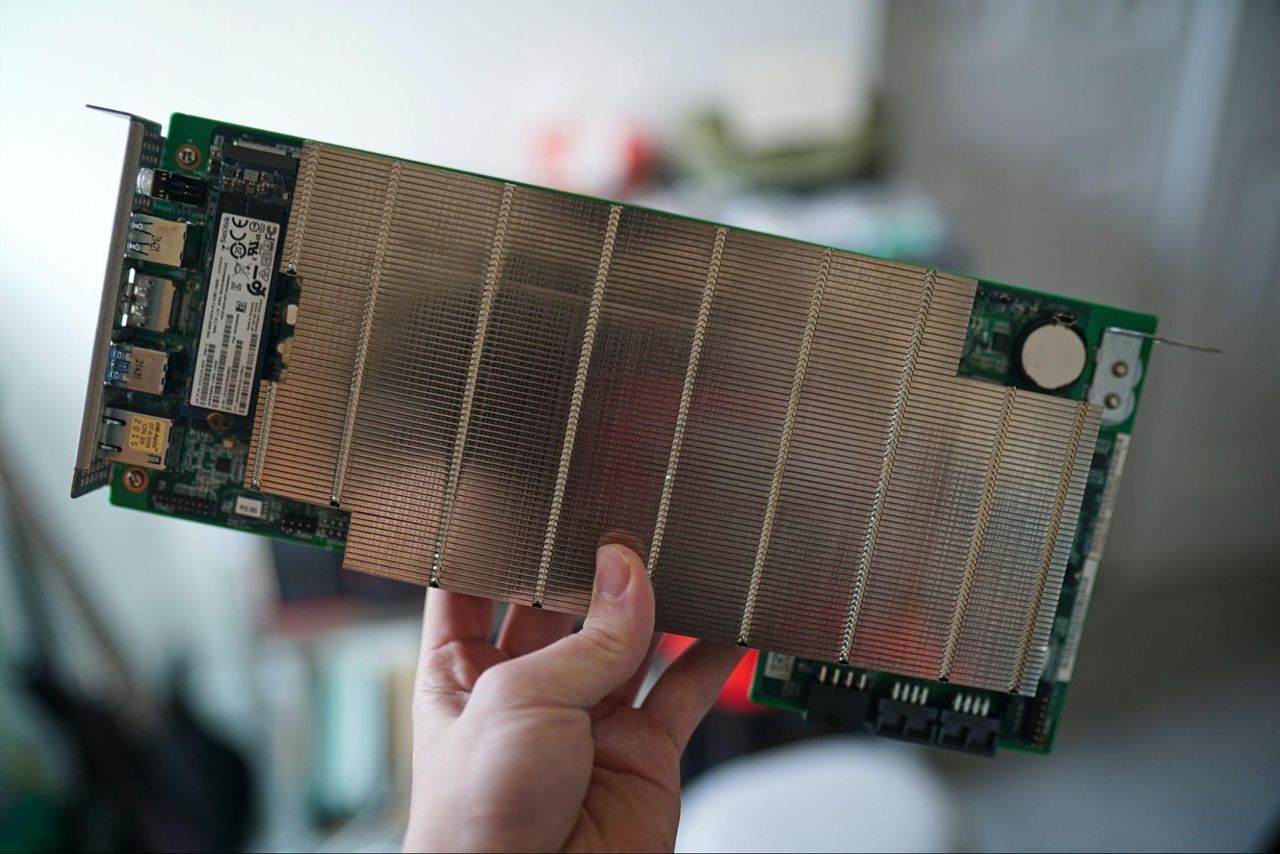
This success highlights a fundamental truth about modern graphics: specialized hardware sometimes requires specialized, community-driven software to unlock its full potential. The BC-250, built with PlayStation 5-class AMD silicon, was a fascinating piece of hardware, initially conceived for cryptocurrency mining. Today, enthusiasts have built a mature Linux gaming ecosystem around it, complete with custom firmware and specialized fixes.
The work involved deep diving into the mathematical operations FSR 4 performs. By optimizing the INT8 dot-product operations used by the upscaler using more efficient signed 24-bit integer paths, developers managed to drastically cut the instruction count. One representative shader reportedly saw its instruction count fall from 64,269 to 37,613, illustrating the power of smart, targeted modification.
This optimization effort is part of a larger movement. Community efforts have already managed to unlock all 40 physical RDNA 2 compute units on compatible boards, and separate firmware work has restored disabled Zen 2 CPU cores. While the community has achieved incredible feats in unlocking hardware potential, the ecosystem still faces limitations. For example, the BC-250’s aging Zen 2 CPU can still present a bottleneck at 1080p and 1440p in demanding titles, and the board’s 16GB of shared memory can cause issues at 4K resolution.
Even with these physical limitations, the performance gains achieved by halving the upscaler’s per-frame cost give the BC-250 a significant amount of headroom. This story is a testament to the ongoing spirit of modding, proving that even the most unconventional hardware can be pushed to its limits through shared ingenuity and relentless optimization.
Credit