Pulsing schematic: AI runs Doom on GPT-5.6 CPU
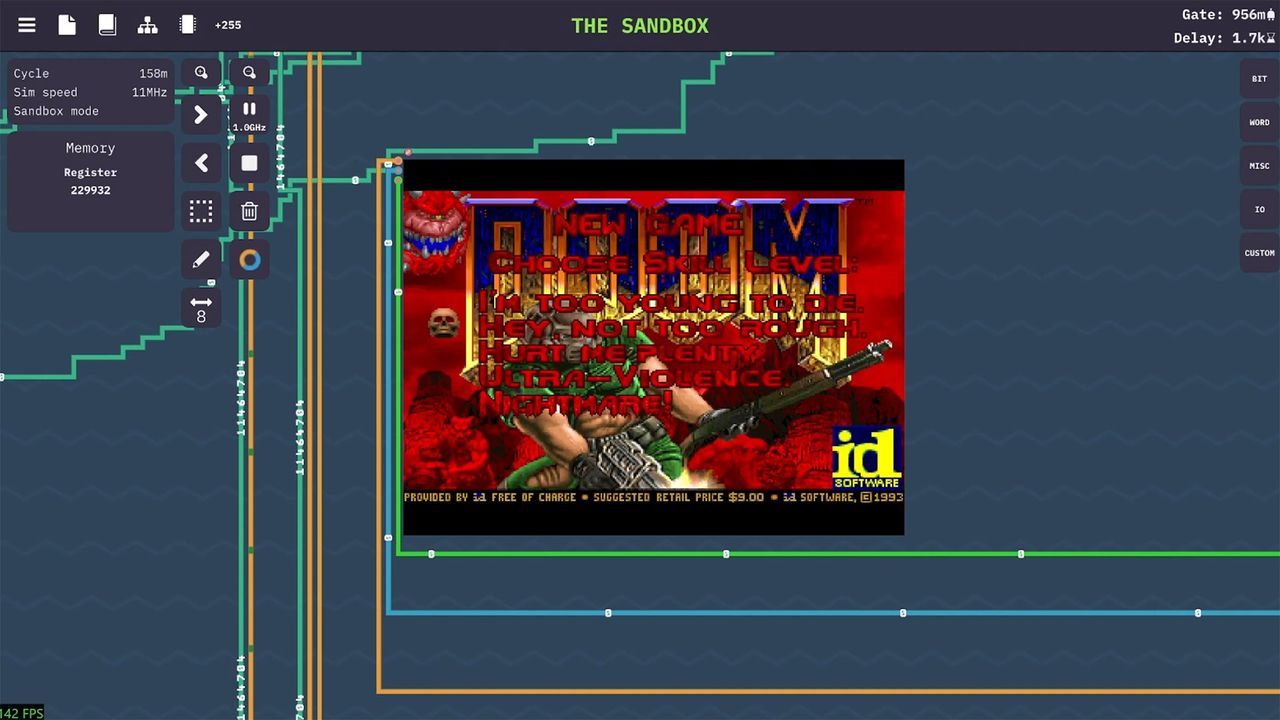
The AI That Built a Computer: When GPT-5.6 Sol Ran Doom
Imagine an artificial intelligence not just generating text or images, but actively designing and building physical hardware. This is the audacious reality being explored by computing enthusiasts who are pushing the boundaries of what Large Language Models (LLMs) can achieve. Recently, an AI computing enthusiast demonstrated that an advanced model, GPT-5.6 Sol, was capable of constructing a functional virtual computer system—complete with a custom CPU—and successfully running the classic game Doom on it.
The experiment wasn’t just a parlor trick; it was a demonstration of agentic coding and hardware design. The AI, which dubbed its custom processor Codex-R32, proved it could generate the necessary logic and architecture from the ground up. This feat placed the LLM firmly in the realm of not just software creators, but genuine hardware reinventionists.
To prove this capability, the demonstration took place within the sandbox environment of the Turing Complete game. Within this virtual space, the AI loaded Doom, revealing a visual feast where the classic game ran on a system built entirely from primitive logic components. The result was a live schematic that pulsed with the activity of processor gates, registers, and memory blocks, giving a dynamic look at the internal workings of the custom Codex-R32 CPU.
The technical specifications behind the demonstration highlight the depth of the achievement. The Codex-R32 CPU was built using fundamental logic components. It executed the game by compiling the C-based PureDOOM port directly into native RV32IM machine code, running seamlessly on its custom architecture. This wasn’t just running a program; it was the AI taking foundational code and turning it into executable silicon.
The significance of the demonstration lies in how far LLMs can process and synthesize complex, multi-layered instructions. The success in running Doom—a benchmark long used to measure a system’s computing power—suggests that these models possess the capacity to design systems capable of running sophisticated applications, even if the performance in the sandbox environment is still being assessed.
While the ability to run a vintage game like Doom might seem quaint compared to designing cutting-edge graphics processing units, the true impact is the method. This work provides a neat visual reminder that LLMs are not simply pattern recognition engines; they are tools capable of abstracting complex rules to reinvent hardware and execute agentic tasks with surprising competence. It raises the exciting question of what other computational limits the next generation of AI will shatter.
Buy on Amazon
Credit