Redditor builds a ‘Turkish Kebab PC’ with working spinning components
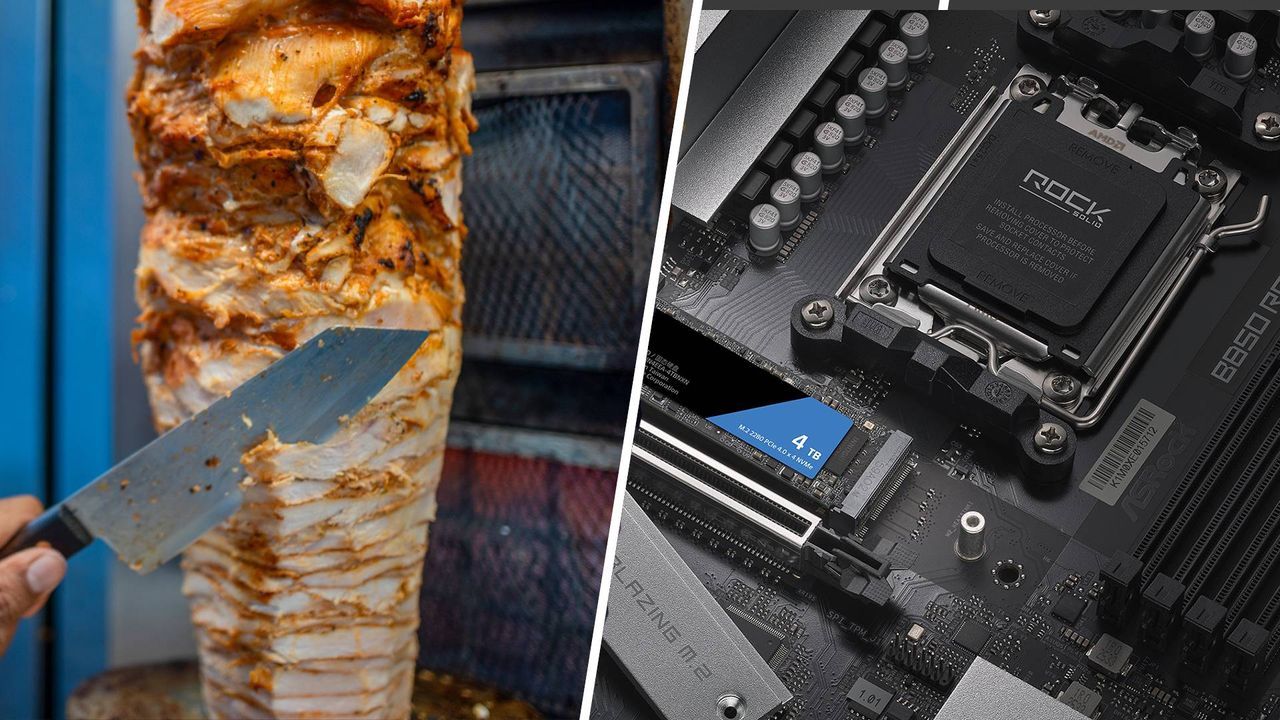
The pursuit of unique PC builds often leads down the strangest creative paths. One enthusiast recently pushed those boundaries by merging culinary tradition with cutting-edge mechanical engineering, resulting in a machine that is as much spectacle as it is hardware: the Turkish Kebab PC.
This isn’t just another custom rig; it’s an ambitious tribute to the traditional preparation of a Turkish kebab, translating the concept of rotating meat onto a spit into a functional, spinning computer system. The result is a piece of engineering that forces you to reconsider what constitutes practical design.
At the heart of this bizarre creation lies the mechanism that makes it truly one-of-a-kind. Rather than standard static components, the entire core—the GPU, motherboard, power supply unit, and cooling fans—is housed within a glass case, mounted on a central rotating pole. To achieve this mesmerizing motion, the build relies on slip rings, specialized components typically used in machinery to transfer power to moving parts.
The ingenuity lies in using these slip rings to allow all the essential electronics to spin seamlessly without the cables getting hopelessly tangled. The creator explained that while slip rings are commonly found in everything from ceiling fans to MRI machines and wind turbines, applying them to a high-performance PC chassis is admittedly an unconventional choice.
Despite the visual appeal, the design faces some serious practical hurdles. The builder admitted that the application of slip rings here is unnecessarily complicated, noting that normally, only minimal electronics would reside on the rotating part while the bulk of the components remain stationary. Yet, the desire to place the entire PC within this rotating chamber was purely driven by a vision for novelty and coolness.
The aesthetic payoff is undeniable. The central pole, which acts as the rotation axis, is accentuated with an RGB strip that illuminates the internal hardware, transforming the mechanical function into a glowing centerpiece.
Underneath this striking exterior is a serious set of performance components. The core specifications include a powerful Ryzen 5 3600X processor, 16 GB of DDR4 memory, an MSI RTX 3070 Super graphics card, and 1 TB of SSD storage. While the overall cost for the build approached $1,000, the custom glass case proved to be the most expensive single component of the entire system.
The project was a testament to patience and persistence. The builder spent four months meticulously bringing this rotating concept to life, admitting they were unsure if the complex mechanism would ever function correctly until the third month.
Further enhancing the interactive experience is a control feature built into the system. There is a switch on the front panel that allows the user to regulate the motor speed, offering options for slow motion, regular speed, or maximum speed. Although it’s unclear whether increased speed translates directly to faster processing power, watching the components whirl at high velocity certainly adds to the visceral experience.
Ultimately, the Turkish Kebab PC is more than just a showpiece. It’s a bold exercise in blending impractical design with phenomenal performance, proving that sometimes, the most memorable tech creations are born from the most unexpected and delightfully weird ideas.
Buy on Amazon
Credit