Robots shatter Bolt’s record and crash into foam
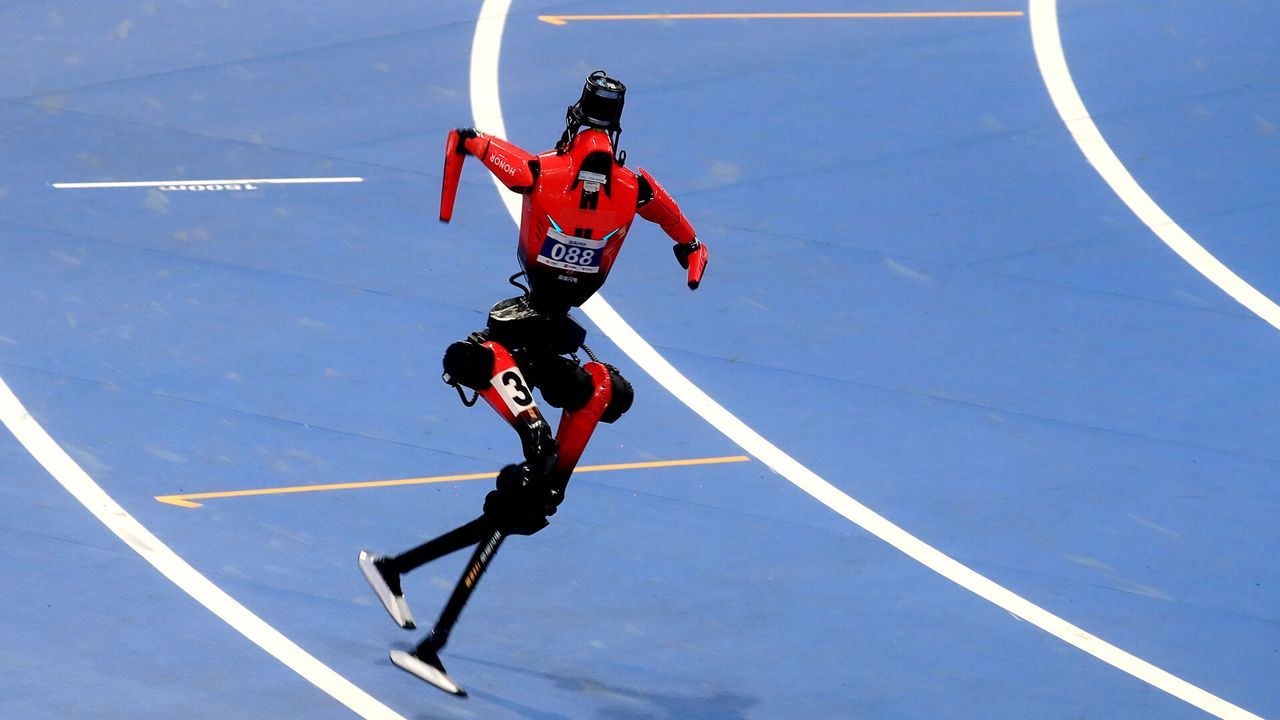
Forget human limits. In a stunning display of artificial intelligence and mechanical might, two Chinese humanoid robots have just shattered the world record for the fastest human in the 100-meter dash. The results weren’t just fast; they were a reminder that in the age of AI, the line between biological speed and mechanical prowess is rapidly blurring.
The contest pitted the autonomous bipedal robots Tiangong Ultra and Honor’s Lightning against the reigning champion, Usain Bolt. The robots clocked a blistering 9.39 seconds and 9.47 seconds, respectively. These times edged out Bolt’s historic 9.58-second record set back in 2009, demonstrating an almost immediate and jaw-dropping leap in performance.
When translating these metrics into familiar terms, the speed gap is staggering. The Tiangong Ultra achieved an average speed of 23.83 mph, narrowly outpacing Bolt’s 23.35 mph. This wasn’t just a marginal victory; it was a massive performance boost, proving that these machines can operate at speeds that redefine athletic possibility.
While the numbers speak to mechanical superiority, the event also provided a fascinating look at the challenges of robotic movement. Building bipedal robots capable of running requires solving complex engineering puzzles, making their achievement at the World Humanoid Robot Games in Beijing a monumental feat. The teams behind these machines managed to refine their projects dramatically in a short timeframe, showcasing remarkable ingenuity.
Of course, the race wasn’t just a display of pure velocity. It was also a spectacle of mechanical imperfection. As the robots neared the finish line, they faced a very human problem: graceful deceleration. Instead of a smooth finish, the machines encountered soft foam pads, leading to a comical tangle of physics. The winning Ultra shot right off the track, while the Lightning seemingly lost control and tumbled helplessly. It was a hilarious reminder that even the most advanced AI still needs to learn how to finish a race politely.
Beyond the lightning-fast dash, the event was a true global showcase of robotic capability. Over the five-day competition, 2,056 robots from 666 teams representing 16 different countries participated in an astonishing array of events, including boxing, dancing, and industrial task contests. While these robots may not yet be ready for industrial deployment, their performance at such a high level proves they are on the cusp of becoming versatile problem-solvers.
The future of robotics is clearly fast approaching. Despite the immediate regulatory hurdles facing the deployment of these advanced models, the world is witnessing a rapid evolution where machines are not just calculating; they are competing, learning, and, most surprisingly, crashing into foam pads with style.
Buy on Amazon
Credit