Scientists sync 105k nano-oscillators in 45 ns for faster chips
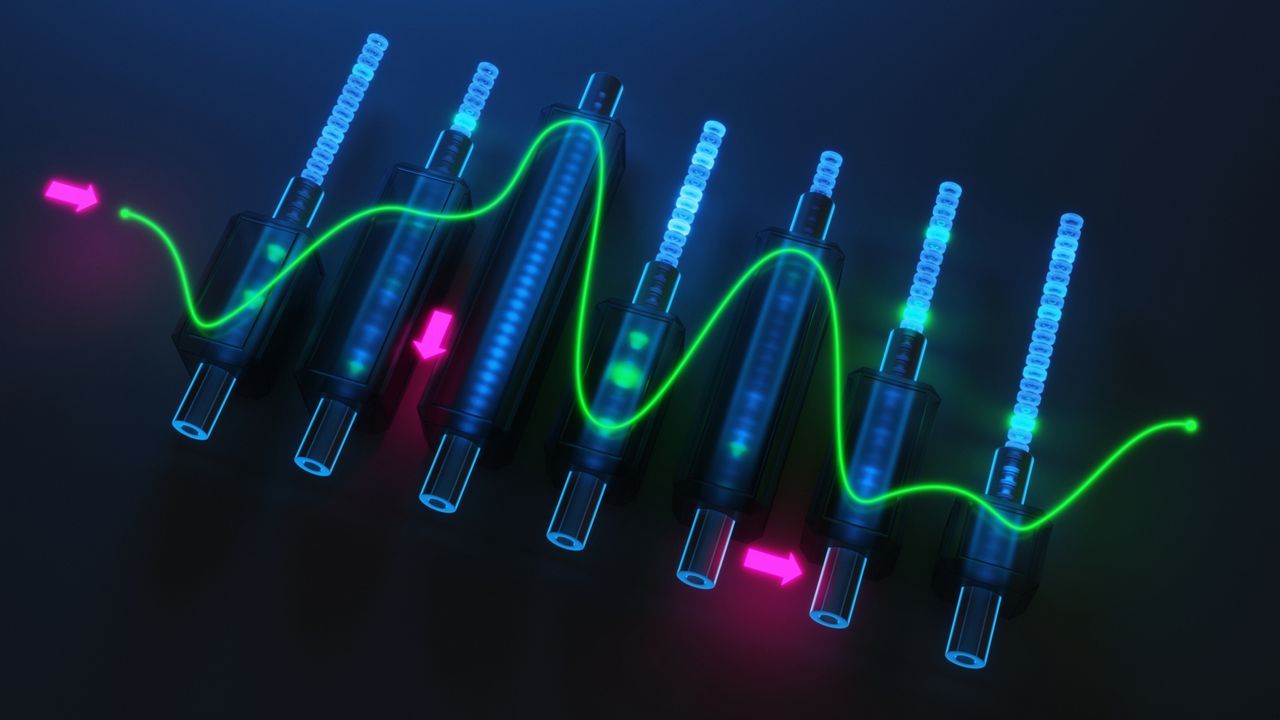
Forget what you think you know about computing. A groundbreaking leap in the future of technology is emerging from a field that doesn’t make the front page: oscillator-based computing.
This isn’t theoretical science confined to dusty laboratories; it’s tangible innovation. Researchers have recently achieved an astonishing feat, demonstrating the ability to synchronize an enormous network of microscopic magnets—or nano-oscillators—with remarkable speed and efficiency. In a single experiment, scientists managed to synchronize 105,000 nano-oscillators in just 45 nanoseconds, using remarkably little energy.
Imagine a grid of tiny magnets, where the synchronized movement is achieved not through complex wiring or traditional processing, but through the inherent spin of the magnets themselves. This process is akin to watching ripples spread across a surface of water; the system synchronizes itself almost instantaneously.
What makes this breakthrough so profound is its scalability. The results show that this synchronization speed barely slowed down as the number of oscillators increased. For instance, when tested with just 100 oscillators, the synchronization time was only 10 nanoseconds, rising to 45 nanoseconds for the massive 105,000-oscillator network. This demonstrates that oscillator grids are not a theoretical curiosity but a practical platform capable of handling massive computational complexity.
This ability to synchronize vast numbers of elements opens up entirely new avenues for problem-solving. Oscillator grids possess the inherent capacity to model systems based on wave propagation, statistics, approximation, and pattern recognition. This means they are naturally suited to tackling complex challenges, including concepts like Ising machines and sophisticated reservoir computing.
By manipulating the frequencies, phases, and coupling strengths of these oscillators, scientists can program the grid to perform calculations. The resulting synchronized state then provides a clear readout of the solution—essentially, letting the pattern emerge from the waves.
The practical implications are vast. This technology promises radical improvements across various sectors, including high-speed communication networks, sophisticated financial and scientific modeling, real-time data analytics, and accelerating artificial intelligence. The system can operate at tens of gigahertz while maintaining efficiency, proving it can perform complex calculations in the time it would take a conventional CPU to process an entire matrix.
Furthermore, unlike some cutting-edge fields like quantum computing, which struggle with maintaining coherence and requiring extensive error correction, oscillator arrays offer a distinct advantage. The high quality factor of this experiment—exceeding one million—means the resulting signal is exceptionally clear and easily readable, offering an inherently stable and reliable computational method for the next generation of devices.
Buy on Amazon
Credit
