Self-replicating GIF prints its own visual output champion coder technique
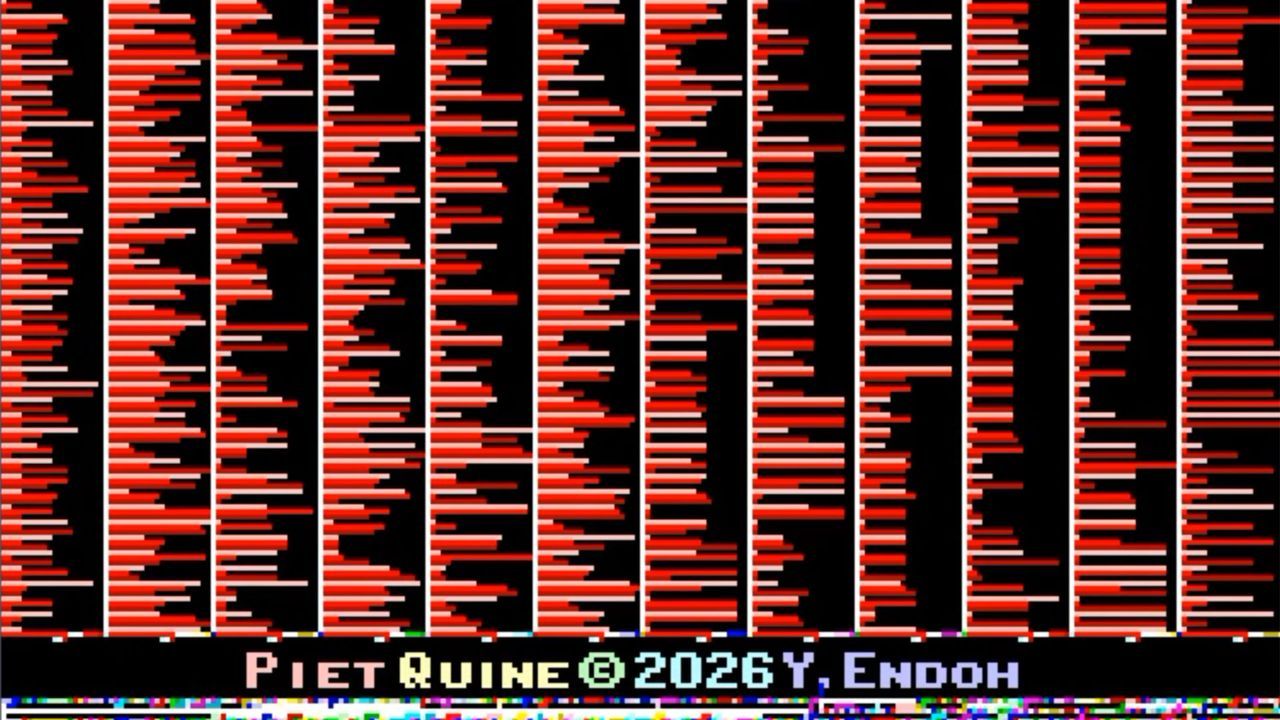
Champion coder Yusuke Endoh has brought esoteric programming to life with a truly mind-bending creation: a Piet Quine. This project isn’t just about writing code; it’s an exercise in merging artistic design, complex data manipulation, and recursive logic into a single, self-replicating image.
At the heart of this feat lies the definitions of the two concepts involved. Piet is an esoteric programming language where programs manifest as vibrant, tiled artwork, inspired by the geometric minimalism of Piet Mondrian. A Quine, in computer science, is a program that produces an exact copy of its own source code without requiring any external input—a paradox made tangible through pure logic.
Endoh’s challenge was to fuse these two concepts graphically. It required transforming the abstract idea of a self-replicating program into a visually stunning GIF. The difficulty escalated quickly, as simply duplicating ASCII text is one task; doing so with compressed image data and binary folding demands meticulous attention to detail.
The process of creating the Piet Quine involved navigating the complexities of the GIF format itself. The file contains layers of compressed data, run-length encoding, and palette information that must be handled precisely by the interpreter before the result can be displayed as art. This technical hurdle pushed Endoh beyond standard programming into the realm of advanced digital reconstruction.
To achieve the desired visual outcome, Endoh utilized cutting-edge tools to refine the design. While achieving the initial concept in 2009 was a monumental effort, making the final GIF compact and visually appealing required further refinement. The developer turned to artificial intelligence, specifically Claude Code, to analyze and reconstruct the underlying script, helping to shape the artwork into the striking 4:3 landscape image seen today.
This collaboration between esoteric programming, visual art, and AI demonstrated that even highly complex technical challenges can yield surprisingly beautiful results when approached creatively.
Beyond the technical execution, Endoh’s ultimate motivation was broader: raising awareness for the creative world of obfuscated programming. By showcasing the intricate mechanics behind the Piet Quine, he aimed to inspire others to explore esoteric languages and design contests. This work serves as a powerful example that true innovation often lies at the intersection of logic, art, and technical ingenuity.
Buy on Amazon
Credit