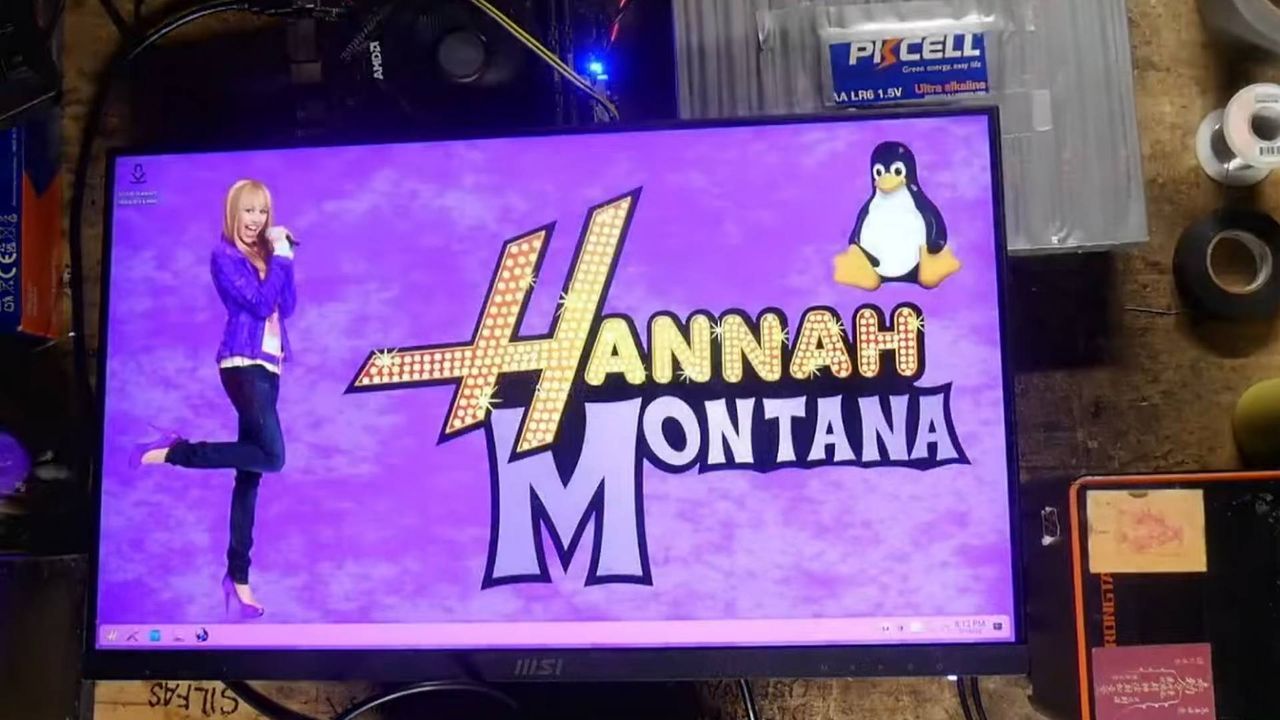
Streamer builds 100AA battery PC and benchmarks it on Hannah Montana Linux
What happens when you throw physics out the window and demand a gaming PC powered entirely by batteries? Streamer Uwos Lab took on this challenge, proving that sometimes, the most cutting-edge innovation isn’t found in silicon, but in mad science.
Last week, over a five-hour livestream, Uwos Lab successfully built an entirely battery-powered gaming desktop. The rules were deliberately restrictive: no laptops and absolutely no lithium ion AA batteries were allowed. The goal was simple yet insane—to power the demands of modern gaming using only basic alkaline cells.
The engineering required to achieve this feat was equally audacious. Uwos Lab didn’t just plug in some batteries; they had to devise a complex wiring scheme. The plan involved stringing eight AA batteries in series to create 12 volts, then grouping these banks in parallel to achieve the high current needed for an ATX power supply. This chaotic electrical journey was managed through custom components.
To handle this monumental task, the streamer used 192 alkaline AA batteries, cleverly distributed across three laser-cut wooden boxes. Each box contained 64 batteries, along with all the necessary clips and contact pads to transmit power to the desktop. These modules were then secured with duct tape, turning basic batteries into a makeshift energy source for a gaming rig.
While the specific internal specifications of the resulting machine remained vague—it utilized an AM4 motherboard, likely a G-series AMD processor, and lacked dedicated graphics—the focus was purely on functionality. Since there was no internal storage, Uwos Lab opted to boot the system using Hannah Montana Linux from a USB drive.
The true test of this unconventional power source came during the stress testing. While the rig was running, Uwos Lab simultaneously monitored performance and streamed the entire chaotic process. The results were staggering: the CPU usage hit 98% while the machine executed intensive Linux stress tests. It was a masterclass in balancing electrical engineering with high-performance computing.
Though the setup provided impressive momentary power, the runtime proved to be finite. The 192 batteries managed to keep the desktop running for approximately 30 minutes, with the potential to extend that window slightly more by utilizing residual energy. This experiment stands as a bold reminder that while battery technology is advancing rapidly, its current capacity still leaves plenty of room for truly outlandish engineering dreams.
Credit